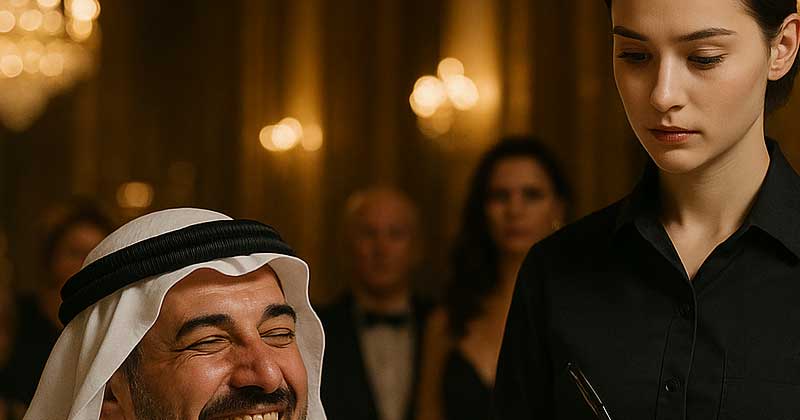
“My lord,” Irina said in a clear and firm voice, but in the same language in which she had been insulted, “your glass may be full of expensive wine, but your soul is empty when you despise a person who works honestly.”
The room fell silent. The chandeliers seemed to shine differently, as if they were spotlighting her serene and determined face. Everyone present had lifted their eyes to the girl who, until then, had been just a silhouette in the background.
Count Ventura cleared his throat, confused, seeking support in the smiles of the flatterers around him. But the oppressive silence made him blush, like a student caught without his homework.
Irina, with eyes as clear as mountain water, continued: “In the culture my father instilled in me, respect is shown to those who extend their hand, whether they are a king or a beggar. That is how I was taught. That is how I chose to live.”
A murmur rose among the guests. The Turkish diplomat at the table raised his eyebrows and discreetly approved. The Egyptian ambassador slightly nodded his head. In a few moments, the simple girl from the serving room had become the voice of dignity.
Irina did not tremble. Inside, however, she felt her heart beating wildly. She remembered her grandparents’ village in Transylvania, where people gathered to help each other, and no one was left in need. There, a person’s worth was measured by their soul, not by their wealth.
“You know,” she added, this time in German, for everyone present, “I come from a simple family. I have had days when I had nothing to put on the table. But my mother taught me never to bow my head, because honest work is brighter than any crown.”
An elderly lady in the audience, dressed in velvet, let a tear slide down her cheek.
Count Ventura bit his lip, unable to respond. His words, spoken with such disdain, had now come back to him like a boomerang.
At that moment, someone began to applaud. Then another. And another. The room, which just moments earlier had been filled with mocking laughter, now resonated with sincere applause.
Irina felt her knees tremble, but not out of fear. It was because she finally felt that her father, somewhere above, was proud of her.
After the banquet, a Romanian diplomat came to her and whispered, “Miss, your courage has done more than ten official speeches could. Romania needs people like you.”
She smiled shyly, thinking of her mother waiting for her at home, sick, and the daily worry of finding money for treatment.
But fate had a surprise in store for her. A Lebanese philanthropist, impressed by her gesture, asked her to provide her details. A few days later, Irina’s mother received the necessary treatment, fully paid for.
Irina was truly crying then, but they were tears of gratitude. She remembered the stories told at the gatherings in her grandparents’ village: that God does not sleep and that every deed, good or bad, comes back to you.
And for Count Ventura, that lesson was painful. The press picked up the episode, and his image was irreparably tarnished. No matter how much money he had, he could not erase the shame of the moment when he was put in his place by a simple waitress.
In contrast, Irina remained the same modest girl. She continued to work, but now with her head held higher, knowing that she had shown the whole world that respect and dignity are worth more than billions.
And on quiet evenings, when she brought her mother a cup of tea, she always remembered her father’s words: “A person is not great by what they have, but by how they lift others when they are down.”
This was her true victory. Not the applause, not the newspaper articles, but the fact that she managed to keep her soul clean in a world where money seemed to buy everything.
And that is why Irina’s story remains one that touches everyone’s hearts: because it reminds us that wherever we are, no matter how hard life may be, dignity and courage can never be taken from us.
This work is inspired by real events and people, but has been fictionalized for creative purposes. Names, characters, and details have been changed to protect privacy and enhance the narrative. Any resemblance to real persons, living or dead, or to real events is purely coincidental and not intended by the author.
The author and publisher do not assume responsibility for the accuracy of events or for the portrayal of characters and are not liable for any misinterpretations. This story is provided “as is,” and any opinions expressed belong to the characters and do not reflect the views of the author or publisher.


