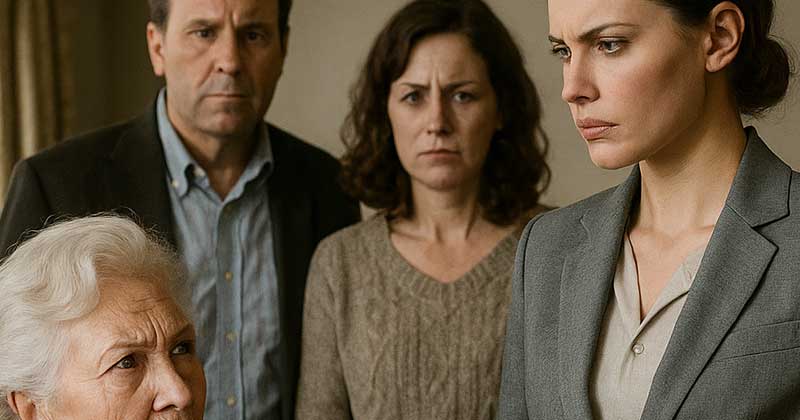
“My conscience? Do you know where it has been all these years? When you encouraged your son to bring his mistresses into our home. When you laughed behind my back and told me that ‘the real family’ is not me, but your relatives. My conscience remained silent, endured, and bled. And now, it speaks.”
I felt her hand weaken on my arm. Her relatives, gathered in the spacious hallway of the villa, looked at me as if I were a stranger. In fact, they had never considered me part of their family. And then I understood: I owed them nothing.
In this country, people usually build large houses, accumulate wealth, and believe that the family name is above all. But I learned firsthand that a house without respect and love is just a cold shell.
I thought of my grandmother, the simple woman from the village who, although she never had palaces or riches, knew how to share her bread with the neighbors. She always told me: “My girl, a home is made with good people, not with bricks.” And with these words in mind, I made my decision.
When I signed the donation deed, I did not do it out of revenge. I did it because I knew that nothing good had grown within those walls for my children. They wanted to see me humiliated, but now they would see me free.
My mother-in-law collapsed into a chair, crying theatrically, and one of the cousins tried to approach me:
“But where will we go? What will we do? We have no other shelter…”
I raised my hand and said calmly:
“I am not the city hall. I am not social services. For fifteen years, you have eaten, slept, and enjoyed comfort on my back. It’s time for you to build your own life. This villa is no longer yours or mine. It will belong to those who truly need it.”
My words fell like a thunderbolt. My children, who stood behind me, looked at me with wide eyes. It was the first time they saw me truly stand up. And in their gaze, I felt pride.
In the following days, the rumor spread throughout the neighborhood. Neighbors gathered at their gates and whispered. Some criticized me: “How can you throw away so much money?” Others silently applauded me. But I knew it wasn’t about money. It was about dignity.
When the charity organization came to make the first renovations, the village children curiously peered through the fence. They saw how the luxurious rooms, where once extravagant parties were held, were transformed into bedrooms for orphans. They saw how the dining room, where crystal glasses were shattered, became a place of nourishment for lonely elderly.
I stood on the sidewalk, with my children beside me, looking at the villa. I no longer felt pain. I felt peace.
My mother-in-law and relatives left in a chaotic rush, carrying their luggage, trying to salvage what they could. They never thanked me for the years I supported them. But I no longer needed their gratitude.
Instead, I received another form of gratitude: from a 7-year-old girl brought from a foster home. She looked at me with her big eyes and said:
“Ma’am, it’s the first time I have a room just for myself. Thank you.”
In that moment, I felt that my decision not only freed me but changed destinies.
Today, I no longer have that villa, but I have something more precious: the peace of mind and the respect of my children.
And if someone asks me if I regret it, my answer is simple:
“I regret nothing. I lost a house, but I gained freedom.”
This work is inspired by real events and people, but has been fictionalized for creative purposes. Names, characters, and details have been changed to protect privacy and enhance the narrative. Any resemblance to real persons, living or dead, or actual events is purely coincidental and not intended by the author.
The author and publisher do not assume responsibility for the accuracy of events or the portrayal of characters and are not liable for any misinterpretations. This story is provided “as is,” and any opinions expressed belong to the characters and do not reflect the views of the author or publisher.


