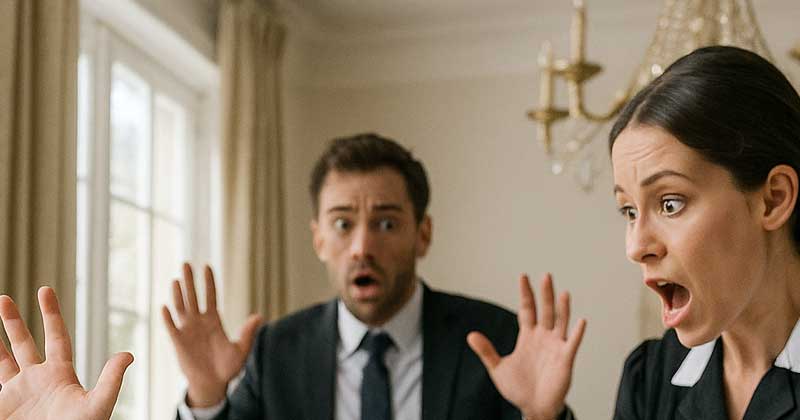
Mihai approached closer, his footsteps echoing on the wooden floor. Natalia had her gaze fixed on the ground, perhaps waiting for a reproach. However, Levente looked at him with wide, bright eyes, still filled with the joy of dancing.
— Dad, he said with a trembling voice, can you believe it? I danced!
Those words pierced through Mihai. He expected his son to ask for a toy, a gift, a vacation. But his child only wanted to feel life flowing through him again.
In an unexpected gesture, the businessman pressed the remote control button that closed the curtains and said:
— Turn up the music.
Natalia flinched, not understanding. But Levente began to laugh again, and Mihai, for the first time in years, let himself be carried away by impulse. He took a seat behind the wheelchair and started to spin it to the rhythm of the music. At first embarrassed, Natalia joined in, and the three found themselves dancing together.
For a few minutes, that cold house, filled with marble and crystal, came alive.
Mihai had never danced with his son. He realized then how much he had lost, absorbed in contracts, meetings, and numbers.
In the days that followed, something changed radically. The housekeeper, who had until then been invisible to everyone, became the soul of the house. She taught Levente dance exercises, encouraged him, and restored his confidence. And Mihai… Mihai no longer spent nights at the office. He found time to be home, to listen to music, to watch his son smile.
Neighbors began to whisper. How could a billionaire, always serious and cold, be seen at the window singing, dancing, or even cooking with the housekeeper? Some laughed, others were amazed. But in his heart, Mihai felt that he was only now beginning to understand the true meaning of wealth.
Money had bought silence, but not happiness.
One Sunday morning, he made a decision that shook the entire family. He summoned relatives and a few close business partners to his residence. Everyone expected a grand announcement, perhaps a new investment.
However, Mihai stood up and simply said:
— From now on, my son will have a life, not cold treatments. And that is thanks to Natalia. She is no longer the housekeeper of this home. She is Levente’s teacher and friend.
Silence fell. His sister-in-law burst out:
— Have you gone mad? How can you elevate a simple woman to this rank? What will people say?
But Mihai was no longer the man who feared words. He looked at his son, who was smiling happily, and replied:
— Let the world say what it wants. I have found my family again.
Natalia cried silently, overwhelmed by his words. For the first time, she did not feel invisible.
In the following months, Levente’s life began to change visibly. Dance became therapy, and the child regained his strength. He learned to move his hands better, to play the piano, to laugh again.
And Mihai, instead of seeking happiness in the glass buildings of Bucharest, now found it in the smell of Sunday sweet bread, in the folk songs played by Natalia, and in his son’s laughter.
Their story spread, first among neighbors, then in the press. Everyone was shocked. Not by money, not by wealth, but by the fact that a man who had everything discovered the true treasure: simple, human love.
And thus, a cold billionaire learned what the grandmothers from the villages had always known: that happiness does not lie in gold and palaces, but in being together, in dancing when your heart sings, and in living each day as a celebration.
This was the legacy Mihai chose to leave to his son: not glass and concrete empires, but the lesson that true wealth is love and the joy of being human.
This work is inspired by real events and people, but has been fictionalized for creative purposes. Names, characters, and details have been changed to protect privacy and enhance the narrative. Any resemblance to real persons, living or dead, or to real events is purely coincidental and not intended by the author.
The author and publisher do not assume responsibility for the accuracy of events or for the portrayal of characters and are not liable for any misinterpretations. This story is provided “as is,” and any opinions expressed belong to the characters and do not reflect the views of the author or publisher.


