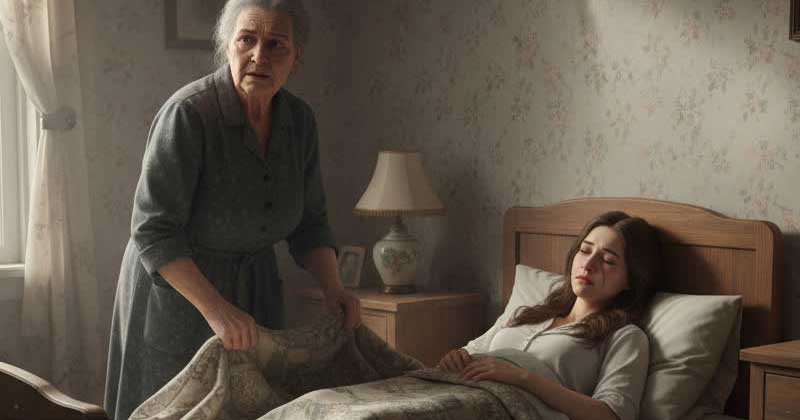
I didn’t want to be impulsive. I sat down at the table with a cup of cold tea and took a deep breath. I repeated in my mind all the days I felt belittled, all the mornings when her voice rang in my ears like a sentence. I decided that revenge would not be a blow, but a setting of boundaries — a lesson to transform anger into power.
The first step: to no longer remain silent. I called my friend Maria and briefly told her what was happening. Maria didn’t judge me. She simply said, “Anca, go see a doctor, get a note, ask for a psychological consultation if needed. You and the baby are the priority.” In Romania, when you feel alone, having a soul beside you works wonders. Maria came the next day, with coffees and an unwavering attitude.
I made an appointment with the doctor, and I started to note all the incidents — dates, times, what my mother-in-law said, how I felt. At the office, the doctor listened to me gently and gave me clear recommendations. “You have the right to peace. If it gets worse, take care and seek help. It’s not madness; it’s chronic stress.” I now had an official paper: concern for my pregnancy due to stress. It wasn’t a war path; it was the document that protected my child.
My plan was not to create a public scandal, but to reveal the truth to wake my husband, Mihai. He had grown up with his mother like a rock — respect for her was almost sacred. But true respect is born from integrity. So I gathered my courage and spoke to him one evening, when the baby was not yet born, but was already between us, in every worry of mine.
“Mihai,” I said, “you need to know how your mother treats me. I’m not asking for war; I’m asking for support.” I laid my notes on the table, showed him the letter from the doctor. He was silent, and his silence sounded different from the silences before — it was a silence that listened to me. I felt a turmoil in him. I didn’t ask him to choose between me and his mother; I asked him to choose us, the little one and me, over the habit of saying nothing.
The second part of the plan was simple and firm: we set boundaries. Not with sharp words, but with actions. When the next morning my mother-in-law suddenly entered our room, I stayed in bed but calmly told her, “You can’t come in like this. If you need something, talk to me, don’t yank the blanket from me.” My words came without trembling. I closed the door behind me when I went down to the kitchen.
Her reaction was predictable: she started to speak harshly again, to make a scene. But Mihai was beside me. I saw how he changed — he didn’t come with accusations; he came with a clear question: “Mom, stop. Have you forgotten that this is our home? Respect us.” His tone was not cold; it was responsible. That moment was a turning point. When a child has a father who defends their mother, the strength of the relationship is reinforced.
My mother-in-law protested, became sad, made that dramatic figure of a wounded woman, but for the first time, I didn’t allow her to turn her pain into guilt for me. I began to take concrete steps: I set rules for the household schedule, established when it was appropriate for her to visit, and requested that accusations not be made in front of closed doors. We were no longer a sacrificial table.
As the days passed, unexpected things happened. My mother-in-law, when she had no audience, began to stumble in her own loneliness. I noticed a moment of weakness in her gaze when, one afternoon, I brought her soup at the table because she was sick. I didn’t do this as a concession; I did it as a demonstration of gentle strength: we can be firm and still human.
The climax came at a Sunday dinner. The house was filled with the smell of sweet bread, and I, with my round belly and balanced hands, announced that we would go for a check-up together. Mihai talked to his mother, and she understood that she could no longer continue to bind us with our fears. She apologized, her voice trembling, and said she didn’t know she was hurting me so much. It was a true confession, not forced, but born from observation — when you love, you come to recognize your mistakes.
I gave birth a few months later. In the first hour, when they brought the baby to my chest, my mother-in-law cried. These were not tears of victory, but tears of relief and shame. She took my hand and whispered, “I’m sorry, Ana. I was wrong.” That “I’m sorry” was more than an apology — it was the beginning of a new arrangement in the family.
It wasn’t magic. It was courage, discipline, and love for what was to come. I didn’t take revenge with humiliation, but earned respect through gentle strength. I learned that sometimes the best revenge is to take care of yourself and create an example. Our home then echoed with new steps — the steps of the mother who came to help us change diapers, the steps of the father who took his role seriously, and my steps, which no longer trembled when someone touched my heart.
The ending? Spectacular in its simplicity: on the first walk with the stroller, in the village, all the women stopped to see us. My mother-in-law stood beside me, holding a small blanket in the shade and smiling. Not because she had been defeated, but because she had learned to be beside us without crushing us. And I, looking at the sleeping baby, knew that true power is not in revenge, but in transforming pain into safety for those you love.
This work is inspired by real events and people, but has been fictionalized for creative purposes. Names, characters, and details have been changed to protect privacy and enhance the narrative. Any resemblance to real persons, living or dead, or to real events is purely coincidental and not intended by the author.
The author and publisher do not assume responsibility for the accuracy of events or for how characters are portrayed and are not liable for any misinterpretations. This story is provided “as is,” and any opinions expressed belong to the characters and do not reflect the views of the author or publisher.


