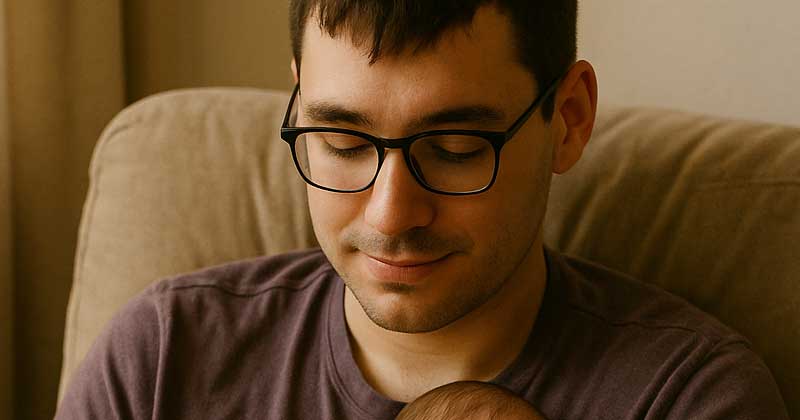
— It’s good now. It smells like you.
I leaned against the wall, my heart still in my throat, with a wet towel stuck to me and my eyes as wide as saucers. I didn’t even know if I had heard correctly.
— What did you say? I asked, barely daring to blink.
Keane looked at me for a moment. His smile was fragile, but it was there. Then he turned his gaze back to the baby and repeated:
— It smells like you. And it calmed me too.
I fell to my knees in the middle of the hallway. Not out of weakness, but from an unexpected wave of gratitude, of wonder, of love that I didn’t know I could feel like this, in silence.
I grew up in a small village in Buzău. My mother made Easter cakes and had us wash the eggs with salt to make them shine. My father didn’t talk much, but when he did, people listened. And Keane, the “different” child, as the neighbors called him, was always in his own world. With a blanket in hand and a wandering gaze at the sky.
Some said he would never be a “whole person.” Others said it would be better to take him somewhere “where there are qualified staff.” But my mother didn’t want that. She kept him at home, taught him the language of the heart, not of the mouth. And me? I loved him as best as I could, but honestly, I never fully understood him.
Until today.
Today, when my “non-speaking” brother calmed my child, he calmed my soul and, in a whisper, said more than I could have in a hundred lines.
I quietly entered the room. I sat next to them on the floor. It didn’t even matter that I was wet. I just wanted to be close. To be a witness.
Mango reached out to me, purring, while the baby sighed softly in his sleep, with his nose pressed against Keane’s shirt. Silence. But not that oppressive silence, rather a full silence. Like a prayer.
I reached out my hand and touched my brother’s knee. He looked at me again, as if he could read my whole life in my eyes. And he said softly:
— I remember how you used to hold me when I was little. I hold like that too.
Then I cried. Not loudly, not with sobs. I just let the tears flow. For my mother who defended him. For me, who didn’t know how much he could see. For him, who learned, in silence, everything that is important.
Then I knew.
On that day, something changed in our house. Not suddenly. Not with fireworks. Just with a glance, a touch, a whisper.
When my husband returned, with bags full and a hurried air, he entered and stopped.
— What happened? he asked, looking at us.
I smiled at him. And I simply said:
— Keane spoke.
But the truth is he had been speaking all along. It’s just that we had only now learned to listen to him.
This work is inspired by real events and people, but has been fictionalized for creative purposes. Names, characters, and details have been changed to protect privacy and enhance the narrative. Any resemblance to real persons, living or dead, or actual events is purely coincidental and not intended by the author.
The author and publisher do not assume responsibility for the accuracy of events or for how characters are portrayed and are not liable for any misinterpretations. This story is provided “as is,” and any opinions expressed belong to the characters and do not reflect the views of the author or publisher.


