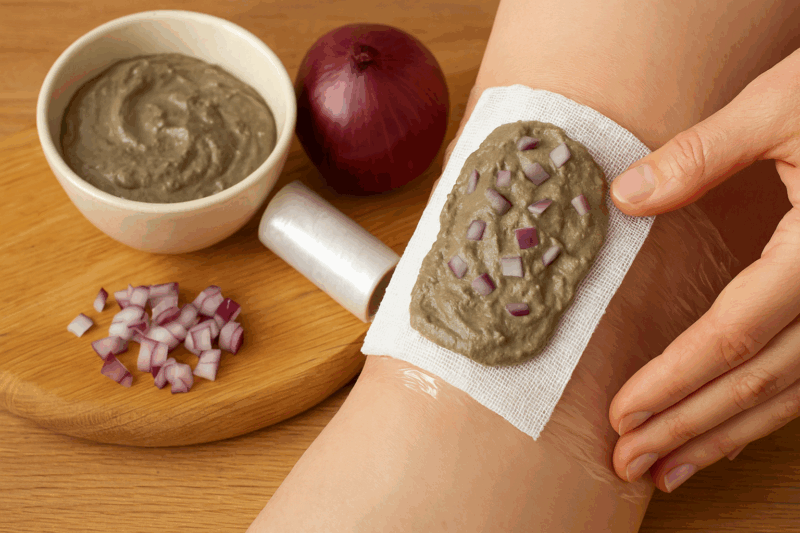
Poultices have been used for centuries as external therapeutic methods to relieve pain and reduce inflammation. One of the most effective combinations is that of natural clay and raw onion, two ingredients known for their anti-inflammatory and detoxifying properties. This poultice is frequently used to treat joint pain, rheumatism, sprains, or strains. Being a natural alternative to conventional anti-inflammatory creams, it is easy to prepare at home and does not contain harmful chemicals.
Benefits of the Clay and Onion Poultice
1. Reduces Joint Inflammation
The combination of onion and clay produces a strong local anti-inflammatory effect. Clay absorbs toxins and excess synovial fluid from inflamed joints, while onion acts as a natural anti-inflammatory due to its rich sulfur compound content. These compounds, especially allicin, reduce the levels of inflammatory prostaglandins. Daily application of the poultice helps decrease swelling and improve joint mobility. The effects are particularly noticeable in cases of pain caused by arthritis or gout.
2. Quickly Relieves Pain
Onion contains quercetin, a flavonoid that inhibits the release of histamine and has proven analgesic effects. When combined with clay, the pain-relieving effect is amplified, especially in tense or overworked areas. The poultice acts quickly, providing a soothing sensation after just 30 minutes of application. Many users report a significant reduction in pain within 2-3 days of consecutive use. It is an excellent option for those who wish to avoid oral analgesics.
3. Detoxifies and Stimulates Local Circulation
Clay has the property of attracting toxins from tissues through the skin, while onion stimulates blood circulation due to its volatile essential oils. This combination has a healing effect on the affected area, helping to eliminate substances that may worsen joint inflammation. Repeated application contributes to cellular regeneration and activates peripheral circulation. This leads to better oxygenation of tissues and reduced stiffness.
4. Prevents Fluid Accumulation in Joints
Excess synovial fluid is a common cause of joint pain. Onion has diuretic and local draining properties, helping to reduce fluid retention, while clay absorbs the accumulated fluid and reduces pressure on the nerves. Thus, the poultice helps diminish the sensation of joint tension. Additionally, it prevents recurrences if used periodically.
5. Accessibility and Ease of Application
One of the major advantages of this poultice is that it can be prepared with easily obtainable ingredients at minimal cost. It does not require special equipment or sterile conditions. It can be applied at home by anyone, without medical assistance. It is ideal for elderly individuals or those who wish to avoid synthetic medications.
Preparation Method
Ingredients:
-
2 tablespoons of green or white clay (non-metallic)
-
1 large raw onion
-
Warm water (enough to form a paste)
Instructions:
-
Grate the onion on a fine grater.
-
Mix it with the clay and add warm water until a thick paste is formed.
-
Spread the paste on a piece of gauze or a cotton cloth.
-
Apply directly to the painful joint, cover with plastic wrap, and then with a warm towel.
-
Leave it on for 1 hour or even overnight, then remove and rinse the area with warm water.
Recommended Frequency: Once a day for 7-10 days.
Relevant Studies and Research
A study published in Journal of Inflammation (2018) highlighted that quercetin from onion reduces levels of inflammatory cytokines, such as TNF-alpha and IL-6. These cytokines are directly involved in triggering joint pain in individuals with rheumatoid arthritis.
Researchers from the University of Tehran (2020) conducted a clinical study on the use of locally applied clay in patients with knee osteoarthritis. The results showed a 40% reduction in pain after just 10 days of daily application, compared to a placebo group.
In another study published in Evidence-Based Complementary and Alternative Medicine (2021), it was demonstrated that external applications with clay can improve joint elasticity and reduce chronic inflammation due to its high mineral content.
A laboratory experiment conducted in Germany (2017) showed that onion extracts applied to inflamed tissues rapidly reduce the expression of COX-2 enzymes, which are involved in joint pain.
The clinical study in Iranian Journal of Pharmaceutical Research (2019) confirmed that the mixture of herbs and clay can be a safe method for reducing arthritic symptoms without significant adverse reactions.
A Japanese study in 2022 tested the onion-clay combination on a group of 60 patients with chronic joint pain, and 83% of them reported improved mobility within two weeks.
All these studies indicate that this external remedy can be a valid alternative for managing joint pain, especially in the early or moderate stages of the disease.
Contraindications and Precautions
-
Do not apply to open wounds or irritated skin.
-
Individuals allergic to onion should avoid this poultice.
-
In case of irritation, excessive redness, or discomfort, discontinue use immediately.
-
Pregnant or breastfeeding women should consult a doctor before application.
-
Do not replace treatment prescribed by a rheumatologist or family doctor.
-
Not recommended for use in cases of acute joint infections (septic arthritis).




