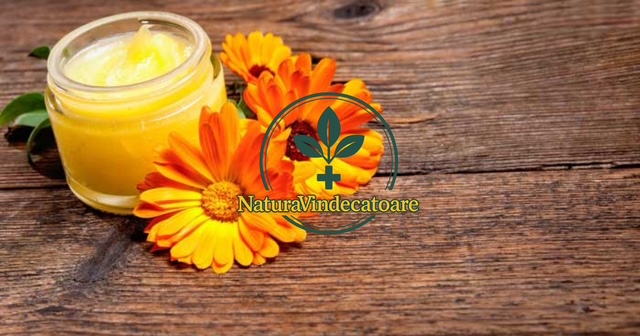
Calendula (Calendula officinalis) was one of the most cherished gifts of nature for Maria Treben. She wrote that this plant should not be missing from any garden or home. The ointment made from calendula flowers became her primary remedy for irritated skin, wounds, eczema, varicose veins, hemorrhoids, and even skin ulcers.
What Maria Treben Said:
Calendula ointment is a true balm for the skin. It heals old wounds, eczema, and ulcers that would not close.
Maria Treben, Health from the Lord’s Pharmacy
Original Recipe from the Book
Ingredients:
- 250 g unsalted pork fat (or beef tallow)
- 2 handfuls of fresh calendula flowers (coarsely chopped)
Preparation Method:
- Heat the fat in a pan until it melts.
- Add the calendula flowers and let them simmer gently for 12 minutes.
- Remove from heat, cover, and let it sit at room temperature until the next day.
- The next day, gently heat, strain through cheesecloth, and pour into glass jars.
- Store in a cool place.
How to Use
- Eczema and psoriasis: apply locally, daily, after washing the area.
- Wounds that do not heal: apply the ointment in a thin layer, and place sterile gauze over it.
- Hemorrhoids and varicose veins: apply gently to the affected area after washing with yarrow tea.
- Skin irritations or dry skin: use as a soothing lotion, massaging gently into the skin.
Calendula ointment should NOT be used on infected, purulent wounds or those with active secretions. In such cases, there is a risk that applying a greasy layer may close the wound and promote the development of infection beneath the crust.
It is recommended only for clean wounds that do not show active infection, or for old wounds that heal slowly but without pus. In her book, Maria Treben gives examples of varicose ulcers and chronic wounds that healed after the area was first cleaned, and then the ointment was applied.
For safety:
- Before application, wash the area with yarrow tea, chamomile, or sage (all have antiseptic effects).
- Apply a thin layer of ointment, and place sterile gauze over it.
- If intense redness, secretions, or local fever occur, it is a sign of infection and medical attention is needed.
Benefits
Calendula:
- Contains flavonoids, carotenoids, and triterpenoids, with anti-inflammatory and epithelializing effects.
- Stimulates the formation of new tissue, accelerating wound healing.
- Reduces irritation and discomfort in dermatitis and psoriasis.
- Has antibacterial and antifungal action, protecting the skin from infections.
What Do Modern Studies Say?
- Journal of Wound Care: calendula extract ointment accelerated the healing of venous ulcers.
- Clinical Therapeutics: ointments with Calendula officinalis reduced inflammation and skin pain in patients with dermatitis.
- Phytomedicine: calendula extracts have shown antimicrobial and regenerative activity on the skin.
Contraindications
- May cause allergic reactions in individuals sensitive to the Asteraceae family (ragweed, daisies, chamomile).
- Do not apply to severely infected wounds without medical advice.
- Internal consumption of the ointment is not recommended.
Sources:
- Maria Treben, Health from the Lord’s Pharmacy
- Journal of Wound Care, Efficacy of Calendula officinalis ointment in venous ulcers
- Clinical Therapeutics, Calendula ointment in dermatological conditions




