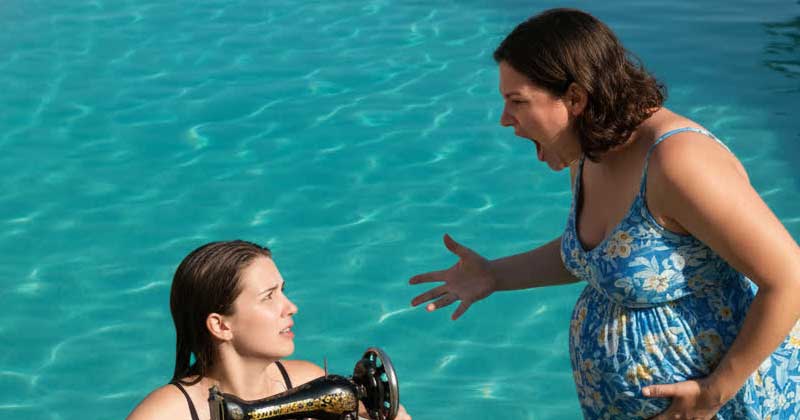
Her smile had completely faded. The air on the terrace felt heavier, as if filled with the same water from the pool that had just taken Elena’s dream away.
I didn’t shout. I didn’t pound my fist on anything. I did something much simpler and, at the same time, much more painful: I spoke.
“Stay here,” I told them, without hatred in my voice, just with a cold calmness. “Everyone stay until we resolve this issue.”
Marius wanted to protest. He opened his mouth, stumbled, and said nothing. Raluca shot a triumphant glance but trembled slightly at the corner of her eyes. Elena held my fingers tightly. I felt the threads of hope that still kept her tied to life.
I took out my phone and called a friend. “Andreea, come quickly with a blanket and a big box,” I said. “And bring a key from the workshop in the building next to yours.”
A few minutes later, I was holding the box. By the pool, Elena looked at me with wide eyes. “What are you doing, Mom?”
“I’m bringing you something,” I said. “But first, I want them to listen.”
I asked Elena to tell me, while I noted it on my phone, everything she had done to get her sewing machine: how many nights she had glued flour sacks to make some bags, how many corners she had cut from her expenses, how many treats she had given up. She said it all, her voice trembling, but with a pride that tears could not hide.
I sent that message — with the list, with pictures of the bags, with all the conversations where Elena offered products — to the group of neighbors and friends. Within ten minutes, the yard was full of people. One woman brought a spare sewing machine, another brought materials. A retired lady opened a jar of money. An uncle from the neighborhood took out a small piece of hand-stitched fabric and placed it on the table as a sign of support.
Marius and Raluca froze. They looked at the neighbors who were throwing increasingly sharp glances at them. It wasn’t a huge scandal, but it was enough to shake their comfort.
“What do you think?” I said, with all eyes fixed on them. “That you can destroy a child’s dream and no one will say anything? That this is how respect is earned?”
Raluca bit her lip. Marius took out his phone, started typing, then put it back in his pocket. The neighbors began to talk about responsibility, about how children should be treated, and how respect is learned — not through public humiliation, but through hard work and taking responsibility for mistakes.
I proposed a simple agreement. In front of everyone, I asked Marius and Raluca to take responsibility: to pay for the repair of the machine or, if it couldn’t be repaired, to buy one of equal or better quality. To pay in installments, working together with Elena on volunteer projects in the neighborhood — to sew bags for social centers, to participate in workshops for local children, to clean up the nearby park. To take on household chores for a period and to show respect to the girl, day by day.
I looked up at Marius. “If you learn something from this, it won’t be out of fear, but out of respect. And if not, then the people around you will constantly remind you.”
It was a public lesson, but a fair one. It wasn’t gratuitous humiliation. It was imposed responsibility.
Raluca sighed, then sighed again. Marius exhaled heavily. “Fine,” he said finally. “We’ll change it. We’ll pay. And… we will… get involved.”
Elena began to cry this time for a different reason — not just from pain, but from relief. The neighbors draped the blankets they had brought over her shoulders and brought warm tea. A man took out an old but good sewing machine and handed it to my daughter with a gentle smile: “It’s not new, but it has a soul.”
In the following weeks, Marius and Raluca worked. They came to workshops, sewed alongside Elena, learned to turn seams, sew buttons, and repair hems. It wasn’t just work — it was the recognition that what they had done had created a void. By filling that void with effort and sincere apologies, they began to understand.
Elena didn’t get her old machine back — it was decided that it was compromised — but she received something more: a community that held her in its arms, a functioning sewing machine, and, most importantly, respect from those who had hurt her. Raluca paid for the repairs and made donations to the children’s club. Marius began, without anyone forcing him, to offer help with homework, changing cold remarks for gentle words.
In the end, on a sunny Sunday, we set a table in the yard. I chopped onions, made sausages, and set out a cake. Elena cut a red ribbon on her new sewing machine. Raluca took the improvised microphone and publicly said “I’m sorry,” with tears in her voice. Marius followed her, shook my daughter’s hand, and said: “You worked hard. You taught us to work better too. Thank you.”
It wasn’t my victory against them. It was a beginning. I showed them what it means to lose — and I showed them how to repair loss through actions, not humiliation. Elena smiled, and when the machine started working, the needle dropped and rose with a sound that felt like a promise.
As evening fell, the light dimmed over the yard, but something remained lit: respect earned through sweat and sincerity. And I knew, with a new calm in my chest, that sometimes the lessons that hurt the most are the ones that ultimately heal.
This work is inspired by real events and people, but has been fictionalized for creative purposes. Names, characters, and details have been changed to protect privacy and enhance the narrative. Any resemblance to real persons, living or dead, or to real events is purely coincidental and not intended by the author.
The author and publisher do not assume responsibility for the accuracy of events or for how characters are portrayed and are not liable for any misinterpretations. This story is provided “as is,” and any opinions expressed belong to the characters and do not reflect the views of the author or publisher.


