Inside was a charred piece of paper, taped with clear tape. Next to it, a carefully folded letter and an old photograph of me at 18, holding the admission envelope.
On the burnt paper, I recognized the university’s logo. It was indeed my letter, or what was left of it. I felt my breath catch.
I slowly unfolded the letter. My mother’s shaky handwriting filled the pages.
“Son, if you are reading this, it means Radu is no longer here. You need to know something about that day. He didn’t burn the letter to hurt you. He did it to protect you.”
I felt my temples throb. Protect? Why?
I continued reading, and my mother’s words began to overturn everything I had believed for years.
“On the day you received the letter, another paper came in the mail — one with a debt. It was in your name, from the bank. Radu discovered that a man from the village had stolen your information and taken out a large loan in your name. If you had gone to college then, they would have sued you, and you would have lost everything. Radu went to them, paid the debt with the money he had saved for his surgery, but he burned the letter to stop you until everything was resolved. He wanted to spare you from shame and trouble.”
I stood frozen. The paper trembled in my hand.
On the back of the photograph, it was written in blue pen:
“Tell him I loved him like a son, even if he couldn’t forgive me.”
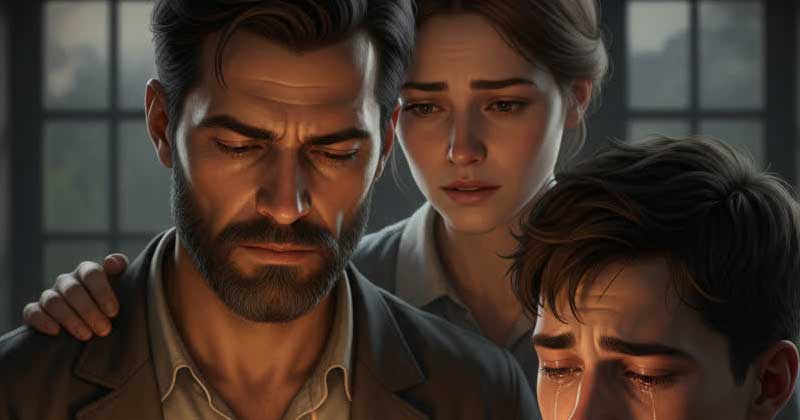
I fell to my knees. Tears fell onto the wooden box, over the charred piece of paper.
Everything I had built in my mind — hatred, bitterness, guilt — was collapsing. I remembered how Radu would come home late from work, tired, but he always brought a warm loaf of bread and said to my mother: “Save it for him, he might come home.”
I never wanted to hear.
I went outside, into the yard. On the old bench in front of the house was a rusty mug with dried roses. My mother came out after me and looked at me in silence.
“Why didn’t you tell me?” I asked.
“Because I was afraid you wouldn’t believe me. He didn’t want gratitude, just peace for you.”
I stood there for a long time, in silence, watching the sunset. I got up and walked to the place where my mother had told me he was buried.
The earth was fresh, and on a simple cross, it only said: “Radu Ionescu — lived for others.”
I left my photograph on the grave, with the burnt envelope taped next to it.
“Forgive me, father,” I whispered.
The wind blew gently, like a caress. And for the first time in years of heaviness, I felt my soul was free.
Since then, every year, on the day I received that admission letter, I light a candle in the yard. Not for the lost dream, but for the man who gave up his own, just so I could have one.
This work is inspired by real events and people, but has been fictionalized for creative purposes. Names, characters, and details have been changed to protect privacy and enhance the narrative. Any resemblance to real persons, living or dead, or actual events is purely coincidental and not intended by the author.
The author and publisher do not assume responsibility for the accuracy of events or for how characters are portrayed and are not liable for any misinterpretations. This story is provided “as is,” and any opinions expressed belong to the characters and do not reflect the views of the author or publisher.


