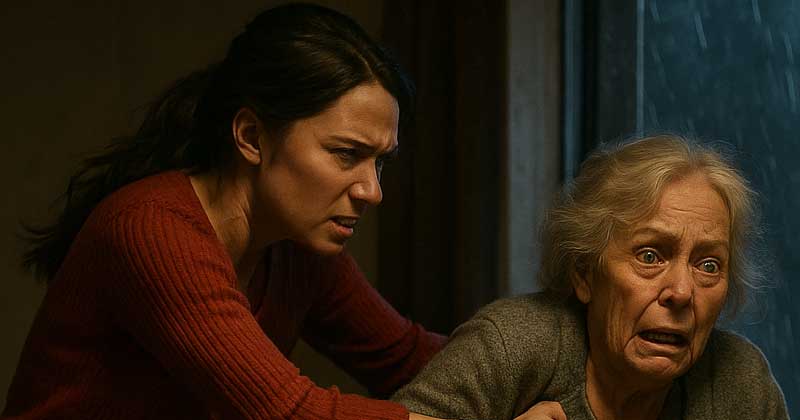
…a week later, fate began to show its true face. I still felt the chill of that rain in my bones, but this time I was holding something much more precious than a suitcase full of clothes: the winning ticket.
I had bought it on the day I went to the market, just as I always did. At the corner of the road, an old ticket seller smiled at me and gently said, “Luck never comes to those who chase it, but it always finds those who wait patiently.” At the time, I didn’t pay much attention, but now every word echoed in my mind like a prophecy.
My daughter, in her haste to push me away, hadn’t noticed that the ticket was purchased in my name. I was the one listed as the owner. I was the one chosen by fate. And now, while she boasted to everyone about the wealth she thought she possessed, the true fortune belonged to me.
I didn’t rush to take revenge. I thought of all the nights she held my hand when she was a child and trembled with fever. Of all the mornings I prepared her school lunch, even when I had no money for bread. I remembered her little girl voice when she told me she would take care of me in my old age.
But reality hit me like a cruel slap. My child had renounced me for money.
And yet, the life of a Romanian has never been easy. Many of us know what it’s like to rise from the mud, to grit our teeth and move forward. I did what any simple woman from the village knows: I wiped my tears, put my scarf on my head, and set out on my way.
When I presented myself at the National Lottery office with the ticket in hand, the officials looked at me for a long time. “Madam, you are the winner of ten million.” I felt the ground shake beneath me. For the first time in a long time, I was not crying from pain, but from relief.
In the village, the news spread like wildfire. Neighbors who always saw me coming back with heavy bags from the market, hunched over, began to look at me differently. The priest called me to the church, and at the end of the service, people applauded me. “This is how God wanted it,” they said. And I knew it was true.
Instead of buying a cold, soulless villa, I decided to repair the old house. I brought craftsmen from the village, changed the roof, put in new windows, and painted the fence. I created a garden full of flowers, so I could hear the buzzing of bees and see the rainbow again after the rain. I also bought a big stove, so I would never be cold again.
But the most important thing: I set aside money for my grandchildren’s future. They were not to blame. And if one day they come to me, they will know that the door will be open for them.
As for my daughter, she sought me out after learning the truth. I saw in her eyes the same pride, but also fear. “Mom, we need to talk,” she said. But this time, I did not respond with silence.
I looked her in the eyes and said firmly, as only a Romanian mother, tested by life, can say:
— It’s not money that makes you a person, child. It’s how you honor your roots.
I closed the gate behind her, feeling a peace I hadn’t known for years. I was not just an “old witch,” I was a woman who had conquered her fate.
And then I understood: the true wealth was not the lottery ticket, but my regained dignity. Romania taught me not to be defeated, to carry my cross, and to emerge stronger.
Under the same sky under which I had been chased away with a suitcase in the mud, I now walked with my head held high. And no million could equal the power of that moment.
This work is inspired by real events and people, but has been fictionalized for creative purposes. Names, characters, and details have been changed to protect privacy and enhance the narrative. Any resemblance to real persons, living or dead, or to real events is purely coincidental and not intended by the author.
The author and publisher do not assume responsibility for the accuracy of events or for how characters are portrayed and are not liable for any misinterpretations. This story is provided “as is,” and any opinions expressed belong to the characters and do not reflect the views of the author or publisher.


