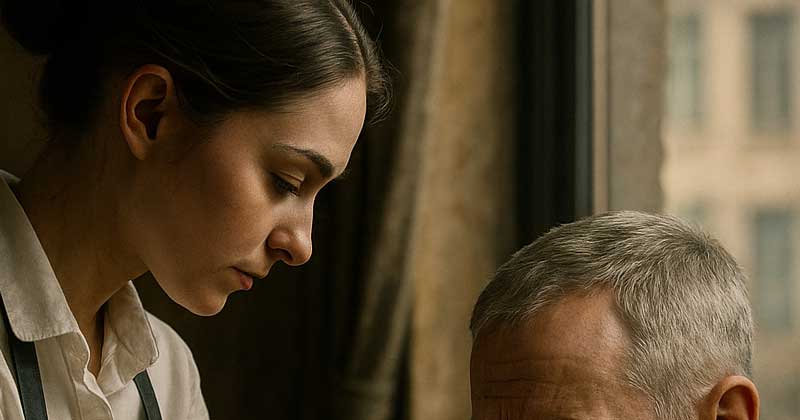
The silence in the café hung heavy, like a damp blanket. The few customers turned their gaze towards them, curious, but the veteran did not loosen his grip on the girl’s wrist. In his eyes, there was no anger, but a mixture of astonishment and old pain.
“My girl, this falcon is not just a simple picture,” he said in a low voice. “It’s a mark I saw on the battlefield, where my comrades fell and where only a few of us still believed in hope.”
Loredana remained motionless. The tremor in her hand betrayed her, but she tried to stand tall, not letting anything show.
The veteran ran his palm over his forehead, as if trying to chase away some heavy memories. He then let his voice be heard clearly, as if he were speaking not just to her, but to the whole café.
“In the ’90s, in a field hospital in the Balkans, this mark was worn only by those who were part of a secret unit of rescuers. Not just anyone could have it. Those who wear it know things that the rest of the world will never understand.”
His words fell like a thunderbolt. Loredana felt the ground slip from under her feet. Around her, people were watching, but no one was laughing.
She bit her lips and, for the first time, her eyes filled with tears.
“I didn’t want it to be known,” she whispered. “I didn’t want to carry that burden anymore. But… I didn’t choose the tattoo. It was made on my skin when they took me from my village, from the mountains. I was just a child.”
The veteran looked at her for a long time. A bitter understanding appeared on his face.
“Then you are one of the missing children…”
A murmur rose from the café. Many remembered the stories of the little ones abducted during the war, taken who knows where, marked with symbols that no one spoke of anymore.
Loredana set her tray on the table and sat down in a chair, powerless.
“My mother is not my real mother,” she continued in a low voice. “She found me at the side of the road, with a fever and almost breathless. She raised me as her daughter, but she never told me much. I wore long sleeves to hide the mark. When I was little, they told me it was a curse.”
The veteran clenched his fists.
“It’s not a curse, child. It’s proof that you survived terrible times. And if you are who I think you are, then maybe you are the key to unraveling that dirty past.”
At that moment, the café door opened, and an old priest entered, leaning on a cane. People stood up respectfully, but the priest walked directly towards Loredana and the veteran.
“I knew this day would come,” he said.
Everyone fell silent. The priest raised the girl’s hand, looked at the tattoo, and wept.
“I once baptized a child with this mark. His family perished in the flames of war. You are that child, my girl. You were hidden, raised by a good woman, and now the truth comes to light.”
Loredana burst into tears, but the tears were no longer just of pain, but also of release.
The veteran placed his hand on her shoulder.
“From now on, you will no longer be just the waitress in the café. You will be living proof that, no matter how deep the wounds of the past, the truth comes to the surface.”
The customers erupted in applause. Some were crying, others were making the sign of the cross. In the corner of the room, the smell of coffee intertwined with the emotions of the people.
Loredana wiped her tears and lifted her gaze. She felt that, for the first time, the burden of the tattoo was no longer a shame, but proof of survival.
The priest whispered a prayer, and the veteran nodded.
“You have a journey to take, my girl. But you will no longer be alone.”
And then, on that ordinary morning, among the simple tables of the café, an entire community united around a girl who bore on her arm not just a mark, but a whole history.
And Romania, with its pains and healings, wrote another page of life in which the truth, no matter how hidden, reveals itself when people have the courage to look each other in the eye.
This work is inspired by real events and people, but has been fictionalized for creative purposes. Names, characters, and details have been changed to protect privacy and enhance the narrative. Any resemblance to real persons, living or dead, or to real events is purely coincidental and not intended by the author.
The author and publisher do not assume responsibility for the accuracy of events or for the portrayal of characters and are not liable for any misinterpretations. This story is provided “as is,” and any opinions expressed belong to the characters and do not reflect the views of the author or publisher.


