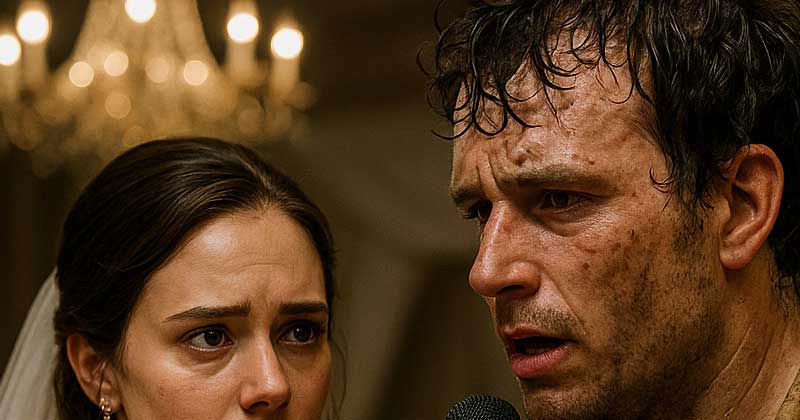
— Today I came here because this bride… is my daughter.
His words fell like a thunderbolt over the entire hall. Everyone froze. The bride’s eyes widened, and her lips trembled. The groom was stunned, unsure whether to believe it or to get even angrier.
A murmur rose among the guests. Some shook their heads, others whispered to each other: “It can’t be… he must be an impostor.” But the man straightened his shoulders, looked directly at the bride, and continued:
— Maybe I don’t look like a father. Maybe my clothes don’t say anything good about me. But my blood runs through her veins. And today I came not to ruin the celebration, but to ask for forgiveness.
The bride slowly stood up, feeling her heart race wildly. A memory, which she thought was forgotten, began to take shape. A young man, with warm eyes and calloused hands, once lifted her onto his shoulders and showed her fields full of poppies. He told her stories of dragons and princesses, just as Romanian fathers do on long summer evenings, by the light of the lamp.
But then he disappeared.
For years, her mother had told her that he chose another path, that he didn’t have the strength to be with her. The bride had grown up with this hidden wound, convinced that her father had forgotten her. And now, right on her wedding day, he had returned.
— I didn’t come to ruin anyone’s joy, — said the man with a trembling voice. — I came to tell her that, although life has knocked me down, I have never stopped thinking about her. I know I was wrong, I know I lost precious years, but today I just want to bless her.
In the corner of the hall, a few women were wiping their tears with tissues. The men who had looked at him with disdain earlier began to lower their heads. The groom looked from father to bride, unsure how to react.
The bride took a few steps toward him. The white dress rustled softly, and the entire hall breathed with her. She stopped right in front of the man, looked him in the eye, and said:
— If you are truly my father… why now?
The man’s eyes filled with tears.
— Because I needed courage. I lived in the shadows, ashamed of what I had become. But when I found out you were getting married, I felt that if I didn’t come today, I would lose you forever.
A collective sigh was heard among the guests. It was impossible not to feel the weight of those words.
The bride took a deep breath. Then, to everyone’s surprise, she stretched out her arms and embraced her father. A long embrace, full of tears, but also of release.
The hall erupted in applause. Even those who had initially looked at him with disgust now felt a strange warmth in their chests. The groom approached, placed his hand on the unexpected father-in-law’s shoulder, and simply said:
— If she forgives you, then I accept you too.
At that moment, the musicians began to play a slow doina, an old Romanian song that spoke of longing and reconciliation. Tears flowed down many cheeks, for it was impossible not to find oneself in a story of family, forgiveness, and roots.
The homeless man no longer seemed a stranger. He appeared to be the lost father who had finally found his place. And in that brightly lit hall, the wedding transformed into a lesson about love and forgiveness.
It is said that in Romanian culture, no matter how far you go, blood and roots will call you back. This is what happened here. A father returned to his daughter, and a daughter rediscovered her roots on the very day she was starting a new family.
And perhaps this was the most beautiful wedding gift: forgiveness.


