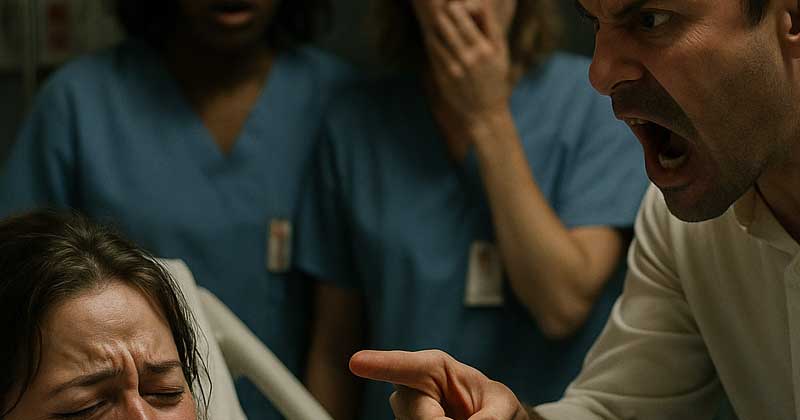
The years were hard for Emilia. She raised Ana alone, working day and night at the clinic and doing everything in her power to ensure the little girl did not feel the absence of her father. The small village, filled with gossip, never forgave her. The women whispered at the gate, and the men looked at her with disdain.
Still, Emilia held her head high. Her mother, a simple but strong woman, had taught her that dignity is not sold with words. Every evening, after putting her daughter to bed, she lit a candle at the icon and prayed. She firmly believed that the truth would eventually come to light.
Ana grew up beautiful, with bright black eyes and a warm smile that won over anyone. Often, the village elders told Emilia that the girl resembled a relative of theirs, with features reminiscent of a long-forgotten aunt from another time. But Ion, stubborn as he was, did not want to hear it.
Almost 10 years after that day, fate made Ion confront the truth. He was at the funeral of an elderly aunt, his grandfather’s sister. On the coffin lay an old sepia photograph. Ion stopped abruptly. The face in the photograph had the same large eyes, the same olive skin, and curly hair, just like Ana’s.
An old cousin explained to him then that, in their lineage, there had long been people with mixed blood, who came from the south, back when Romanians and Roma lived and worked together. No one had spoken of this for years; the shame of the past had been swept under the rug. But genes do not lie.
Ion felt his world collapse. All the hatred, all the suspicion, all the lost years became an unbearable burden. He immediately left to find Emilia.
He found her in front of the clinic, dressed modestly, with her hair tied back, while Ana played nearby with a colorful string. When the girl saw him, she ran joyfully towards him, without a trace of resentment. She knew his face only from a few scattered photos, but she recognized him.
Ion fell to his knees and burst into tears. — Forgive me, Emiliană… Forgive me too, my little girl. I was blind and foolish.
Big tears rolled down his cheeks. Emilia stood frozen for a few moments. Ten years of suffering could not be easily erased. But looking at Ana, who was hugging her father, she felt her heart soften.
— For her, I will try, Ion, she said slowly. Not for you. For her.
They then began a difficult but true journey. Ion had to regain his family’s trust, endure the village’s gazes, and bear the shame he had brought upon himself.
But Ana, with her pure child’s heart, welcomed him with open arms. She asked him for stories in the evening, called him to celebrations, and often brought him drawings with hearts. And slowly, the village began to forget, because where a child smiles, people can no longer throw stones.
At the church’s feast, the priest called everyone to shake hands and leave the past behind. Ion and Emilia lit candles together, and Ana sang in the children’s choir. It was living proof that true love endures even when people make mistakes.
And thus, after a decade of suffering and misunderstandings, Ion understood what it truly means to be a father: not blood, but heart; not pride, but forgiveness.
The truth, no matter how painful, also brings freedom. And for their family, that freedom was a new beginning.
This work is inspired by real events and people, but has been fictionalized for creative purposes. Names, characters, and details have been changed to protect privacy and enhance the narrative. Any resemblance to real persons, living or dead, or to real events is purely coincidental and not intended by the author.
The author and publisher do not assume responsibility for the accuracy of events or for the portrayal of characters and are not liable for any misinterpretations. This story is provided “as is,” and any opinions expressed belong to the characters and do not reflect the views of the author or publisher.


