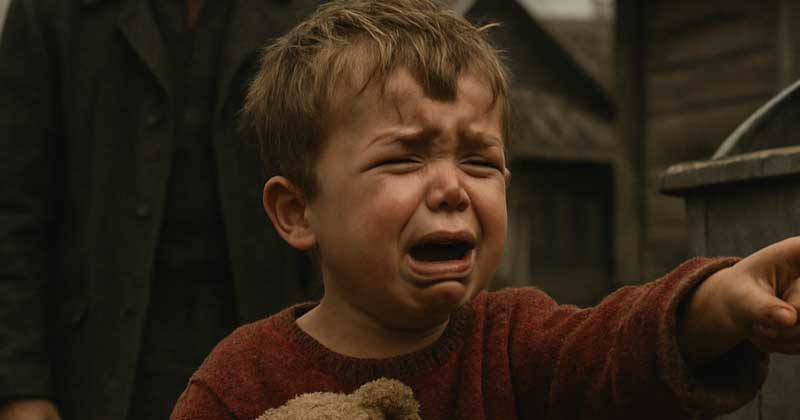
Alexandru, used to seeing the world as a transaction, stood still for a moment. The child’s eyes were wet, but they had a strength that seemed to pierce his soul.
He approached slowly, despite the mocking glances of passersby. It was clear to him that the boy was not lying. That desperation could not be faked.
He grabbed the lid of the container and lifted it with a jerk. A heavy smell hit him immediately, but what he saw made his knees feel weak.
Among the trash bags and debris, two dirty hands were struggling, trying to cling to the edge. A woman, with a pale face and tangled hair, looked up with wide eyes, suffocated by the lack of air.
A murmur arose in the crowd. The woman was indeed there.
The child rushed towards the container, shouting with a broken voice:
— Mom! Mom!
Without hesitation, Alexandru took off his expensive jacket and threw it aside. He stretched out his arms, grabbed her by the armpits, and with an unexpected effort, pulled her out. The woman fell to the ground, gasping, while the child clung to her with all his strength.
The onlookers were frozen, ashamed of their disbelief. The old man with the cane lowered his gaze, and the woman who had spoken earlier bit her lips, feeling guilty.
Alexandru knelt beside the two, something he had never done in his life. He looked at them and felt something inside him break. He, the calculated, cold man who judged everything by numbers and contracts, was now discovering a harsh reality: behind a dusty market, there could be a true tragedy.
— Are you okay? — he asked, with a voice softer than he had ever heard.
The woman, still trembling, nodded. Her eyes filled with tears, but there was gratitude in her gaze.
— If it weren’t for you…
She couldn’t finish the sentence. The child was hugging her tightly, and Alexandru felt a lump in his throat.
In that moment, he remembered his grandmother from the countryside. The stories she told by the stove, the simple words: “A person is known by their deeds, not by their words.” He remembered how, as a child, he helped gather hay, and the whole village came together to raise a barn. Community meant life. And he, in all the years spent in glass offices and private planes, had forgotten that.
He stood up and looked at the crowd.
— And you could have saved her too, he said firmly. But you chose to look away.
His words fell like a hammer. People shifted uncomfortably, ashamed, avoiding his gaze.
The woman was taken by some locals to a nearby bench, where they gave her water. The boy did not leave her side, and Alexandru remained in place, watching the scene.
For the first time in his life, he did not feel it was about money or image. It was about a simple truth: there, in that insignificant little town, he rediscovered what it meant to be human.
In the following days, Alexandru did not continue his way to the café. He returned several times to the market, buying clothes for the child and medicine for the mother. The townspeople, initially surprised, began to see him differently. Not as a wealthy stranger, but as a man who had rolled up his sleeves and mingled among them.
And Alexandru Harris, who had come only for a business meeting, discovered a truth more valuable than any contract: that true wealth does not lie in bank accounts, but in the gestures that save souls and restore hope.
And that evening, looking at the sky over the quiet square, he said softly, like a promise:
— I will never walk past a cry for help without stopping.
That decision, born from the tears of a child and the trembling arms of a mother, would change his life forever.


