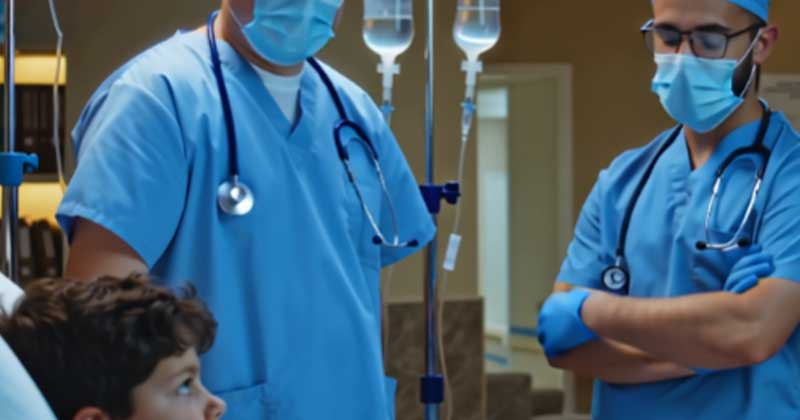
A seven-year-old orphan lay in the hospital room, as if he were already detached from life.
He was a lonely child — without parents, without love, without any chance, or so it seemed to everyone around. Only the doctors, the ticking clock, the cold walls, and the hum of medical machines. They were about to disconnect him from the life support machines: the readings showed no consciousness, the heart was beating only because of the machine. But just as the doctor reached for the button, the boy whispered a few words.
What were those words? A prayer? The name of a mother he had never known? Or a final “forgive me,” addressed to a world he had not had the chance to love?
Time seemed to freeze. The doctors stood still. And the small heart, which stubbornly resisted in his chest, suddenly became a symbol of something greater — a reminder that miracles happen. Especially when it comes to children.
This is not just a story. It is a memory: as long as there is life — there is hope. Even in the quietest hospital room, even in the body of a child where the pulse is barely audible, a light burns capable of surpassing any diagnosis.
Anna, the head nurse, stood by the door for a long time. She had worked here for over twenty years, but she had never felt this way — not even with a dying patient.
Not because the child was dying — there were many like him. But because he was alone. Completely alone. Without the voice of a mother, without the hand of a father, without a toy under the pillow, without the smell of home-cooked food. Just sitting there, like a forgotten thing, in the corner of the world.
Anna approached the bed, brushed her palm over his forehead, and whispered:
“Radu… if you can hear me — don’t give up. You need to have a tomorrow. Just a drop of hope…”
Meanwhile, Vasile, the head of the intensive care unit, signed the papers.
“Clinical brain death” — black on white. Signature, stamp, approval. All the documents in order. Disconnection scheduled for 5:00 PM. According to protocol. According to the rules. According to the law.
No one knew that that morning, a thousand kilometers away, a woman woke up in a small village house. Elena. She woke up sweating, with chest pains, with a rupture inside.
“My grandson… my boy… where are you? Where are you, Radu?”
Seven years ago, her daughter had given birth to a child and abandoned him. She had run away. And Elena had lost contact with her descendant. But that night he appeared to her in a dream — in a white room, alone, with a question:
“Grandma, will you find me?”
She did not wait for answers. She put on an old sweater, took a cross, and left. A mother’s heart, especially a grandmother’s, rarely goes wrong.
At 4:55 PM, the doctor entered the room.
All preparations had been made. The nurses had left. The lights had been turned off. Only one button remained to be pressed.
And at that moment — weak, through the silence, as if from another world — the boy whispered:
“Grandma… I’m here… don’t disconnect me…”
The doctor stepped back. He couldn’t believe his eyes. The readings were the same. But the child’s lips had indeed moved. And there was a voice. Quiet, but real.
“Speak…” he began, but Anna rushed into the room.
“He’s alive! I heard him! He wants to live!”
From that moment on, everything changed.
The disconnection was canceled. Emergency diagnosis. And suddenly — a spark of activity in the brain. The lungs began to function independently. The heart was beating not from the machine, but of its own will. And although the movements were weak, each became a victory.
Two days later, Elena came to the hospital.
In her hands — a photograph of the boy she had searched for seven years. She asked with a trembling voice:
“Do you have a boy named Radu? I am his grandmother. I just want… to see him.”
They wanted to say “no,” but a nurse suddenly froze:
“He… he called for his grandmother. Before he woke up.”
They led her to the room. She entered — and saw not a body, but LIFE. Radu lay with his eyes closed, but his cheeks were already rosy. And when he whispered:
“Grandma…”
She fell to her knees. She cried as if for the first time. And everyone around — doctors, nurses, even those who had been there for the disconnection — just stood and watched. Without words. Without movement.
Weeks passed. Radu began to rise.
Reactions appeared, speech, first steps. When they first placed him by the window, he took Elizaveta’s hand and said:
“I knew you would come.”
Months of recovery behind.
He returned home. Not to an institution, not to a hospital — to his home. A small village house that smelled of pies, where the tomcat Tom purred, where his childhood photo hung on the wall. Where he was awaited.
He fell asleep in his grandmother’s arms, listening to a lullaby. And no one spoke of his death anymore.
And only one doctor, the most cynical of all, wrote in his journal:
I did not believe in miracles. Until the boy whispered two words. After that, I fell silent.
Radu was silent for a long time.
He just sat by the window, watching the curtains sway. There was a depth in his eyes that children rarely have. He remembered the smell of the hospital, the sound of tubes, the taste of loneliness. He knew what it meant to be unwanted.
Elena did not rush him. She did not ask questions. She cooked soup, stroked his head, told him stories. Even the ones she had sung to his mother when she was little.
One day he asked quietly:
“Grandma… why didn’t anyone look for me?”
Her hands trembled. She put the bowl down, sat next to him.
“I searched. But I didn’t know where they took you. Your mother… left. I’m afraid she never learned to love. And I… didn’t get there in time.”
He fell silent. Then he rested his head in her lap and whispered:
“Teach me to love.”
Elena cried. Because not every adult can ask that. But he could. He knew the price of love. He had suffered it with every cell.
Over the years, Radu began to remember.
Fragments. Nightmares. Cold rooms, indifferent gazes, punishments for crying. He would wake up sweating, calling for his grandmother. And she was always near.
“I’m with you,” she whispered, holding him tight. “No one will hurt you again.”
He was taken to the local school.
The children were simple, the teacher kind. And for the first time in his life, Radu heard:
“What beautiful handwriting you have, Radu!”
He blushed with embarrassment.
“You can draw a whole comic strip!” they told him at the art club.
He laughed for the first time.
His grandmother bought him pencils. He drew day after day. Each drawing — a house, a stove, a cat, grandma. And inscriptions:
“Here is my home.”
“Here I am loved.”
“Here I am not alone.”
One day, a television crew came to the school.
Radu was chosen among the students — for resilience, for winning the children’s drawing contest. They asked him:
“How did you become so strong?”
The boy thought. Then he simply replied:
“Once I wanted to die. But my grandmother came. And when you are needed by at least one person… that is life.”
That moment went viral. Millions of views. People wrote letters to Elena, sent things, books, even money. But most importantly — a letter came. From his mother.
The woman lived in another city. She was scared. She was ashamed. For many years she had not dared to come.
On the phone, she whispered:
“Is he alive?”
Elena replied firmly:
“He is alive. And you need to see him. But only he will decide — if he forgives you.”
Ioana came. She stood on the porch, trembling with fear. And Radu came out and simply asked:
“Are you my mother?”
She nodded, unable to say a word.
“Grandma said you were scared. And I was scared too. But now I’m not scared anymore.”
He reached out his hand.
“Do you want to start over?”
They embraced. Awkwardly, but sincerely. Like people who have finally stopped hiding from the past.
Two years passed.
Radu grew up. He learned to wash himself, to prepare for school, to take care of the cat. He drew every day, and now he studied at the regional art high school — where he was immediately accepted as one of their own.
His grandmother sat on a bench by the house, watching him step into life.
Every time he passed by her, he quietly said:
“I’m alive. Thank you…”
One day, the hospital where he had lain received a letter from Radu himself.
A simple postcard, with a child’s neat handwriting:
“Dear doctor, you didn’t disconnect me. You gave me a chance. I’m growing. I’m drawing. I’m breathing on my own. You didn’t believe — but I’m alive. If there is ever a child like me nearby, don’t rush to turn off the machine. Just tell him: ‘You are still needed by someone.’”
The chief doctor read the letter and went outside. For the first time in many years, he cried.
Spring came. There were swings in the yard. Radu was pushing his little sister.
His mother had another child — this time she stayed. And his grandmother held an old frame with a child’s drawing.
On it — a little house, a stove, trees. And the inscription:
“This is my life. I received it. Thank you.”
Three years passed. Radu turned ten.
He knew what love was — not from books, but from his grandmother’s voice at bedtime, from warm milk with honey, from how she stroked his head every morning. He understood how fragile life is. He spoke almost like an adult, looked with a rare wisdom for children.
But he still didn’t know everything.
One day, his grandmother took out an old box. Inside — letters, photographs, stamped envelopes from distant cities. On one of them — a young woman with long hair.
“Is that mom?” Radu asked cautiously.
Elena shook her head. And sighed.
“She was beautiful. Very kind. But too gentle for this world. When she became pregnant with you, the man she loved left her. And she… broke. She decided she couldn’t cope. She ran away. I searched for you every day. I prayed. I wrote. And then, one day, I heard your voice in a dream.”
Radu hugged her. Without words. Without tears.
Since then, his mother came more often.
At first, she sat quietly in a corner. Then she began to take his hand. A year later, she brought him a backpack. Then she stayed overnight when Elena fell ill.
They learned to be a family. Not perfect, but real. They argued. They made up. They cried. They rejoiced.
One day, Radu wrote a composition titled: “Who I Love Most?”
“I love my grandmother because she didn’t abandon me when she didn’t know where I was. I love my mother — because she came back when she could have stayed away. I love them differently, but with all my heart. Because now I know: no one is perfect. The main thing is not to leave when you are expected.”
The teacher took it home and cried reading it aloud.
At a school event, Ioana called herself a mother for the first time:
“I am Radu’s mother. And I am proud of that.”
Elena stood aside, watching her and thinking: everything was not in vain… everything.
One day an official document arrived — the restoration of parental rights.
Ioana placed it on the table and said:
“I won’t take him. He is here. His world is here. You are his support. And I want to be close. Until he makes his own decision.”
Radu heard. He came, hugged them both, and said:
“I want to have two homes. Is that okay?”
They sat together, embraced. And they cried. Not from pain — but from forgiveness.
Radu became a teenager. He continued to draw. Only now — more seriously.
He was noticed at the capital’s art high school. He went to study there. He took only a notebook. On the first page — the inscription:
“I haven’t forgotten. I’m just moving on.”
He called every evening. He came every weekend.
“Did you eat?”
“Yes, grandma.”
“Did you put on your hat?”
“Of course.”
“I love you.”
“And I love you more than anyone in the world.”
At eighteen, he told his story for the first time in front of a large audience.
The college organized a night of revelations. Radu was the last speaker. He approached the microphone and said:
“I was an orphan. But that doesn’t mean I was alone. I was on the edge. But someone heard me. Someone didn’t let me go. Now I breathe. I draw. I live. And I owe this life to my grandmother, my doctor, my mother… and God.”
The audience stood and applauded. Someone after the speech said:
“You changed my heart.”
A few years later, his first exhibition took place.
The exhibition was titled:
“As long as you are needed — you live.”
The centerpiece of the exhibition was a drawing — a boy in a hospital room and someone’s hand reaching out to him. In the corner — the inscription:
“I hear you.”


