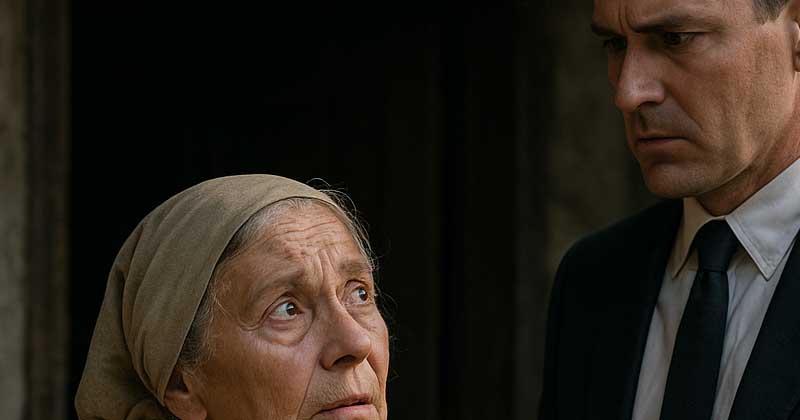
— “You are Jun’s mother, aren’t you?” the man said, his voice carrying a harshness that was hard to describe.
I stood there with my hands clenched around the damp cloth, my heart racing wildly. I didn’t want to admit it, but I couldn’t deny it either.
— “Yes… I am,” I replied, trying to keep my composure.
The man approached the table, leaning on the worn wood.
— “Your son has significant debts. If he doesn’t pay them, it will be very bad for him. Perhaps even for his family.”
I felt my blood freeze in my veins. Ramón’s face appeared in my mind, with his words from the past: “People are only good as long as they have something to gain.”
I remained silent. I didn’t acknowledge that I had anything. I just shrugged and said in a low voice:
— “I have nothing. I’m barely getting by from day to day.”
He looked at me suspiciously, but he didn’t press further. He left, leaving me with a tight heart.
That night, I cried silently. They were bitter tears, not for myself, but for my son. I had raised him with love, given him everything I had, and now he was a prisoner of his own weaknesses.
But even so, he was my child. And no matter how much he hurt me, a mother cannot stop loving her son.
I then decided something I never thought I would do.
In the morning, I went to the bank. I withdrew some money, not much, but enough to settle the most pressing debts. With it in an envelope, I went to Jun’s house.
When he saw me, he was embarrassed. He looked weak, with deep circles under his eyes and wrinkled clothes. His children were playing in the yard, unaware of the storm in their father’s life.
— “Mom… what are you doing here?” he said, avoiding my gaze.
I handed him the envelope.
— “I’m giving you this just once. Not for you, but for your children. They shouldn’t suffer for your mistakes.”
His eyes filled with tears. For the first time in his life, I saw him truly small, overwhelmed by shame.
— “Mom… I was wrong… I pushed you away, I was blind. I don’t deserve your forgiveness.”
I sighed deeply.
— “I don’t know if you deserve to be forgiven, Jun. But I know Ramón wouldn’t have wanted to lose you completely. Take the money, but promise me you’ll stop gambling. Life isn’t a dice game; it’s daily toil.”
He knelt and took my hands.
— “I swear, Mom, I will change everything.”
I felt that his promise was sincere, but I no longer had the blind trust I once did. I let him prove it through actions.
In the following weeks, I learned that Jun had indeed gone to work. He was selling fruits at the market, alongside his wife. Their home was poorer, but more peaceful.
Slowly, I began to reconnect with his family, especially with my grandchildren. I taught them poems by Coșbuc, took them to church on Sundays, and in the evenings, I told them stories about life in the village, about how, once upon a time, people had nothing but lived with full hearts.
I felt that all the suffering I had gone through now had a purpose.
One day, Jun said to me:
— “Mom, I know you sacrificed a lot for us. I want to bring you home. Not to ‘keep’ you, but to be a family again.”
I smiled bitterly.
— “That house is no longer mine, Jun. It’s yours. I’ve found my place. But if you want to come see me, my door is always open.”
And so it remained. I continued to live simply, discreetly, keeping my secret, but at peace.
Because in life, I learned that it is not wealth that makes us human, but the way we choose to love and forgive.
And I, even though I was cast aside, chose to remain a mother.
And that was my greatest victory.


