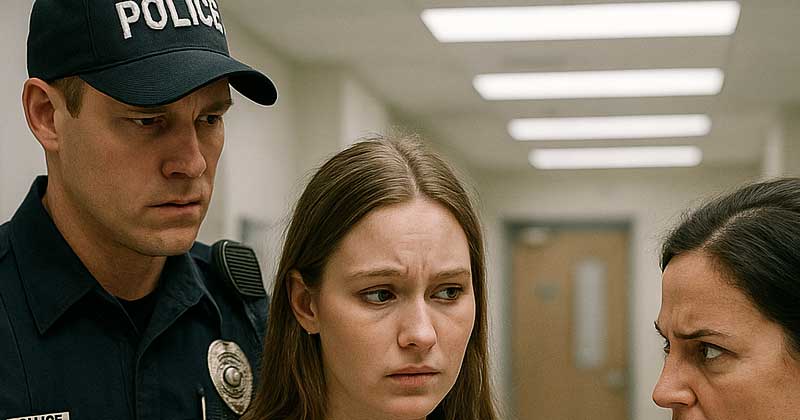
Doru walked determinedly towards the reception, and the oppressive silence of the waiting room transformed into a dense tension. The patients, who until then had been helplessly watching, began to whisper, sensing that something was about to change.
His gaze settled on the pale face of his wife. Maria was trembling, her hands clasped on her belly, trying to gather her strength. Doru clenched his jaw and then turned to the police officers.
“This woman is my wife. She is seven months pregnant, and her doctor called her to the hospital urgently. Please explain to me why, instead of being examined, you called the police.”
The officers exchanged glances, visibly embarrassed. One of them replied in a low voice, “We received a call that the patient might be aggressive. We came to ensure there were no problems.”
“Aggressive?” Doru turned to the receptionist. His cold, penetrating gaze made Lidia suddenly lose her confidence. “My wife has never raised her voice. She asked for help. And you denied her the right to medical care.”
A heavy silence fell. The patients began to murmur approvingly, some nodding their heads.
“Ma’am,” Doru continued, “do you understand the consequences of what you have done? Leaving a pregnant woman in pain to wait until she nearly faints is more than a lack of professionalism. It is cruelty.”
Lidia tried to respond, but her voice broke. “I… I was just following the rules.”
“The rules?” Doru took a step closer. “The rules say to put life first. That’s how we were raised in this country: to respect life, to help each other. In the villages, people still go out at night if they hear a woman screaming that she is giving birth. And you, in a hospital, refused to help her?”
His words echoed. An elderly woman in the corner raised her voice: “That’s right, sir. When I gave birth, the whole neighborhood rushed to help me. Now, in the hospital, to be humiliated?”
The police officers lowered their phones and took a step back. “We have no business here,” one of them said. “The doctor must be notified immediately.”
Miraculously, a few young nurses appeared, drawn by the commotion. One of them quickly approached Maria. “Ma’am, please come with me. We’ll take you to the ward for monitoring right away.”
Maria burst into tears, relieved, leaning on her husband’s arm.
In a few moments, the situation transformed completely. The people in the waiting room began to clap slowly, a spontaneous gesture of solidarity. It was like an outburst against the injustice they had witnessed.
Doru turned back to Lidia. “Today you forgot that you wear the white coat not for power, but for duty. Never dare to treat someone like that again.”
Lidia lowered her gaze, unable to say anything more.
Maria was taken to the ward, where Dr. Radu arrived immediately. When he learned what had happened, his face flushed with anger. “This is not how you treat a patient, especially in a critical condition. I will report the incident to the hospital management.”
Tests showed that the fetus was stable, but the cramps required monitoring. Maria rested her head on the pillow, breathing deeply, knowing that the danger had passed. Doru held her hand, looking at her tenderly.
“Everything will be fine,” he whispered.
That evening, the story spread quickly among relatives, friends, and then on social media. Many Romanians found themselves in it, recalling times when people supported each other, without bureaucracy and without humiliation.
The case caught the attention of the press, and the hospital management was forced to take action. Lidia was suspended, and the hospital revised its emergency admission protocol.
But beyond everything, Maria and Doru felt they were not alone. The community stood by them, and that simple, Romanian solidarity healed them more than any treatment.
Because, in the end, in this country, people do not forget: life and dignity are the most precious values.
This work is inspired by real events and people, but has been fictionalized for creative purposes. Names, characters, and details have been changed to protect privacy and enhance the narrative. Any resemblance to real persons, living or dead, or to real events is purely coincidental and not intended by the author.
The author and publisher do not assume responsibility for the accuracy of the events or for how the characters are portrayed and are not liable for any misinterpretations. This story is provided “as is,” and any opinions expressed belong to the characters and do not reflect the views of the author or publisher.


