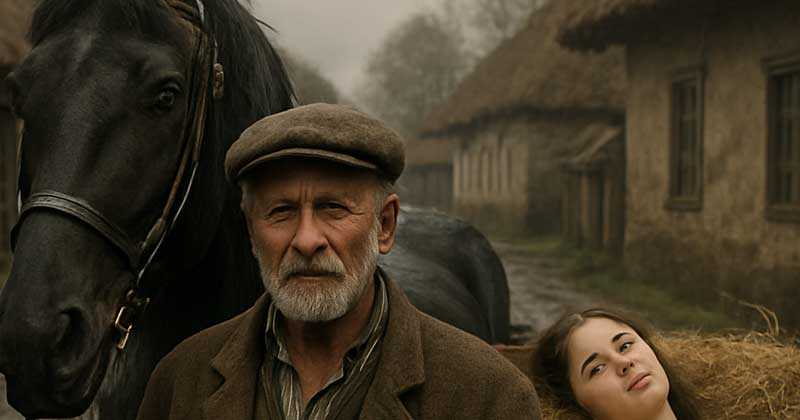
Every morning, Valia began to step out of the house with small steps, leaning on the old fence of Aunt Duna. The fresh air of the field filled her lungs and reminded her of her childhood, of the time when her mother baked bread in the oven and the smell of golden crust spread throughout the yard. The villagers looked at her in amazement. For many of them, Valia had become a living story, a woman who defied death with a quiet stubbornness.
The paramedic, named Sorin, came almost daily. He brought her not only medicine but also herbal teas made from plants gathered from the surrounding forests – St. John’s wort, yarrow, thyme. He told her how his grandmother, from the Apuseni Mountains, healed people with teas and incantations. Valia listened with a full heart, as if each word wove an invisible thread of hope.
One autumn evening, when the sky was red as fire and the leaves burned in colors, Sorin came with a thick blanket and draped it over Valia’s shoulders.
– You’ll see, this winter you won’t be cold, he said with a warm smile.
For the first time in a long time, she felt that someone was thinking of her, not as a burden, but as a person. And then, in her soul, a crazy thought sprouted: maybe life wasn’t over yet.
Days passed, and Valia began to walk further through the village. People brought her apples from the orchards, cheese pies, jars of jam. It was a simple gesture, but in each gift lay a comfort. Slowly, her body grew stronger, and the lost light began to return to her gaze.
One morning, as the sun rose over the fields, Valia looked at herself in a small, cracked mirror that she kept on her nightstand. Her face was no longer pale and dull, but full of life. She felt tears filling her eyes, but this time they were tears of joy.
At the end of winter, on a Sunday, the village organized a small fair, with folk music and dances. Valia stepped out of the house dressed in a white blouse that Aunt Duna had gifted her. The villagers looked at her as if she were a miracle. The music echoed from the violin and accordion, and she felt for the first time that the ground beneath her feet belonged to her again. Sorin extended his hand, and she accepted. They danced slowly, in a circle, among the people.
In that simple dance, Valia understood that she was no longer the woman abandoned by her husband, sick and hopeless. She was a woman who had risen from the ashes of her own suffering. A woman who, in a forgotten village, had regained her right to live.
In spring, when the trees bloomed and the birds returned, Valia went out daily to the small garden in front of the house. She planted flowers and medicinal herbs alongside Sorin. A few children came to help her, laughing and running among the beds. One day, a little girl said to her:
– You are like the story of the grandmother, Mrs. Valia. The one who rose from the dead.
At that moment, Valia smiled with all her heart. In the midst of the fields, in that quiet village, she had found not only healing but also a purpose. She understood that sometimes life breaks your wings just to teach you how to fly again.
And one morning, when the sun shone over the green forests and the air smelled of cut grass, Valia felt all her past lift off her shoulders. She was no longer the girl waiting by the window for a husband who would not return. She was the woman who had found her strength in the heart of the village, in the kindness of the people, and in her own hands.
And thus, in the place where she had been left to die, Valia chose to live. And in her large, bright eyes, there now reflected not only the pain of the past but also the promise of a new, pure life, founded on hope and dignity.
This work is inspired by real events and people, but it has been fictionalized for creative purposes. Names, characters, and details have been changed to protect privacy and enhance the narrative. Any resemblance to real persons, living or dead, or to real events is purely coincidental and not intended by the author.
The author and publisher do not assume responsibility for the accuracy of events or for the way characters are portrayed and are not liable for any misinterpretations. This story is provided “as is,” and any opinions expressed belong to the characters and do not reflect the views of the author or publisher.


