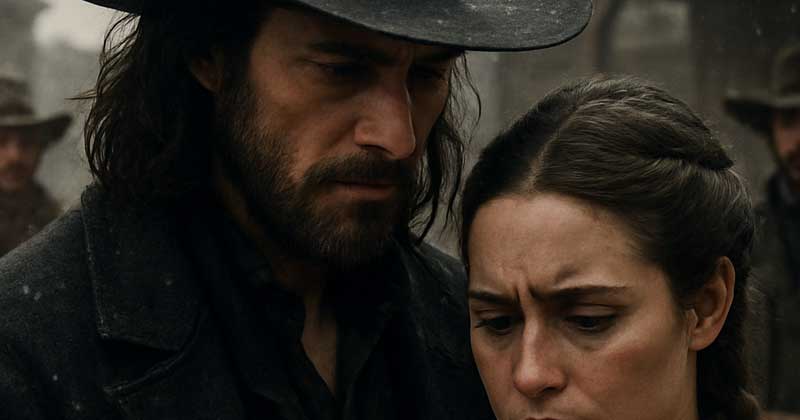
Santiago felt a lump in his throat. He could not ignore that clear suffering; he could not move on as if he hadn’t seen it. He made a sudden, determined decision, looking don Esteban straight in the eye. “Let her go,” he said, his voice firm, without a trace of doubt. The merchant became furious, but Santiago did not back down.
The woman blinked in astonishment, as if she couldn’t believe that someone could offer her freedom. She trembled all over, and tears streamed down her cheeks, mixing with the dust of the market. Santiago reached out and gently lifted her. She was weak and fragile, but her brown eyes shone with gratitude and hope.
“What’s your name?” he asked, trying to soothe her fear.
“Ana… Ana Popescu,” she whispered. “Please, ranchero… don’t leave me.”
In that moment, Santiago felt all the burdens of years of work, loneliness, and misunderstandings dissolve. Ana was not just a frightened young woman; she was a story of survival, a soul seeking a drop of humanity in a harsh world. And Santiago knew he could not let her fall into the hands of don Esteban or others like him.
They set off towards his farm, on dusty paths winding through the sunflower fields. Ana whispered about the years she had been treated cruelly, about the long nights spent alone, but Santiago did not interrupt her. He listened patiently, with his hands protecting her, with an open heart.
At the mountain farm, Ana quickly began to integrate. Her simple yet tasty cooking brought an unexpected warmth to Santiago’s home. On long autumn evenings, when the wind carried the scent of walnut leaves and damp earth, she told old legends about ancestors, about forgotten Romanian customs, and holidays with carolers. Santiago listened, fascinated, feeling his heart, once hardened, slowly open.
But not all days were peaceful. Don Esteban had not forgotten the humiliation he suffered and tried desperately to harm Ana. Santiago, however, did not give an inch. He had learned to be firm but also just, and every evening, when the stars rose over the mountains, he felt their destiny intertwining more closely.
On a cold autumn morning, when the dew still sparkled on the wheat ears, Ana and Santiago worked together in the farmyard. Ana brushed her hair from her face, smiling shyly, and Santiago felt that, for the first time in his life, he was truly home. Their souls understood each other without words, and their bond was stronger than any past pain.
That dusty village, the horse market, don Esteban, all of these had become mere distant shadows behind them. Ana and Santiago were building together something that could not be bought: trust, love, and hope. In a cruel world, they had found a place where blood, tears, and fear transformed into a smile, into the warmth of a lively home, and into the promise of a bright future.
And so, amidst the golden sunflower fields, with the mountains looking down, Santiago and Ana learned that true value does not lie in horses or money, but in the hearts that connect and in the courage to protect what truly matters.
This work is inspired by real events and people, but has been fictionalized for creative purposes. Names, characters, and details have been changed to protect privacy and enhance the narrative. Any resemblance to real persons, living or dead, or to real events is purely coincidental and not intended by the author.
The author and publisher do not assume responsibility for the accuracy of events or for how characters are portrayed and are not liable for any misinterpretations. This story is provided “as is,” and any opinions expressed belong to the characters and do not reflect the views of the author or publisher.


