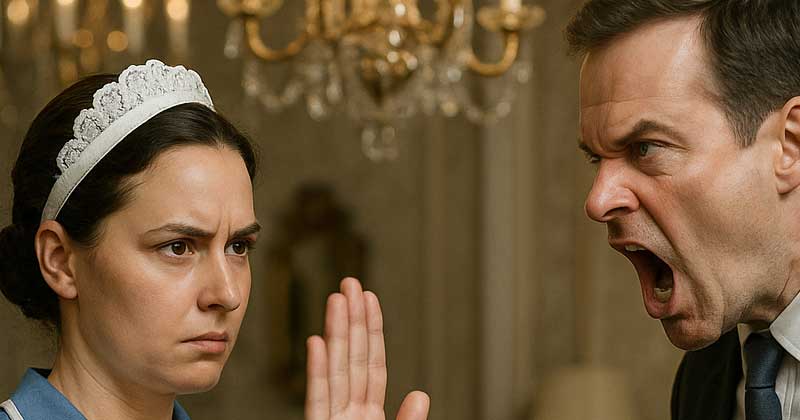
But before he could raise his hand, Isabel met his gaze.
It was a gaze that did not tremble, but burned with an ancient intensity, like the smoldering fire of a pyre he thought was extinguished.
— You haven’t changed at all, Carlos, she said calmly, her voice resonating louder than his shout.
A shiver ran down the man’s spine. For the first time in years, he was no longer the absolute master of that palace.
The twins stood up and clung to each other, unsure whether to flee or to approach. Carmen and Lucia did not understand everything, but they felt that there was a hidden secret between that woman and the man who had raised them, deeper than the cold marble they walked on every day.
— Do you remember the lullaby? Isabel asked, her eyes moist.
And without waiting for a response, she began to hum softly. An old song from the countryside, which mothers whispered to their children at the window where the night wind blew: “Nani, my little one, nani…”
Then, the little girls flinched. The memory of that song had gathered in their dreams for years, like a forgotten perfume on the edge of a pillow.
— Mama… whispered Lucia.
An echo shattered against the marble walls. Carlos flushed, waving his hands chaotically, like an animal caught in a trap.
— It’s a lie! he screamed. It’s a farce! You are mine!
But Isabel took a step towards the girls, and they instinctively threw themselves into her arms. A warm, genuine embrace, unlike anything they had known before.
Suddenly, all the grandeur of the mansion melted into a ridiculous image: an angry father, drunk on power and alcohol, and a mother reborn from the ashes of her own fate.
— You built your empire on my blood, Isabel said firmly. On my bruised body, on my forced silence. You thought I was dead, but I hid, I was reborn, and I gathered evidence. Everything will come to light.
Carlos froze. He realized that the woman was not speaking in vain. He saw it in her eyes, behind the sharp calm.
At that moment, the heavy door of the parlor opened. Three men in black suits entered, followed by an elegant woman, the chief prosecutor of Madrid.
— Mr. Mendoza, you are under arrest, she said, handing him the warrant. Money laundering. Fraud. Domestic abuse. The list was long.
Carlos tried to protest, but his voice faded. The whiskey he drank every day could no longer numb his terror.
Isabel held her twins close, and their tears mingled.
— Let’s go home, she told them. Home does not mean gold and marble. Home is where our hearts beat together.
The prosecutor nodded and closed the file. Justice had found its voice in a mother who refused to die.
In the courtyard of the mansion, the villagers who came daily to deliver bread and milk watched the scene. They knew that Mendoza’s empire had been built on tears and fear. And for the first time, they saw that the high walls no longer concealed terror, but freedom.
Isabel took her daughters away from opulence, to a simple house with a garden and the smell of bread baking on the hearth. There, under the old walnut tree, the girls learned to laugh again. They picked cherries, ran through the grass, and listened to their mother’s stories about how the Romanian village weaves courage from deep roots.
And thus, revenge did not only mean punishing a cruel man, but the rebirth of a family.
Carlos Mendoza lost everything in a single day. Isabel, however, gained everything that was most precious: the arms of her twins holding her and their whisper, like an evening prayer:
— Mama, now you are with us. Forever.
This work is inspired by real events and people, but has been fictionalized for creative purposes. Names, characters, and details have been changed to protect privacy and enhance the narrative. Any resemblance to real persons, living or dead, or to real events is purely coincidental and not intended by the author.
The author and publisher do not assume responsibility for the accuracy of events or for the portrayal of characters and are not liable for any misinterpretations. This story is provided “as is,” and any opinions expressed belong to the characters and do not reflect the views of the author or publisher.


