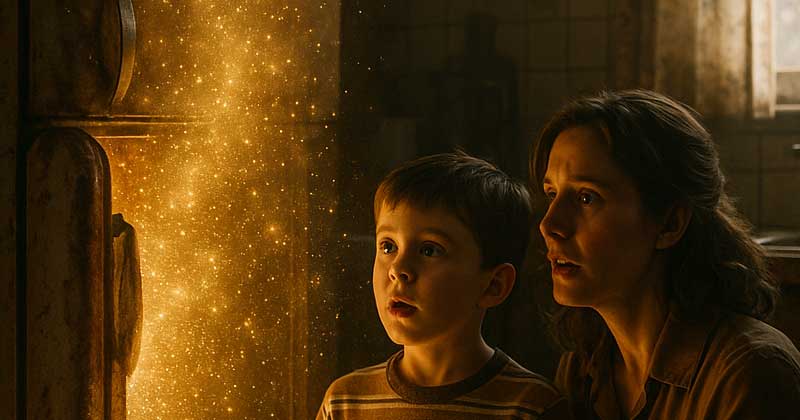
The boy picked her up, grumbling, and together, like two allies of misfortune, they stepped into the dark staircase, smelling of dampness and cheap cat perfume.
The apartment door creaked, allowing them to enter the silence and dust that had accumulated. Everything was covered with white sheets, the curtains drawn, and the dim light from the street only outlined the dust dancing in the air. The smell of old books intertwined with a deep sadness — the scent of an abandoned home. Sergiu dropped his bag, looked around like a householder, and pronounced the sentence:
— Yeah, there’s work to be done here… A week, if we both work.
Marina smiled faintly. His pragmatism brought a spark of life to the heavy atmosphere. She looked at him: thin, frail, but with a serious face. She knew that after he helped her, he would leave again to the streets, into the cold and danger.
— Listen, Sergiu, — she said firmly. — It’s late. Stay here overnight. It’s cold outside.
The boy raised his eyes in surprise. For a moment, disbelief appeared in them — but then he just nodded.
In the evening, after a modest dinner — bread and cheese bought from the corner store — they sat in the kitchen. Washed and warmed, Sergiu looked almost like an ordinary child from a normal home. He told his story — mercilessly, without tears. His parents drank. A fire in the shack. They died. He survived. He was taken to a center, but he ran away.
— I don’t want to go to the orphanage, — he said, looking into the empty cup. — They say you end up in prison from there. It’s like a ticket to poverty. Better on the street…
Marina looked at him for a long time, her heart tight. The boy’s words echoed in her mind like an echo of her own childhood, when she too felt that life had taken her parents too soon. She understood him without needing further explanations.
She got up and slowly pulled out the drawer from the old sideboard, where her grandmother used to keep a few icons and a small box of candles. She lit one, and the yellow flame danced gently, filling the room with a strange warmth.
— Grandma always said that no house remains empty as long as a candle burns, — she whispered, more to herself.
Sergiu watched her closely, as if trying to understand every word. Marina placed the candle on the table and smiled at him for the first time genuinely.
— You know, in my grandmother’s village, after a funeral, people didn’t let themselves be overwhelmed by sadness. They gathered, told stories, made coliva, and shared it with the neighbors, believing that the soul of the departed warms from the goodness left on earth.
— Coliva? — Sergiu asked, puzzled.
— A kind of boiled wheat, with honey and nuts. Simple, but with a taste of celebration and memories.
In Marina’s mind, a crazy thought took root. Maybe it wasn’t a coincidence that this child appeared in her life just now. Maybe it was a sign. A chance to no longer be alone, to give meaning to a house filled only with shadows.
The next morning, they went to the market together. Marina bought wheat, nuts, honey, and a few red apples. Sergiu followed her, curious about every movement. On the way back, in the small kitchen, the steam from the pot rose with the smell of childhood. Marina felt that for the first time in years, she was doing something with her soul, not out of obligation.
— Taste, — she offered him a spoonful of the freshly mixed coliva.
Sergiu took a bite, and his eyes lit up.
— It’s good! It’s like rice pudding, but sweeter.
His genuine laughter filled the house, washing the walls of the heavy silence that pressed upon them. Marina felt her grandmother watching from somewhere, satisfied.
In the following days, the apartment began to come to life. Together they washed curtains, aired out, and dusted. Sergiu sometimes sang a refrain from the street, while Marina hummed carols she had known since childhood. It was late autumn, but in her soul, spring was blooming.
The neighbors, surprised by the lights on in the seventh-floor apartment, began to knock on the door. An old lady brought stuffed cabbage in an enamel pot, and another neighbor came with a sack of firewood for the little stove. “It’s good that it’s not empty up there anymore,” they said.
Marina then understood how deeply she had always longed for a true “home.” Not one built on lies and contempt, as it had been with Andrei, but one where people support each other.
Sergiu no longer slept on the streets. Every evening, she prepared him a cup of tea and a warm bed. In his eyes, she saw gratitude, but also a mute fear that one day he would be cast out again.
On a Sunday morning, Marina lit the candle from the icon again and knelt by the window.
— Grandma, I promise I won’t be alone anymore. And I will raise Sergiu as you raised me.
Then, in the silence of the room, she felt for the first time that the burden from her soul was lifting. Her life was not over. On the contrary, it was just beginning.
And in that old apartment, where once her tears softened the walls, now echoed the pure laughter of a child learning to believe in family again.
This work is inspired by real events and people, but has been fictionalized for creative purposes. Names, characters, and details have been changed to protect privacy and enhance the narrative. Any resemblance to real persons, living or dead, or to real events is purely coincidental and not intended by the author.
The author and publisher do not assume responsibility for the accuracy of events or for the portrayal of characters and are not liable for any misinterpretations. This story is provided “as is,” and any opinions expressed belong to the characters and do not reflect the views of the author or publisher.


