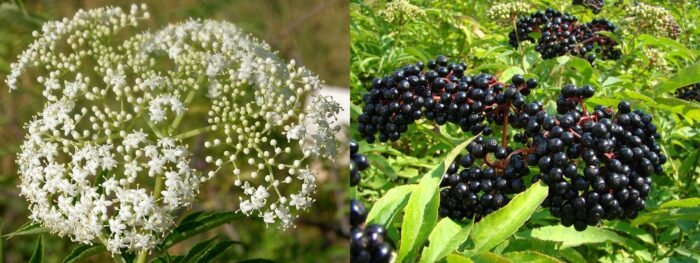
The elder is a shrub that produces flowers and fruits of significant value, both for the food industry and for medicinal purposes.
The elderflowers contain vitamin C, mucilage, organic acids, and essential oil.
The fruits contain high doses of vitamin C (65-120 mg%), potassium (300 mg%), vitamin A (300 mcg%), proteins (2.5%), and sugars.
Both the flowers and the fruits are used for food purposes in the preparation of refreshing drinks, syrups, and teas.
From the ripe elderberries, numerous preparations are made: jam, jelly, marmalade, juice, compote, syrup, wine, liqueur, vinegar, or tinctures.
The elderberry juice has a very strong pigment and can be used as a natural dye.
What Properties Do Elderflowers Have
Elderflowers are often incorporated into teas for colds, coughs, or rheumatism.
They have diuretic and depurative, sudorific, antiseptic, laxative, antineuralgic, and anti-rheumatic properties.
In What Diseases Are Elderflowers Indicated
Elderflowers can be used for the following ailments:
- colds and flu
- fever caused by colds
- bronchitis
- cough
- renal and bladder conditions
- neuralgia
- rheumatism
- boils
- abscesses
- burns
What Properties Do Elderberries Have
While the flowers are depurative, elderberries are laxative.
Due to their rich content of vitamin C and minerals, they have immunostimulant, tonic, and mineralizing properties.
They are also antiseptic and antineuralgic.
The most significant contribution they make is in treating constipation, but also in respiratory conditions.
Studies have shown that extracts from elderberries have significant antiviral properties.
They are also effective in weight loss treatments.
Harvesting Period for Elder
Elderflowers are harvested in spring, after full blooming. The branches are cut and dried in a single layer.
The fruits are harvested in autumn, during September-October. The sign that they have reached maturity is their black color.
All the inflorescences are cut. They are dried in the sun or in attics covered with metal sheets.
Once dried, they are shaken to remove the berries and stored in paper bags.
Attention, elderberries should not be consumed raw (green), but only when they are fully ripe and have turned black. Otherwise, they can be toxic.
Treatments with Elderflowers and Elderberries
Sciatic neuralgia, trigeminal neuralgia, intercostal neuralgias
Put 2 tablespoons of dried elderflowers in a cup (250 ml) with boiling water. Cover and let steep for a quarter of an hour.
Strain and drink 3 cups a day.
For treating pain caused by neuralgias in general, Prof. Constantin Prvu also recommends elderberries.
Juice the well-ripened berries and extract the juice. Mix 20-30 grams of juice with 20% alcohol.
This tincture alleviates pain within a few minutes. If the condition is chronic, results appear after 3-5 days of treatment.
Another remedy for sciatic and intercostal neuralgias and non-articular rheumatism consists of using all parts of the elder.
Thus, put 50-100 g of flowers, leaves, and fruits to steep in 3 liters of water. After half an hour, strain.
The infusion is poured into warm bath water.
For intercostal neuralgias, poultices are made with an infusion of 50 g of flowers, leaves, and fruits in one liter of water.
Flu, rhinitis, cold, adenoviral infections, cystitis, renal conditions
The infusion of elderflowers is recommended. Use 1-2 tablespoons of dried flowers and 200 ml of boiling water. Let steep for a quarter of an hour, then filter.
The recommended dose is 3-4 cups of tea per day.
Cold
Inhalations with elderflower tea are done twice a day. The last procedure should be done in the evening.
Constipation, weight loss treatment
It is advisable to consume a cup of elderflower infusion in the evening, before bed.
Use 1 tablespoon of dried flowers with 200 ml of boiling water.
This tea stimulates intestinal transit, increases diuresis, and induces sweating.
Cardiorenal hydropsy (fluid in pleura, pericardium, peritoneum, joints)
3-4 cups of elderflower tea per day are recommended as an adjunct. Use 2-3 tablespoons of dried flowers with 200 ml of boiling water. The infusion lasts 15 minutes.
Urinary conditions
Put 1 tablespoon of elderberries to boil with 1 cup of cold water. After a few minutes of boiling, the berries are blended with a vertical blender.
Add sugar or sweetener. Drink 1-2 cups a day.
Skin diseases
In case of burns, abscesses, boils, erysipelas, folliculitis, or bruises, wash with elderflower tea.
Put 40 g of dried flowers to steep for 20 minutes in one liter of boiling water.
Strain and use for local washes or as poultices.




