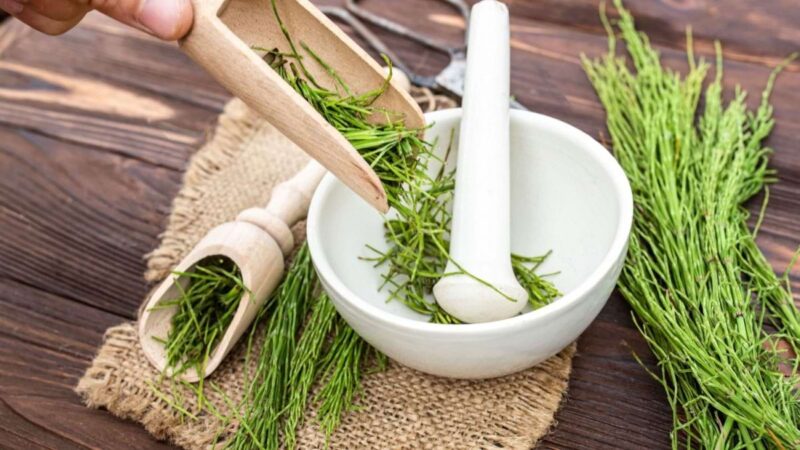
Horsetail (Equisetum arvense) is a medicinal plant with a long history in phytotherapy, primarily used for its remarkable effects on the skin. When applied externally in the form of an infusion, it can yield visible results in a short time, supported not only by traditional observations but also by modern scientific research.
What Does Horsetail Infusion Contain
The main active substances that act directly on the skin are:
- Organic silicon in high concentration stimulates collagen production and strengthens connective tissues.
- Flavonoids (kaempferol, quercetin) with antioxidant effects protect the skin from oxidative stress and improve elasticity.
- Phenolic acids and tannins have antiseptic, healing, and anti-inflammatory effects.
- Saponins help deeply cleanse the skin and support regeneration processes.
How to Prepare the Infusion for External Use
Ingredients:
- 2 tablespoons of dried horsetail
- 250 ml boiling water
Preparation Method:
- Pour boiling water over the dried plant.
- Cover the container and let it steep for 15-20 minutes.
- Strain and allow to cool.
Usage:
- Apply to the skin using a sterile compress or by gently dabbing, 2-3 times a day.
- It can also be used as a natural tonic lotion for the face or for washing superficial wounds.
Quick Effects Observed on Skin
1. Reduction of Inflammation and Redness
Studies show that horsetail extracts reduce local inflammation by inhibiting prostaglandins. A study published in Journal of Inflammation (2021) highlighted that aqueous extracts from Equisetum significantly decreased levels of inflammatory markers in epithelial tissues.
2. Slowing Down the Skin Aging Process
The silicon present in the plant stimulates collagen synthesis, essential for maintaining skin firmness and elasticity. A study from Archives of Dermatological Research (2020) demonstrated that topical application of horsetail extract increased dermal density and improved the structure of collagen fibers.
3. Healing Minor Wounds and Irritations
Due to its antiseptic and healing action, the infusion applied externally accelerates the healing of minor wounds, scratches, and irritations. A clinical trial conducted in Iran (2014) concluded that applying a horsetail-based ointment led to significantly faster healing of postpartum episiotomies in women compared to the control group.
What Doctors and Specialists Say
Dr. Maren Nordheim, dermatologist at the Integrative Dermatology Institute in Berlin, states:
Horsetail extract is one of the most effective natural solutions for epidermal regeneration. I recommend the infusion applied externally in cases of sensitive skin, couperose, or mild inflammation.
PhD. Livia Popescu, researcher in phytotherapy:
The bioactive components in horsetail not only soothe but also stimulate the skin’s natural defense mechanisms. The external use of the infusion is safe and effective, especially in natural therapies.
Contraindications and Precautions
- Do not apply to infected, bleeding, or deep wounds without medical consultation.
- Avoid contact with eyes as it may irritate the ocular mucosa.
- Allergies individuals sensitive to plants in the Equisetaceae family should perform a patch test on a small area of skin.
- Daily prolonged application (over 2 weeks) without breaks is not recommended to avoid excessive drying of the skin.
The external application of horsetail infusion represents a quick, effective, and gentle remedy for multiple skin issues ranging from inflammation and redness to superficial lesions and loss of elasticity. Supported by studies and endorsed by specialists, this simple method of skin care has the potential to replace some conventional cosmetic products while providing quick and natural results.
Sources:
- Wound Healing Effects of Equisetum arvense Ointment on Episiotomy Site in Primiparous Women: A Randomized Clinical Trial Iran Red Crescent Med J, 2014.
- Anti-inflammatory potential of Equisetum arvense extract in in vitro and in vivo models Journal of Inflammation, 2021.
- Silicon and skin aging: facts and myths Archives of Dermatological Research, 2020.
- Statements taken from interviews within the project Medicinal Plants in Dermatology (2022-2024), Berlin & Cluj.




