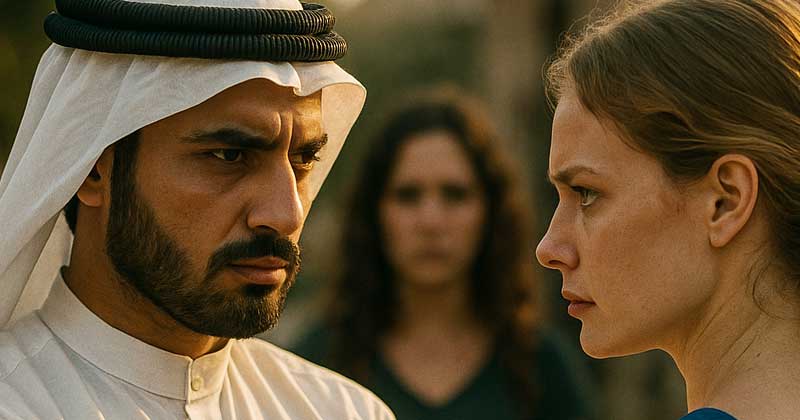
The wedding was lavish, adorned with gold, diamonds, and music brought from afar. Everyone around applauded the sheikh, but in the girl’s gaze, there was a cold calm, like the storm about to break.
She did not cry, did not smile, but stared straight ahead, as if a plan was being woven behind her eyes. Deep in her heart, she did not feel defeated, but more determined than ever.
In the first months, the sheikh tried to subdue her with the same crude methods. He dictated every step, forbade her from writing letters, and speaking to anyone. But the girl quickly learned to play a role. She listened to him, but silently gathered strength.
One evening, while the sheikh flaunted his wealth in front of distinguished guests, she heard an old song brought by a Romanian minstrel invited to entertain. The lyrics spoke of freedom, of longing for home and kin. Her heart stirred. Then she remembered her mother’s stories about the heroes of the village, about the outlaws who never let themselves be defeated.
That night, she cried for the first time, but not out of weakness, rather out of anger and the desire to take her life back.
Over time, she began to gain the trust of the other women in the harem. She spoke to them in whispers, reminding them that they were daughters, mothers, and sisters before being the “possessions” of a tyrant. Slowly, she ignited a spark in their souls that seemed extinguished.
One morning, she drew a Romanian symbol on her hand with henna that she had once seen on her grandmother’s traditional blouse: a small sun surrounded by rays. When the other women asked what it meant, she told them, “It is the sign of life. As long as we wear it, we are alive and free in spirit.”
The sheikh saw the drawing and laughed scornfully. He did not know that behind that small symbol, a rebellion was being born.
Her plan began with small steps. She taught the servants how to use the secret doors of the palace, forged friendships with the guards through small acts of kindness, and gathered information about every corner of the residence.
But the decisive moment came one festive evening. The sheikh organized a grand feast, and wine flowed in waves. At that moment, the student raised her gaze to the women around her and, with a barely visible gesture, signaled them.
In the midst of the crowd, one of them began to sing an old tune learned from the student. Her voice trembled, but soon others joined in. A whole hall of women began to sing about longing, about suffering, and about freedom.
The guests fell silent, and the sheikh erupted in fury. But something had changed: the women no longer had fear in their eyes. For the first time, they looked at him as a mere man, not as a master.
That night, the sheikh tried to silence them again. But they were many, and he was alone. The guards, tired of years of tyranny, no longer defended him.
The student stepped forward and said firmly, “You are no longer our master. Nor anyone else’s.”
It was the last time the palace echoed with his shouts.
The next morning, the harem no longer existed. The women took their paths, some to their families, others to a new life.
And the student? She returned home to a small Romanian village, where she embraced her mother and watched the sunrise with eyes full of light. She knew that her story was not just hers, but that of all the women who had found their courage.
And from that day on, in her village, people began to say that freedom is not bought with gold, but conquered with heart and dignity.
This work is inspired by real events and people, but has been fictionalized for creative purposes. Names, characters, and details have been changed to protect privacy and enhance the narrative. Any resemblance to real persons, living or dead, or to real events is purely coincidental and not intended by the author.
The author and publisher do not assume responsibility for the accuracy of the events or for how the characters are portrayed and are not liable for any misinterpretations. This story is provided “as is,” and any opinions expressed belong to the characters and do not reflect the views of the author or publisher.


