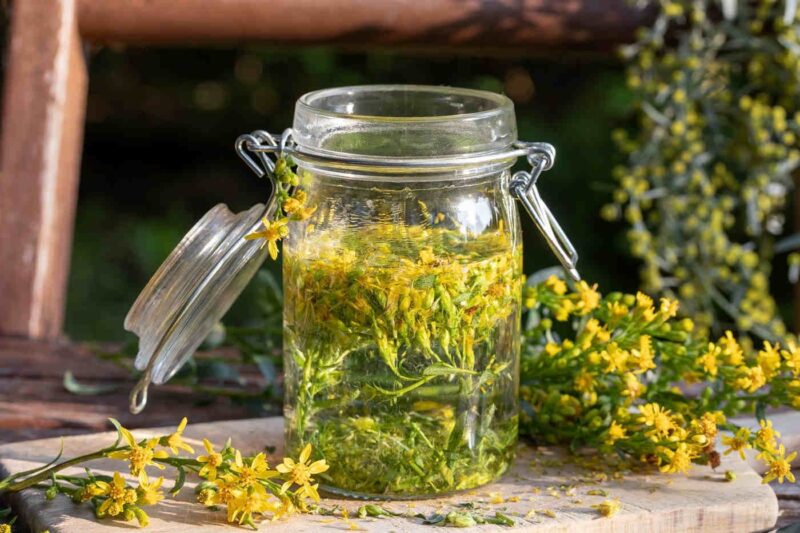
Goldenrod is a wild yellow flower, but it is also a popular ingredient in herbal supplements and teas.
Its Latin name is Solidago, which means to make whole or to heal, reflecting its use in traditional herbal medicine.
Goldenrod, a fall flower, is most commonly used as a supplement to improve urinary health and reduce inflammation.
What is Goldenrod
Goldenrod grows in Europe, Asia, and North and South America. It thrives in the wild along roadsides and in fields, often considered a weed. Its yellow flowers bloom at the end of summer and the beginning of autumn. It is easily cross-pollinated with other plants, leading to the existence of over 100 different species of goldenrod. Many of these are believed to have similar beneficial properties.
Solidago virgaurea, sometimes called European goldenrod, is probably the most studied species regarding its health benefits. It is used in both traditional Chinese medicine and in herbal medicine in some European countries. To benefit from its properties, people consume the above-ground parts of the plant, especially the flowers and leaves. Goldenrod can also be purchased in the form of tea or dietary supplements. The tea may have a slightly bitter taste, and some prefer to sweeten it slightly.
Health Benefits of Goldenrod
Rich Source of Plant Compounds Goldenrod provides numerous beneficial plant compounds, including saponins and antioxidant flavonoids such as quercetin and kaempferol.
Saponins are plant compounds linked to various health benefits. They can be particularly effective in inhibiting the growth of harmful bacteria and fungi, such as Candida albicans.
Candida albicans is a fungus that can cause yeast infections, as well as infections in other parts of the body. Saponins have also been shown to have anticancer and anti-inflammatory effects in studies on test tubes and animals.
The antioxidant flavonoids quercetin and kaempferol in goldenrod help protect your cells from damage caused by unstable molecules called free radicals, as noted by Healthline.
Damage caused by free radicals is a factor in many chronic conditions, including heart disease and cancer. Remarkably, the antioxidant activity of goldenrod is greater than that of green tea and vitamin C. The antioxidant flavonoids and other plant compounds in goldenrod also have anti-inflammatory benefits.
It may reduce inflammation. In traditional medicine, goldenrod has been used to combat inflammation, which contributes to pain and swelling. In studies on rodents, a combination of goldenrod extract with extracts from trembling aspen and ash in a supplement reduced swelling of injured tissues by up to 60%. It also reduced inflammation associated with arthritis by 12-45% in rodents, with greater effects at higher doses.
Goldenrod from this supplement has also been tested on humans. In an analysis of 11 studies on humans, treatment with this supplement was as effective as aspirin for reducing back pain and knee arthritis.
This is partly due to quercetin, an antioxidant flavonoid in goldenrod, which has strong anti-inflammatory effects.
However, trembling aspen bark contains salicin, the active ingredient in aspirin, which also contributed to the anti-inflammatory benefits of the tested herbal mixture.
Test tube research suggests that the most significant pain relief effect is due to the combination of ingredients rather than a single ingredient. Thus, it is unclear how significant the effect of goldenrod is on its own.
Human studies focusing solely on goldenrod are needed to clarify its role in treating inflammation and pain.
The European Medicines Agency (EMA) recognizes goldenrod as potentially useful for improving the effectiveness of standard medical treatments for minor urinary issues.
This means that goldenrod may support or enhance the effectiveness of medications, such as antibiotics for urinary tract infections, but the plant should not be used alone as a treatment for such conditions.
Test tube studies suggest that goldenrod may help prevent these infections. However, it may be more effective when combined with other plants.
For this reason, you may encounter herbal supplements for urinary health that contain goldenrod and other plants.
Additionally, test tube studies indicate that goldenrod extract may help with overactive bladder or the frequent urge to urinate. It may also reduce painful spasms of the urinary tract.
Finally, the EMA notes that goldenrod increases urine flow. Its diuretic effect may help eliminate potentially harmful bacteria and support kidney health. Therefore, it is generally recommended to drink plenty of water when taking goldenrod.
Some studies have tested goldenrod for other purposes, but much more research is needed to confirm its effectiveness in these areas.
Preliminary studies have examined goldenrod for:
Weight Control Test tube and some animal studies suggest that goldenrod may combat obesity by regulating genes that control fat synthesis and the size of fat cells. For this reason, the plant is used in some teas for weight loss.
Cancer Prevention According to test tube studies, goldenrod extract may kill cancer cells. Additionally, a study on rodents reported that injections of goldenrod extract suppressed the growth of prostate cancer tumors.
Heart Health Rodents that were given oral goldenrod extract daily for 5 weeks before being induced with heart injury had 34% lower levels of a blood marker for heart injury compared to the control group, according to one study.
Anti-Aging A test tube study found that goldenrod extract delayed the accumulation of old, poorly functioning skin cells. This could have the potential to delay premature skin aging.
Due to the lack of human studies in these areas, it is unclear whether goldenrod would have the same effects in humans.
How to Consume Goldenrod
You can buy goldenrod in the form of herbal teas, liquid extracts, and pills. Liquid extracts are sold in dropper bottles for easy dosing. Capsules and tablets containing dried goldenrod extracts are more commonly found in mixtures with other plants, such as juniper berries.
Planting and Care
There are over 100 species of goldenrod, most of which are native to North America. While many grow in sunny pastures and fields, others prefer semi-shaded areas in forests, moist meadows, and even coastal salt marshes. Due to the variety of habitats in which they are found, consider the native habitat of goldenrod when choosing a variety for your garden.
Where to Plant
Goldenrods grow either from crowns that form clumps or through rhizomes. Clumping types are better suited for well-maintained garden beds and borders, as they will not spread aggressively. Plant rhizomatous types in areas where you can control their spread or in a naturalistic garden setting where they will not be invasive.
Light Requirements
Most prefer full sun, except for forest species, which grow well in partial shade.
Soil Requirements
Goldenrods will thrive in almost any ordinary garden soil with decent drainage. Some species adapt well to clay, sandy, or rocky soils. Avoid planting in overly rich soils, as this can lead to tall and spindly growth.
How to Plant
Like many wildflowers, goldenrod is extremely easy to grow from seeds, which can be sown directly in the garden in the fall or spring or started indoors 6 to 8 weeks before the last frost date. If you plant the seeds in late fall or winter, they will begin to germinate when temperatures warm in the following spring.
Maintenance and Care
Like many wildflowers, goldenrods are extremely easy to care for, tolerating drought and resisting diseases. However, if you cultivate them in a perennial garden, there are a few simple tips you can follow to keep them looking healthy and control their spread.
There is no need to fertilize goldenrods, as they do well without added nutrients. By planting goldenrod, you will obtain beautiful yellow flowers that you can use for teas that will help with various ailments and contribute to your overall health. Additionally, they look great in the garden, providing a splash of color.




