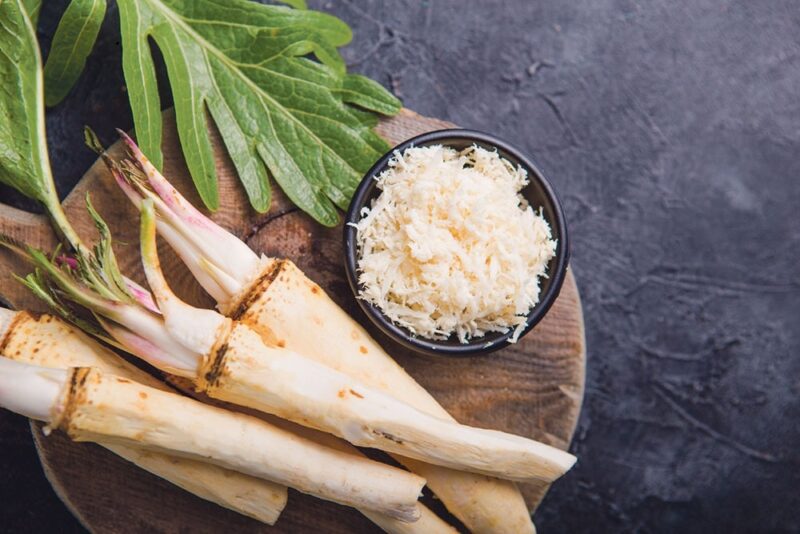
In folk medicine, grated horseradish has long been considered a living fire that, when applied carefully, drives away deep pains from joints and back. Used in the form of a compress, horseradish becomes a remarkable ally in cases of rheumatism, sciatica, neuralgia, or persistent colds.
Benefits
1. Stimulates local circulation and reduces joint pain
Horseradish contains sinigrin, a sulfur compound that, once released through grating, produces isothiocyanates—substances with rubefacient effects, meaning they produce intense local warming. This process dilates capillaries and increases blood flow to the affected area, facilitating the elimination of toxins and reducing inflammation.
A study published in Journal of Medicinal Plants Research (2019) demonstrated that topical application of horseradish extract reduces joint inflammation induced in animal models, with effects comparable to those of classic anti-inflammatories.
2. Relieves muscle pain and neuralgia
The horseradish compress has analgesic effects by stimulating heat receptors (TRPV1), which send pain-inhibiting signals to the brain. This action is particularly effective in cases of post-effort muscle pain, lumbago, or intercostal neuralgia.
3. Combats colds and pulmonary congestion
Through its mildly irritating and warming effect, a horseradish compress applied to the chest or back can help decongest the respiratory pathways. Volatile substances (such as isothiocyanates) stimulate mucus secretion and ease its elimination.
An article in Evidence-Based Complementary and Alternative Medicine (2020) highlighted the expectorant and antibacterial effects of horseradish, emphasizing its potential in treating respiratory symptoms.
Recipe and Application Method
Ingredients:
- 1 fresh horseradish root (about 10-15 cm long)
- 1 piece of gauze or a cotton cloth
- A greasy cream (optional, for sensitive skin)
Instructions:
- Grate the horseradish root finely.
- Spread the grated horseradish in a thin layer on the gauze and fold it, forming a compress.
- Apply the compress to the affected area (back, knees, shoulders, etc.), but not directly on the skin—place a thin piece of gauze between the compress and the skin to prevent irritation.
- Action time: 3-10 minutes, depending on skin sensitivity. At the first sign of burning or strong stinging, remove immediately.
- After removal, rinse the area with warm water and apply a soothing cream.
It can be applied 2-3 times a week.
Contraindications and Precautions
- Do not apply to broken, irritated skin or in cases of dermatitis.
- Avoid contact with eyes or mucous membranes—isothiocyanates can cause severe irritation.
- People with sensitive skin may want to test it first on a small area.
- Pregnant women and children under 12 should not use the compress without medical advice.
- Do not apply in the area of the heart.
What Do Studies Say?
- Comparative anti-inflammatory effects of horseradish extract J. Med. Plant Res. (2019): The study demonstrated a significant reduction in joint edema after the application of horseradish extract on laboratory animals.
- Antimicrobial and expectorant properties of horseradish root Evid-Based Complement Alternat Med. (2020): Demonstrates the antibacterial effect of volatile compounds and the ability to stimulate the elimination of respiratory secretions.
- Sinigrin and allyl isothiocyanate: pungency and inflammation modulation Phytochemistry Reviews (2022): Shows that isothiocyanates, derived from sinigrin, regulate the inflammatory response through complex molecular mechanisms.




