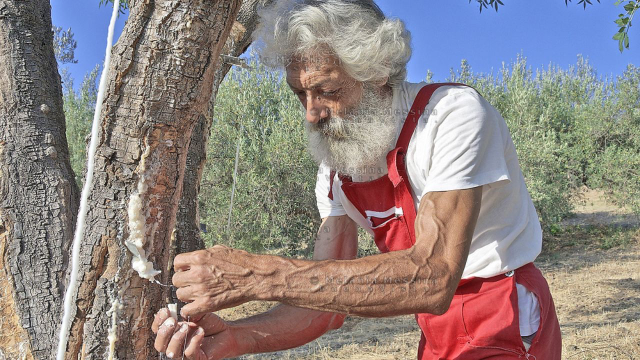
Heavenly manna, a forgotten biblical food for centuries, has been brought back to life by a Sicilian farmer. On the island of Sicily, Italy, a farmer cultivates ash trees to collect the sap from which heavenly manna is obtained, a very popular ingredient in the Bible, produced in the Mediterranean region. Thus, he has succeeded in reviving a tradition that was set aside due to industrialization and modernization.
Manna is, in fact, a resin that forms on the bark of trees, rich in minerals and used for centuries as a natural sweetener or as a medicinal remedy for various ailments. Until the last century, the harvesting of manna was an authentic tradition in the Mediterranean area, but urbanization and industrialization have diminished its popularity. A Sicilian farmer, Giulio Gelardi, decided not to let it be completely forgotten. He began to revitalize the declining tradition in 1985 when he returned to his hometown of Pollina after a 15-year absence.
Heavenly Manna: A Biblical Food Revived by a Sicilian Farmer
In a world where old traditions face the challenges of modernization, a farmer from Sicily has managed to bring back to life a biblical superfood known as heavenly manna. This white resin, mentioned 17 times in the holy book, was once a precious ingredient, but urbanization and industrialization have led to its near-complete disappearance.
A farmer from the Mediterranean region has succeeded in bringing to the forefront an ingredient with biblical roots. In the Madonie mountains of Sicily, Giulio Gelardi’s wealth lies in an ash tree plantation, according to reports. Thanks to this, the famous biblical food known as manna or the white gold of Sicily is produced.
The harvesting of manna requires a special skill based on observation and intuition, according to Gelardi. The ash trees produce sap throughout the year, but only on the hottest days can enough manna be collected to be gathered.
Knowing when the right moment has arrived is a unique skill based on observation and intuition. You have to listen to each plant. Harvesting manna is not something you can learn from a book. If we do not pass on this knowledge, we will lose an agricultural tradition that is centuries old, explained Giulio Gelardi.
The farmer has started sharing brochures about manna with tourists and has organized practical demonstrations of its harvesting. Manna, a natural sweetener, contains mannitol and essential minerals such as potassium, magnesium, and calcium. Professor Vivienne Spadaro from the University of Palermo states that manna can be used as a dietary supplement and in various pharmaceutical preparations.
Manna has been used for constipation, cough, throat pain, and skin wounds due to its soothing and decongestant properties, the professor stated.
The sap of the ash trees is recognized for its numerous beneficial properties, having applications in traditional medicine and phytotherapy. It acts as a detoxifier, facilitating the elimination of toxins from the body. Additionally, it stimulates diuresis and renal function, also contributing to the regulation of intestinal transit. Furthermore, the sap of the ash trees has tonic and relaxing effects, being useful in combating fatigue and supporting the immune system. Last but not least, this sap has diuretic properties, helping to eliminate excess water from the body.




