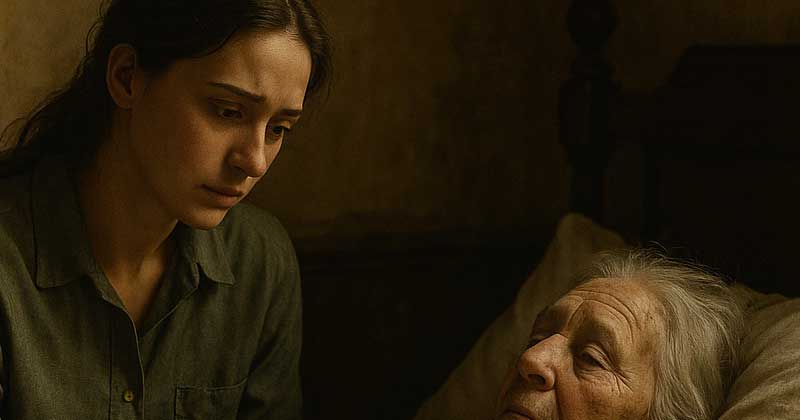
The woman felt her heart stop for a moment. She leaned closer to hear better.
The mother-in-law pressed her dry lips together, trying to gather the strength to speak. Tears had gathered in the corners of her eyes, and her frail hand clung desperately to her daughter-in-law’s.
— What do you mean, mother? the woman asked, her voice trembling.
The old woman took a deep breath and spoke with difficulty:
— Your husband… did not abandon you. He sent money, letters, but… I never gave them to you.
The woman froze. She felt everything she knew until then shake to its core.
— Why? she managed to whisper.
The mother-in-law burst into tears.
— I was afraid… that you would leave after him and leave me alone. You were all I had. You were the daughter I never had. I was selfish; I wanted to keep you here, by my side.
Silence fell over the room, heavy as a boulder. The woman felt an entire universe of sacrifices and patience collapsing. But at the same time, she felt a deep pain for the old woman who, despite her mistake, had loved her as her own blood.
She caressed her forehead and said gently:
— Mother, I didn’t stay here out of obligation. I stayed because I loved you and because you loved me in return. Don’t blame yourself.
The old woman smiled weakly, then laid her head on the pillow and fell peacefully asleep forever.
The woman remained alone in the small room, listening to the hurried beats of her heart and the sound of crickets outside. She felt that time had been stolen from her, but at the same time, she knew that her life had not been in vain.
The next day, the villagers came to help her with the preparations for the funeral. In the village, at such times, everyone pitched in: the women brought sweet bread, the men set up the tent, and the children ran around the yard bringing water from the well.
At the service, the priest said:
— Not everyone inherits wealth. Sometimes, the greatest inheritance is the love and kindness you leave behind.
People nodded, looking at the woman who was wiping her tears with the corner of her black scarf.
After the funeral, someone handed her an envelope. It contained her husband’s letters, yellowed with age, which the mother-in-law had hidden in a drawer.
With trembling hands, the woman opened them and read. They were filled with longing, promises, and unfulfilled dreams. Her husband had died in an accident years ago, but the last letter spoke of his desire to return home and start anew.
The woman felt a wave of peace wash over her. She closed her eyes and thought:
“You both left… but you remain within me.”
From that day on, she began to go to church more often, lighting candles not only for her lost loved ones but also for all those who sacrifice their youth for others.
And every time people told her that she had wasted her life, she smiled and simply replied:
— A life lived for love is never wasted.
This story remained in the village as a lesson about patience, about giving, and about how sometimes a person’s true destiny is not to receive, but to give.
And the woman, though tired and with white hair, walked through the village with her head held high, as a living symbol of the power to love until the end.
This work is inspired by real events and people, but has been fictionalized for creative purposes. Names, characters, and details have been changed to protect privacy and enhance the narrative. Any resemblance to real persons, living or dead, or to real events is purely coincidental and not intended by the author.
The author and publisher do not assume responsibility for the accuracy of events or for how characters are portrayed and are not liable for any misinterpretations. This story is provided “as is,” and any opinions expressed belong to the characters and do not reflect the views of the author or publisher.


