Green leaves and shells of the walnut tree (Juglans regia) are exceptional natural remedies for hair care, used for centuries in folk medicine. They not only provide a natural coloring but also actively contribute to strengthening hair strands, combating dandruff, and regulating sebum secretion. With scientifically documented effects supported by European phytotherapy traditions, walnut leaves and shells deserve a prominent place in hair care routines.
Composition of Walnut Leaves and Shells
Walnut leaves and shells contain:
- Juglone – a natural pigment with coloring and antimicrobial effects;
- Tannins – with astringent and anti-inflammatory action;
- Phenolic acids – powerful antioxidants;
- Flavonoids – protect the scalp;
- Volatile oils and vitamin C – stimulate circulation in the scalp.
Benefits of Walnut Leaves and Shells for Hair
1. Natural Hair Coloring in Chestnut Shades
The juglone pigment, present in large quantities in the green shell, easily adheres to the hair strand, providing a natural, dark shade. Unlike synthetic dyes, it does not affect the structure of the hair.
- The obtained shade varies from light chestnut to dark chestnut, depending on the application duration and hair color.
- It is ideal for those who want to cover gray hairs naturally.
- The effect is subtle but intensifies with repeated applications.
- Juglone reacts with keratin in the hair, coloring the strand without degrading it.
- When applied regularly, this method provides a pleasant uniformity of the natural color.
2. Strengthening and Regenerating Fragile Hair
The antioxidant components and tannins in the leaves support the regeneration of thin, fragile, or damaged hair.
- They act directly on hair follicles, stimulating the production of new strands.
- They reduce the risk of hair breakage due to their strengthening effect.
- They improve hair elasticity and make it more resistant to external factors (drying, dyeing, pollution).
- Tannins tighten the hair cuticle, giving it a smooth appearance.
- The treatment with leaf infusion can be used twice a week for visible results.
3. Regulating Sebum and Combating Dandruff
Due to the astringent effect of tannins, walnut leaves are beneficial in seborrheic dermatitis and oily scalp.
- They reduce scalp inflammation and the sensation of itching.
- They have an antifungal effect against Malassezia furfur, the fungus responsible for dandruff.
- They help normalize sebum secretion.
- Used as a final rinse after washing, walnut leaves keep the scalp clean and free of flakes.
- The antibacterial effect is also supported by juglone, which inhibits the development of pathogenic microbes.
Scientific Studies
1. Study Published in Pharmaceutical Biology, 2021
A study on the phytochemical properties of Juglans regia demonstrated the antimicrobial and antifungal action of green leaves and shells against Candida albicans and Staphylococcus aureus, two microorganisms involved in scalp conditions.
- The authors highlighted the presence of juglone and tannins as the main active agents.
- The antifungal effect was comparable to that of ketoconazole at a 2% concentration.
- A slight healing action on irritated skin was also noted.
- Topical application of the extract significantly reduced itching and flaking in clinical tests.
- Researchers support the use of walnut extracts in natural scalp products.
2. Journal Molecules, 2019 – Phytochemical and Cosmetic Analysis
The research showed that juglone, a compound with a quinone structure, binds to hair proteins, coloring them in a wash-resistant manner.
- The study compared the efficacy of juglone with henna and concluded that it is more stable over time.
- No toxic reactions were observed in biocompatibility tests.
- Walnut leaves had a high polyphenol index, being useful in antioxidant treatments for the scalp.
- Extracts proved effective in preventing oxidative stress on hair strands.
- The authors recommend using leaves in natural treatments for sensitive scalps.
Simple Recipes for Home
1. Decoction for Hair Coloring
Ingredients:
- 10 tablespoons of dried walnut leaves
- 5 tablespoons of green walnut shells (dried or fresh)
- 1 liter of water
Preparation:
- Boil the leaves and shells for 15 minutes.
- Let it infuse for 30 minutes, then strain.
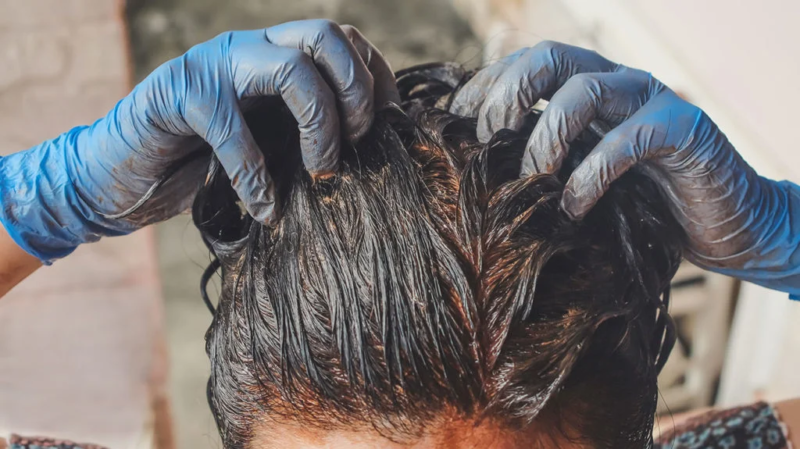
- Apply to clean, dry hair using a brush.
- Let it act for 30-60 minutes, then rinse with cold water.
- Repeat 2-3 times a week to intensify the color.
2. Fortifying and Anti-Dandruff Rinse
Ingredients:
- 2 tablespoons of walnut leaves
- 250 ml of water
Preparation:
- Boil for 5 minutes, let it infuse for 15 minutes.
- Use as a final rinse after washing the hair.
- No need to rinse afterward.
Contraindications and Precautions
- Not recommended for individuals allergic to walnuts or walnut pollen.
- Avoid contact with eyes as juglone may irritate.
- May stain nails, skin, and clothes – wear gloves.
- Pregnant or breastfeeding women should avoid use without medical advice.
- Not recommended for daily use – maximum 2-3 times a week.