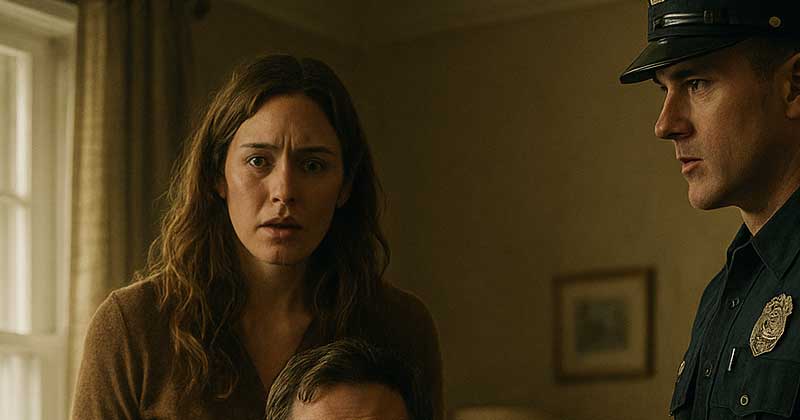
From behind the tattered fabric, a sharp, indescribable smell emerged. I felt my blood freeze in my veins. The police mustered their courage and shone their flashlights inside the couch. Their expressions said it all: something was not right.
I took a step back, holding my husband’s hand. Max barked desperately, as if trying to protect us from what we were about to see. One of the officers pulled at the fabric and revealed a small hidden compartment, improvised inside the couch.
Inside, there was an old, rag doll with black, hollow eyes that seemed to stare directly into the soul. It was not just a simple toy — it was wrapped in thin cloth, with strange knots, like ties made with intention. Next to it were a few small, dry bones that looked like they belonged to an animal, and pieces of burnt paper with hand-drawn symbols.
The officers exchanged worried glances, and one whispered, “This looks ritualistic…”
I felt goosebumps on my skin. My grandmother’s stories about her village in Moldova came to mind, where it was said that some old women knew “ancient crafts” that people feared. There were tales of hidden ties in homes, of dolls buried in foundations, meant to bring harm. I always laughed at those stories, but now… I was face to face with proof that perhaps they were not just superstitions.
One officer carefully removed the objects, and Max suddenly calmed down, as if sensing that the danger had been taken out of the house. But something heavy remained in the air, a kind of cold energy that was hard to explain.
I asked, trembling, “How is it possible for something like this to be in our couch? We bought it from a fair; it was old, but it seemed normal…”
One of the officers nodded, “It’s possible that someone used the furniture to hide these things. It may not have had a direct connection to you.”
And yet, deep down in my soul, I knew that the presence of those objects was not coincidental. In Romania, people still place basil at icons, holy water in corners, and willow branches in their homes on Palm Sunday for protection. However, I hadn’t done such a gesture in years. Perhaps that couch carried something else, a dark past brought directly into our home.
After the police took the objects for investigation, the house felt empty, as if it had lost something. That night, I lit a candle in front of the icon in the corner, said a short prayer, and Max lay down peacefully next to us for the first time in many nights.
In the morning, the sun entered the living room, and for a moment, I felt that the evil had been banished. But a dull fear remained within me.
I decided to take the couch outside, so that no corner of the house would be touched by it. Neighbors, seeing us, began to curiously ask why we were removing the furniture. I simply said, “It was broken.” I couldn’t speak the truth.
That evening, my husband and I went to church. The priest, an old and gentle man, listened to us and blessed our home with holy water. He told us not to be afraid, but to never forget that “what is done with evil returns to evil.”
His words remained etched in my soul.
Since then, every year on Epiphany, I call the priest to bless the house. I keep basil at the icon and no longer laugh at my grandmother’s stories.
Because on an apparently ordinary evening, in our couch, I discovered that sometimes, the most terrible nightmares do not hide in the dark… but right beneath us.
This work is inspired by real events and people, but has been fictionalized for creative purposes. Names, characters, and details have been changed to protect privacy and enhance the narrative. Any resemblance to real persons, living or dead, or actual events is purely coincidental and not intended by the author.
The author and publisher do not assume responsibility for the accuracy of events or for how characters are portrayed and are not liable for any misinterpretations. This story is provided “as is,” and any opinions expressed belong to the characters and do not reflect the views of the author or publisher.


