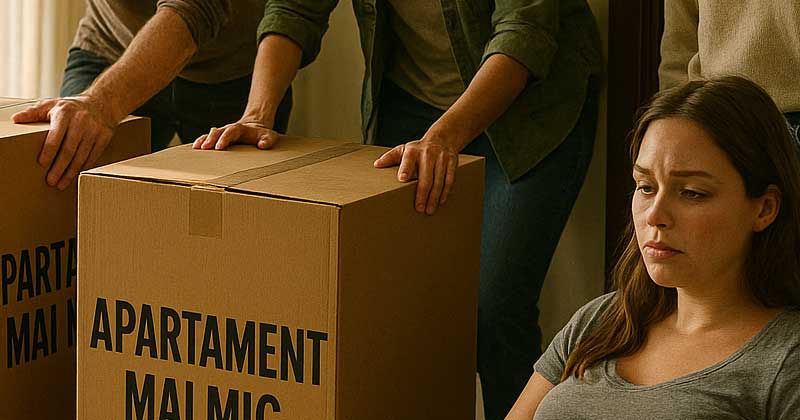
A heavy silence fell in the room. My mother turned to me with a guilty expression but said calmly:
— Camelia, we are just trying to help you do what is right.
My father, arms crossed, added:
— This house is too big for you. Ion needs it, Sorina needs it, the child coming into the world needs it.
I felt my blood boiling. I approached them and snatched the suitcase from my mother’s hand.
— Enough! This house is mine. I have worked for years, I have given up vacations, parties, and sleepless nights to get here. You have no right to take away what I have built with my own hands.
They fell silent, but their looks said it all: for them, “family” was more important than justice.
I picked up the phone and called the police again. When the officers arrived, my parents tried to explain that it was just a “family misunderstanding.” But when I showed them the house documents and the original keys, everything became clear. The police told them to leave the premises immediately and not to attempt such things again.
After they left, I was alone, with the unpacked suitcases in the middle of the living room. I started to cry. Not for the house, not for the money, but for the betrayal I felt in my heart. How could my parents do this to me?
That weekend was the hardest of my life. I didn’t go to Sunday dinner, and for the first time, the silence of the house felt like a refuge, not a burden. I sat in the garden, looking at the roses I had planted with my own hands, and thought about my grandparents.
My grandparents lived in a small house, but they had taught us something all their lives: “Every person earns their piece of bread and their piece of land. If you respect them, you will be fine.” Their words echoed in my mind, and I wondered where that wisdom had gone.
Instead of being respected for my work, I was seen as a resource to be sacrificed. In our Romanian culture, often, a single woman is judged. “Why don’t you have a family? Why don’t you have children?” But rarely does anyone ask: “Are you happy?”
In the following days, relatives began to send me messages. Some scolded me, others begged me to “be understanding.” Sorina even wrote to me: “Don’t you see that we need it more than you?” I read the message and deleted her number from my phone.
The moment of the final decision came. I went to the notary and changed the locks of the house. I revoked my parents’ right to have keys. It was painful, but necessary.
The following Sunday, I received a call from Uncle Gheorghe, the person I respected the most in the family. He said to me:
— Camelia, don’t waver. You did well. Your grandparents would have been proud.
I closed my eyes and felt a relief I hadn’t felt in a long time. For the first time in my life, someone from the family acknowledged the truth.
My life moved on. I filled my house with friends, with laughter, with the smell of sarmale and cozonaci during the holidays. I didn’t need a “traditional” family to feel like I belonged somewhere.
And then I understood something: family is not defined by blood, but by respect, love, and gratitude.
Today, when I look at my house, I no longer see it as a large building with four rooms. I see it as a symbol of my freedom, of my courage to say “no” when everyone was asking me to give in.
And if someone asks me why I am single, I smile and simply reply:
— Because that is how I am happy. And that is all that matters.
This work is inspired by real events and people, but has been fictionalized for creative purposes. Names, characters, and details have been changed to protect privacy and enhance the narrative. Any resemblance to real persons, living or dead, or actual events is purely coincidental and not intended by the author.
The author and publisher do not assume responsibility for the accuracy of events or for how characters are portrayed and are not liable for any misinterpretations. This story is provided “as is,” and any opinions expressed belong to the characters and do not reflect the views of the author or publisher.


