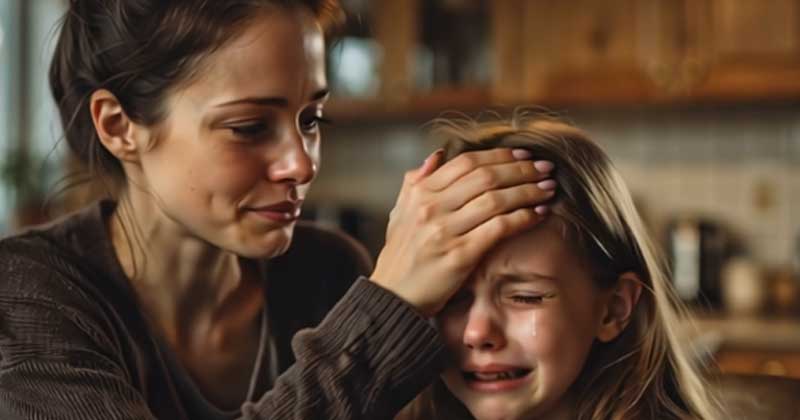
I closed my eyes and felt how the stillness of the night mixed with a heavy unease. Outside, the crickets sang monotonously, but within me, a determination had grown. I had been raised in a Romanian family where children did not ask for permission to eat, where meals were shared at the table, with the smell of hot soup and pickles on the table. I knew that discipline had its purpose, but what I saw in Sofia’s eyes was not discipline. It was fear.
The next day, I decided to start differently. I woke her up with the smell of toasted bread and butter. She looked at me as if the gesture was an unexpected gift. “Can I eat now?” she asked again. I felt a lump in my throat.
“You are allowed to be a child, Sofia. Here, with me, there are no restrictions on being happy.”
Slowly, she began to gain courage. She timidly took a bite of the bread, and when she saw that nothing bad happened, a smile lit up her face. It was the first time in a long while that I saw true childhood in her.
I took her to the garden, where Grandma used to plant tomatoes and basil. “Do you want to water the flowers?” I asked, handing her a small watering can. She looked at it as if it were a forbidden object, but then she gathered courage and poured water over the colorful flowers. In a few minutes, she was laughing, with droplets on her cheeks and wet clothes.
I felt tears in my eyes. It was a laughter that should not be missing from any child.
In the following evenings, I brought into the house the customs of my childhood. I told her stories of Făt-Frumos and Ileana Cosânzeana, I baked apple and cinnamon pies, and when I took the first pie out of the oven, her eyes widened in amazement. “Can I taste it?” she asked again.
I broke off a piece and gave it to her. When she bit into it, she closed her eyes as if the taste was a discovery. “It’s the best in the world,” she said with her mouth full.
With each passing day, Sofia was becoming a child again. Instead of fearful whispers, giggles appeared, and instead of cold, attentive eyes, playful glances emerged.
But within me, anger was growing. I remembered how our mother, a simple woman from the countryside, always said: “A child is not an army. It is a flower. And if you don’t let it breathe, it wilts.”
Emily and Brian viewed their child as a perfect soldier. And I was not going to let that go unpunished.
On the fourth day, I called a lawyer. I described everything: Sofia’s fear, her words, the way she asked for permission to eat, to go to the bathroom, to play. The lawyer was silent for a while, then said: “Ma’am, this child needs protection. What you have described is not education; it is abuse.”
I felt goosebumps. It was the confirmation I needed.
On the seventh day, when Emily and Brian came for Sofia, I greeted them at the door. Emily forced a smile: “So, how did our little lady behave?”
I looked at her coldly. “She behaved like a child, Emily. Something you are not capable of allowing.”
Brian raised his eyebrows, ready to say something, but Sofia appeared from behind me. She was wearing a flower crown on her head that we had made together. For the first time in a long while, she was smiling.
“I’m not going with you anymore,” she said clearly, firmly.
Emily was frozen. “What do you mean?”
“I’m not going,” Sofia repeated, holding my hand tightly.
Then, the lawyer who was waiting for me in the car entered through the gate. I saw the color drain from Brian’s face. “Sir and madam, I am here as the legal representative of Mrs. Miller. From today, the child remains under state protection until the investigation is completed.”
A strong wind stirred in the yard, and the leaves began to dance. It was as if nature was showing its support.
Emily tried to protest, but her voice trembled. Brian angrily retreated to the car.
I lifted Sofia into my arms. “From now on, you are safe,” I whispered to her.
And for the first time, I felt that not only I, but the entire Romanian world I had inherited – with stories, customs, and love for children – was rising alongside me.
The trial was truly beginning now. And this time, justice would not lose.
This work is inspired by real events and people, but has been fictionalized for creative purposes. Names, characters, and details have been changed to protect privacy and enhance the narrative. Any resemblance to real persons, living or dead, or to real events is purely coincidental and not intended by the author.
The author and publisher do not assume responsibility for the accuracy of events or for the portrayal of characters and are not liable for any misinterpretations. This story is provided “as is,” and any opinions expressed belong to the characters and do not reflect the views of the author or publisher.


