With a calm, almost theatrical movement, Javier raised his glass and gently swirled it, as if analyzing the color of the champagne. In Liana’s eyes, the gesture seemed natural, but in his mind, a plan was already taking shape. He was not a man to leave his fate to chance.
He remembered his father, a peasant from a dusty village in Brazil, who had taught him as a child: “The man who looks too much at the foam of the wine forgets to see what lies at the bottom of the glass.” Back then, at ten years old, he hadn’t understood. Now, at fifty, every word echoed in his mind like a prophetic echo.
Javier placed the glass on the table and, with a broad smile, raised Liana’s glass. “A toast, my dear,” he said, his deep voice resonating. “To our future.”
Liana’s eyes sparkled with anticipation. She leaned in and clinked her glass. When Javier brought her glass to his lips and took a sip, blood froze in her veins. It was not part of the plan for him to drink from her cup. But she could not protest. All she could do was maintain her smile.
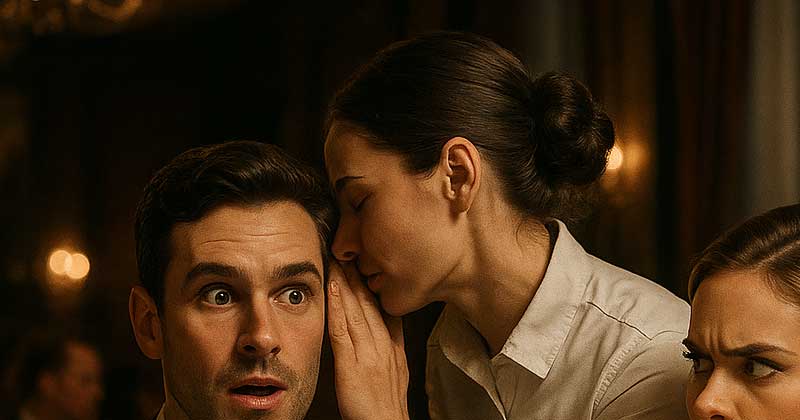
At that moment, Sofia, the waitress, hid behind a column, clutching her apron with sweaty hands. She didn’t know what was about to happen, but she was convinced she was changing a man’s destiny.
The dinner continued in a heavy silence. Liana spoke, but her words sounded hollow, and Javier listened without blinking, weighing each of her gestures. His mind, accustomed to billion-dollar negotiations, betrayals, and alliances, realized that the woman before him was nothing more than a prisoner of her own greed.
At the end of the meal, Javier discreetly called the restaurant manager, an old friend from his youth. He whispered something in his ear, and the manager nodded and left quickly.
Liana, filled with false enthusiasm, urged him to return home earlier. “We need to prepare for tomorrow,” she said, touching his hand with feigned tenderness. Javier smiled and nodded.
But when they stepped out of the restaurant, two plainclothes police officers were waiting for them. “Ms. Liana, please accompany us. You are accused of attempted murder.”
Everything happened in an instant. The smile faded from her lips, and her eyes filled with fear. She tried to protest, but the words stumbled over tears. Around them, people whispered, phones filmed, and the local press already had the evening’s topic.
Javier said nothing. He simply put his coat over his shoulders and looked at the sky. In his heart, there was no triumph, only a bitter calm. He realized that wealth, luxury, all of it meant nothing if beside him was just a beautiful face without a heart.
Later, in his office, with a bottle of Romanian wine opened—a gift from a business partner from Cluj—he sat down and wrote a few lines in a journal. “Money can buy many things, but it cannot buy loyalty. My life could have ended today, in a glass of champagne. And yet, a stranger, a simple waitress, chose to risk everything to save my life. I don’t know if I will ever be able to love again, but I know I will respect truth and courage when I encounter them.”
In an unexpected gesture, the next day, Javier sought out Sofia. He found her in a modest studio apartment, with walls adorned with old icons and rustic carpets, memories brought by her Romanian grandparents. She was left speechless when she saw him at the door.
“You saved my life,” he said simply. “And in my childhood village, it was said that whoever saves your life becomes family.”
Sofia looked down, embarrassed but also proud. She knew that a new path had opened, not just for him, but for her as well.
Thus, a story that could have been a tragedy transformed into a lesson: about greed and betrayal, but also about courage, honesty, and the unexpected strength of simple people.
And somewhere, in the morning light, the bells of an old church rang out like a blessing over the city, reminding everyone that a person’s true wealth is not measured in gold or palaces, but in the souls of those who choose to do good even when it is hard.


