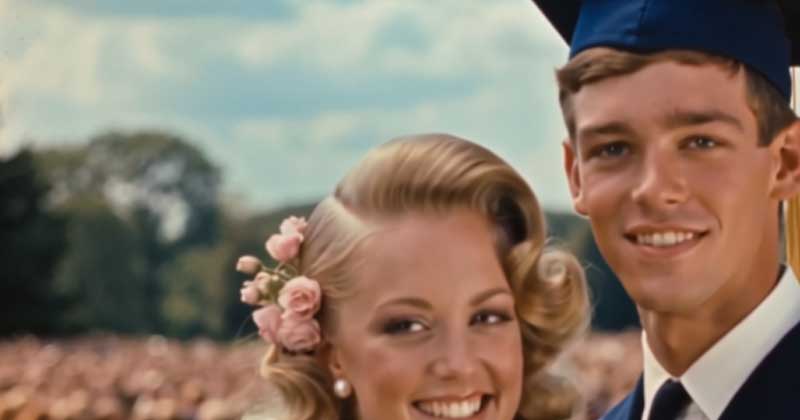
Their daughter, Lena, disappeared in 1990, on the day of her high school graduation.
It was a warm June evening. Her mother had prepared her favorite vanilla pie. Lena was twirling and laughing in front of the mirror, wearing a blue dress, and her father, Nicolae, watching her, suddenly thought: “This is it – true happiness…”
To illustrate
But no one could have guessed that it would be their last evening together.
After the graduation party, Lena did not return home.
Years passed. Olga, her mother, hardly ever left the house. Nicolae aged suddenly. Hope, like a flame in an old lamp, gradually extinguished.
And here it is – the year 2012.
On a rainy October day, Nicolae went up to the attic to tidy up. The air was thick with dust, boxes of books, old toys, and other forgotten things were scattered everywhere. And suddenly, he found a photo album. The very one with pictures from Lena’s childhood: school celebrations, summer trips, the first day of school…
In one of the photos, an adult Lena, about thirty years old, stood in front of a wooden house, with mountains in the background. On the back, it was written: “2002. I am alive. Forgive me.”
From that moment, a new stage of his life began — the search for answers.
Nicolae quietly handed the photograph to his wife, and Olga took it with trembling hands, looked at it carefully — and froze.
— It’s her… It’s Lena…
— She was alive… — he murmured. — After twelve years… and she didn’t look for us. Why?..
To illustrate
The next morning, Nicolae began to search. He found a hotel with that name online — in Kyrgyzstan, in a small mountain village. He didn’t hesitate: he packed his bags, withdrew money from his account, and left.
The hotel existed. An old establishment, a familiar facade.
— Excuse me — said Nicolae. — Do you know a woman named Lena? Lena Nicolaev? She might have lived here about ten years ago…
— Wait. Are you Nicolae? Her father?
— Yes…
The woman approached, opened a drawer, and took out an old envelope. It was labeled in large letters: “For dad. Only if he comes in person.”
Nicolae’s hands trembled as he tore open the envelope.
Father,
If you are reading this, it means I was wrong. I ran away back in 1990. Not from you, but out of fear. I fell in with the wrong crowd. And then it was too late to come back. I was ashamed.
I am alive. I have a son. His name is Artiom. He has never known you.
I wanted to write many times, but I didn’t have the courage.
If you came, look for me. I am not far away.
Forgive me.
L.
Nicolae reread the letter several times until tears began to drip onto the paper. He didn’t even realize how much his hands were shaking.
— She lives in the neighboring village — said the woman. — If you want, I can call her.
A woman appeared next to him — tall, with dark hair. Their eyes met.
Lena.
She stopped. And so did he.
— Father?
He couldn’t say anything. He just nodded. And in the next moment, he was already holding her tightly in his arms — just like that, many years ago.
— I’m sorry… — she whispered. — I will fix everything. I promise.
To illustrate
Several more years passed. Laughter returned to the house.
A boy named Artiom called Nicolae “grandpa,” and Olga, for the first time in twenty years, was planting flowers in front of the house again.
On the last page of the album was a photograph of the whole family: Lena, Artiom, Nicolae, and Olga.
And underneath it was written:
“Family means finding each other. Even after twenty-two years.”
Olga sat on the porch, peeling potatoes, with a knitted blanket on her lap. From the house, the voice of her grandson could be heard:
— Grandpa, is it true that you worked on a tractor?
— True!
— And not only did I work — I was the best driver in the area!
Artiom, a lively boy with sparkling eyes, loved his grandfather’s stories.
Lena came out onto the porch.
— It’s time for dinner! — she shouted. — Artiom, call grandpa!
— You know… I’m afraid every day that I will wake up and you will be gone again.
Lena looked down.
— I was afraid too. That you wouldn’t accept me. That you wouldn’t forgive me.
— Silly girl — said Nicolae gently. — How could I not forgive my own child?
One day, when Olga was taking down winter clothes from the attic, she found an old box. Inside was a worn leather journal — with Lena’s handwriting.
“I worked as a cleaning lady, then in the kitchen. I lived in a corner of a room with an old woman and a lot of cats. Sometimes it seemed to me that I had died long ago. I wanted to go back. But I didn’t have the strength…”
“When Artiom was born, I felt needed again. I swore: if fate gives me a chance, I will return. I will explain everything. Even after twenty years.”
Several months later, a man appeared at the door. Tall, with graying hair, with eyes full of the past. Nicolae opened the door and immediately understood: this was part of their family’s pain.
— Good day. My name is Stanislav. I… knew Lena. In 1990. I… apologize.
They sat on the bench. Lena came out later, saw the guest — and was surprised.
— I don’t ask for forgiveness. I just wanted you to know: I haven’t forgotten either.
Lena was silent for a long time. Then she said quietly:
— Now we can move on.
— I forgave you long ago — Lena said softly. — But not for you. For me. So I can move forward.
Stanislav left. And with him, it seemed, the last shadow of the past dissipated.
The New Year brought warmth, laughter, and that album again. Now it had new pages — Artiom himself pasted in photographs: school pictures, walks, fishing with grandpa.
On the last one, he wrote:
“Family are not those who always stay. But those who return.”
Seven years passed. Artiom turned fifteen.
He loved to photograph places where memories remained: abandoned houses, rusty swings, traces of fire. He called them “traces of life.”
— We have a real artist in the family — Nicolae proudly said. — Only instead of a brush, he has a camera.
Olga had become gentler with the years. Her smile was the same, but her gaze now had something profound, as if she had found inner peace.
Lena began teaching literature at the local school. The students respected her. Life finally had meaning, passion, and a place to stay for a long time.
But time passes. And with it, everything beautiful.
One spring day, Nicolae died.
On the nightstand was an old photograph: Lena in her graduation dress, she and Olga side by side – young, smiling.
Underneath it was written:
“You taught me to remember. Thank you, grandpa.”
Five more years passed.
Artiom entered the University of Bucharest, studying photography and journalism. He wrote home often. Each letter began the same way:
“Mom, hello. I miss you. I remember.”
To illustrate
The year 2025.
Artiom, now an adult, returns home.
He opens an old album. On the first page is Lena as a child. On the last – him, with his mother, under a blooming apple tree.
On the last page, he writes:
“The story doesn’t end as long as someone remembers it.
This is our story. The story of return.”
Artiom often returned to his childhood home. He didn’t move there permanently – he lived between city life, work, filming, and festivals. But every time he returned, he felt he was coming back to something important, to something that belonged to him.
Lena’s books, the albums, Nicolae’s thermos, Olga’s herbs – everything was preserved as it was. One day, rummaging through old things, he found an unsigned envelope. Just with a date: 1990.
Inside was a letter from Lena, written on the day of her disappearance.
“If you are reading this, it means I have left. Don’t look for me. I need another life. Forgive me if you can. I will return when I have earned your forgiveness.”
He took a picture of it, then carefully put it back.
In 2026, Artiom’s book was published. It was simply titled: “Photo Album”.
It contained photographs, letters, Lena’s monologues, notes from Olga’s journal, stories about Nicolae. Everything was real. The pain, the regrets, the love, the forgiveness. The family was not perfect, but it was alive.
The book unexpectedly found thousands of readers. Because it was real.
Lena was invited to the launches. She was afraid to speak in public, but one day she went on stage and said just one thing:
– Thank you for remembering us. Because when someone remembers, we live.
And then I understood:
No one truly disappears. They just become silence, wind, light among the leaves.
And if you truly remember, you are with them. Always.


