…an envelope, carefully placed next to an old key tied with a red ribbon.
On the envelope, it simply said: “From your mother.”
With trembling hands, Livia opened the paper. Inside, a few lines written in straight, firm letters:
“Livia, the money you wanted for your son is not here. It will never be yours. Instead, I leave you the key to something you have forgotten: our house in the countryside. Where we grew up, where you ran barefoot through the wet grass, where your grandfather mowed, and where you learned what respect and honest work mean. If you take your child there, perhaps he will learn his roots too.”
Under the letter was the deed, signed and stamped.
For the first time in years, Livia felt her knees weaken. It was no longer about money, but about an inheritance she had despised. She remembered how, in the summers of her childhood, she played in the shade of the walnut tree, how the mown grass smelled, and how neighbors gathered to help each other without expecting anything in return.
At that moment, Andrei entered the house. He realized that his mother was holding something precious in her hands and asked:
— What is this?
Livia looked at him with teary eyes. She wanted to tell him it was just a piece of paper, but her mother’s voice, which she had read in the letter, echoed in her mind. So she whispered:
— It is everything we have lost and everything we should learn to cherish.
Andrei laughed, like any careless teenager. But when he saw the tears in his mother’s eyes, he fell silent.
In the following days, the two went to the village. When they opened the rusty gate of the yard, the tranquility of the place enveloped them. The garden was overgrown with grass, but in its corner, the old walnut tree still stood. A rickety wooden bench, made by grandfather’s own hands, was also there, a silent witness of time.
Neighbors appeared immediately. An old woman brought them a plate of steaming sarmale, and an old man with hands cracked from work shook their hands and said:
— Welcome back home.
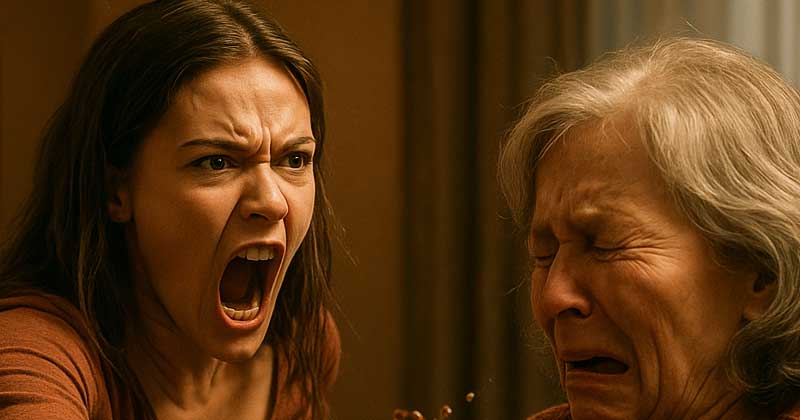
For Livia, the word “home” had not meant anything for a long time. At that moment, she realized how much she had wronged her mother. She remembered how the woman who had given her life had been treated as a burden when, in fact, she was the bridge to this treasure of values.
One evening, sitting on the porch, Livia opened the letter again. She understood that the gift was not the house, nor the land, nor the documents. The gift was the lesson: that dignity cannot be bought with a credit card, and true love is not demanded, but given.
Andrei, who until then had looked at the place with critical eyes, began to ask about the stories from the village. He wanted to know why people help each other with mowing, why they sing at the hora, why everyone gathers at church on Sundays.
And for the first time, mother and son shared something real. It was not the luxury of the city, nor the money in the account, but the simplicity of roots that had always been there, waiting for them.
A few months later, the house in the countryside came to life. Livia was repairing it with her own hands, Andrei brought friends to help, and the neighbors welcomed them with open arms.
One morning, as the sun rose over the hills and the church bell rang for Sunday, Livia felt a peace she had never known. She looked up at the sky and whispered:
— Mother, you were right.
No more words were needed. The lesson had been received.
Dignity, love, and roots — these were the true wealth. The rest had just been dust on a plastic card.
This work is inspired by real events and people, but has been fictionalized for creative purposes. Names, characters, and details have been changed to protect privacy and enhance the narrative. Any resemblance to real persons, living or dead, or to real events is purely coincidental and not intended by the author.
The author and publisher do not assume responsibility for the accuracy of events or for how characters are portrayed and are not liable for any misinterpretations. This story is provided “as is,” and any opinions expressed belong to the characters and do not reflect the views of the author or publisher.


