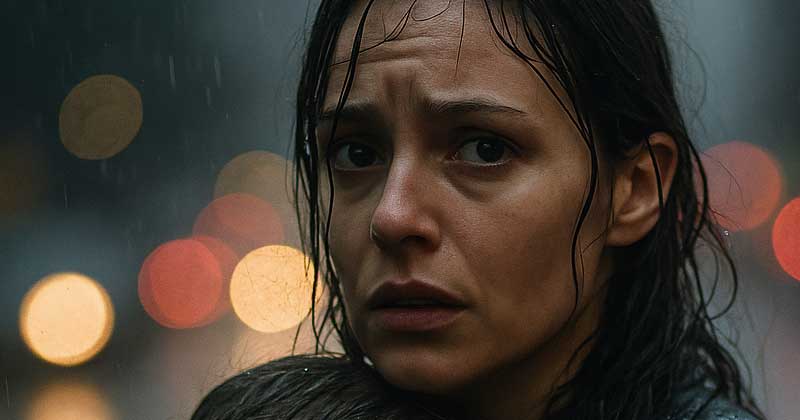
My struggle was not just for daily bread. It was for dignity. For the right not to be defined by a last name that had rejected me.
On quiet evenings, when Lili breathed deeply in her laundry basket, I would look out the broken window and imagine another life. A life where I was not “the cast-out woman,” but a mother who had raised her child on her own.
The neighbors in the neighborhood looked at me with suspicion at first. However, slowly, they began to greet me, to offer me a smile, to ask about the baby. In Romania, I often saw how people in villages share even their last piece of bread with a neighbor. That’s how it happened here too: in a foreign community, I found that warmth I knew from my grandmother’s stories.
When my violin resonated through the subway stations, I noticed how people stopped. Some cried. Others dropped a few coins. An elderly woman slipped me a small icon one day, saying, “Keep it close. It will bring you light.” At that moment, I felt that God had not abandoned me.
As the months passed, my tired hands painted not just colors on paper, but hopes. I began to create small paintings inspired by my childhood in the countryside: a wheat field under the summer sun, a Christmas tree, a girl spinning in the schoolyard.
Mrs. Carter told me one day, “You should sell them. People need beauty.” That’s how it all began.
I organized my first exhibition right in her store, among the shelves of canned goods and jars of pickles. No one expected those simple, naive canvases to attract so many visitors. But people came, looked, and felt something. Perhaps the longing for home, perhaps the peace of their childhood.
A well-dressed gentleman bought a painting of an old fountain, saying, “It reminds me of my grandparents’ village in Oltenia.” That’s when I understood that my painting was not just art. It was my bridge to people.
The money I raised was not much, but it was enough to buy a crib for Lili. To get her new clothes, not just donations. To buy her a soft pink blanket to wrap her in love.
Over time, I began to teach violin lessons to the children in the neighborhood. It was not the conservatory of my dreams, but it was more than I would have dared to hope for after that night in the rain.
One Sunday, when I entered the church, the priest recognized me and invited me to play. I raised my violin, and for a few moments, I felt all my pain transform into light. Lili, in the arms of a woman from the community, smiled with her little mouth and seemed to understand.
Then, one summer day, while I was selling some paintings at a fair, I saw a familiar silhouette in the crowd. Nathan. He stood there, looking lost and ashamed, as people stopped at my stand.
But this time, it didn’t hurt anymore.
Because I was no longer the woman crying on the steps of a mansion. I was the mother who had raised her child, the woman who had built a life from nothing, an artist, a teacher, and a friend to the community.
And when his eyes met mine, I lifted my chin, looked him straight in the eye, and felt something liberating.
I no longer needed his approval. I no longer needed his name.
All I needed was right there beside me: a little girl with a bright smile and a violin that told our story.
And our story was just beginning.
This work is inspired by real events and people, but has been fictionalized for creative purposes. Names, characters, and details have been changed to protect privacy and enhance the narrative. Any resemblance to real persons, living or dead, or actual events is purely coincidental and not intended by the author.
The author and publisher do not assume responsibility for the accuracy of events or for how characters are portrayed and are not liable for any misinterpretations. This story is provided “as is,” and any opinions expressed belong to the characters and do not reflect the views of the author or publisher.


