…our things were thrown on the floor, as if someone had intentionally rummaged through them. The suitcase was open, clothes scattered everywhere, and my wallet, which I had left on the nightstand, had been turned inside out. Nothing was missing, but everything smelled of a harsh lesson and a hidden message.
I stood still for a few seconds, trying to understand what had happened. My wife came in right after me, put her hand to her mouth, and whispered, “I can’t believe they did this…” It was clear to both of us who the uninvited “guest” in the room had been.
In my wife’s family, money has always been a sensitive subject. They pooled money for memorials, for baptisms, for birthdays; everything had to be “shared,” and anyone who didn’t comply was seen as an outsider. I, however, came from a different world. In my family, being invited meant being treated honestly and with respect, not having your hand shoved into your pocket under the pretext of tradition.
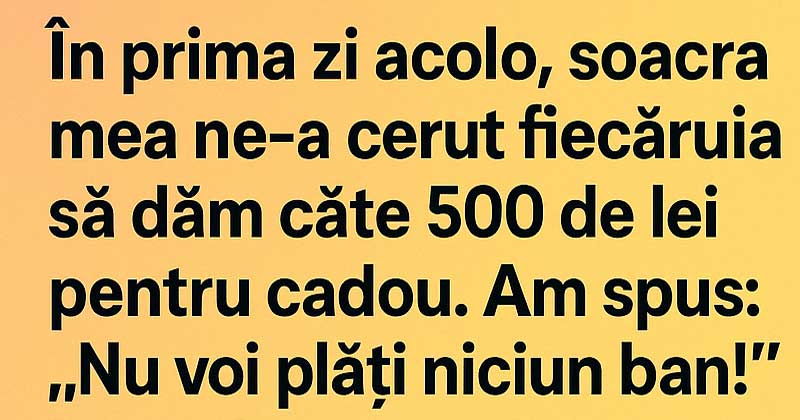
I sat on the edge of the bed, feeling my blood boil. It was 500 lei, not a fortune, but it wasn’t about the money; it was about principle. I had been invited with the promise that I wouldn’t have to spend anything, and now I was being cornered for refusing to play by their rules.
My wife, caught between loyalty to me and pressure from her parents, had tears in her eyes. “Maybe it would be better to just give it to them… Just to avoid a scandal.” I looked at her and shook my head. “It’s not about the scandal; it’s about dignity. If I give in now, next time they’ll ask for more.”
That evening, at dinner, everyone was gathered around a long table in a traditional restaurant in the center of Brașov. The warm lights, the smell of stuffed cabbage, and the music couldn’t mask the tension in the air. My father-in-law, the guest of honor, was smiling and clinking glasses, but my mother-in-law was staring at her plate, as if boiling inside.
A cousin of my wife broke the silence: “So, what are we doing about the gift? Everyone has contributed except you…” Everyone looked at me, waiting for me to give in. I felt the knot in my throat tighten, but I raised my voice: “I was invited here with the promise that we wouldn’t spend anything. If that was a lie, then the real gift for my father-in-law would be to tell him that his family doesn’t know what honor means.”
A heavy silence fell. Some lowered their heads, others whispered. My father-in-law, the guest of honor, raised his hand and said in a trembling voice, “Enough!” He looked at my mother-in-law and added, “I didn’t ask for any gift. If celebrating 70 years means we have to argue over money, then I don’t want anything. I just want peace and for you to be together.”
His words fell like a thunderbolt. I felt a wave of shame wash over the table. My mother-in-law turned her face away but said nothing. Instead, the others tried to change the subject, and slowly the atmosphere lightened.
That night, in the hotel room, I closed my eyes and realized something. Life among Romanians is full of customs that sometimes unite us, and other times divide us. The custom of “giving money” at any event stems from a desire for mutual help, but it can easily slip into obligation and pressure.
In the morning, as we prepared to leave, my father-in-law came to me. He shook my hand firmly and said, “You were right. Sometimes you have to say no, even if it hurts. Thank you for not letting me be a prisoner of my own jubilee.”
Then I understood that it’s not the gift, not the money, not even the stuffed cabbage or the wine that make a true celebration. It’s the respect between people. And if that is missing, any party, no matter how grand, means nothing.
I left Brașov with a bitter taste, but also with a lesson I will never forget: family is not measured in lei placed on the table, but in the sincerity with which you know how to say “I love you” and “happy birthday.”
And maybe, one day, even my mother-in-law will learn this.
This work is inspired by real events and people, but has been fictionalized for creative purposes. Names, characters, and details have been changed to protect privacy and enhance the narrative. Any resemblance to real persons, living or dead, or to real events is purely coincidental and not intended by the author.
The author and publisher do not assume responsibility for the accuracy of events or for how characters are portrayed and are not liable for any misinterpretations. This story is provided “as is,” and any opinions expressed belong to the characters and do not reflect the views of the author or publisher.


