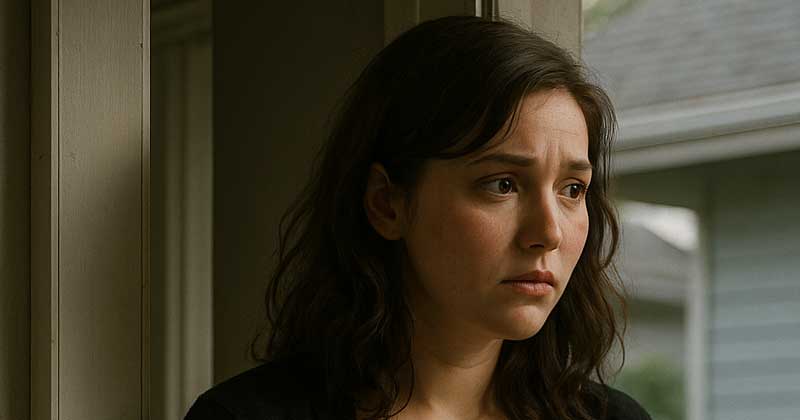
At that moment, I felt like my entire universe was collapsing. In an instant, my home was no longer mine, my bed was no longer mine, and my life seemed to no longer belong to me.
I placed my hand on my belly, as if I wanted to protect my child from the dirt of the world into which they had just been thrown. Tears rolled down my cheeks, but deep inside, I felt a strange strength, as if my grandmother were standing beside me, telling me: “Get up, Măriuca, don’t let yourself be trampled.”
I did what I never thought I could do. I turned my back, went down the stairs, and left the house, leaving them both there in their mess.
The following days were a nightmare. Neighbors whispered, relatives offered their opinions, and I, pregnant and exhausted, tried to find my way. My grandmother was too ill to help me, but her words echoed in my mind.
One morning, I stepped out of the building and saw an elderly woman from the neighborhood selling flowers. I bought a few red carnations and took them to my grandmother. She looked at me with her tired but wise eyes.
“Don’t cry, child,” she said. “From the mud, the lotus flower rises. From suffering, strength is born.”
And she was right.
I began to work more, save money, and prepare for my child’s arrival. I got a small apartment, but it was mine. I learned to cook for two, to sew little clothes with my own hands, and to enjoy every moment I felt my baby moving in my womb.
But life has a strange way of teaching lessons. A few months after I gave birth, on a cold winter evening, I heard a knock at the door. When I opened it, it was Stela. Her face was drawn, her makeup was running down her cheeks, and her eyes were filled with tears.
“Măriuca… please… I have nowhere to go,” she whispered.
I stood frozen. In my arms, I held my baby, who was sleeping peacefully, and I didn’t know whether to close the door or let her in.
She fell to her knees, trembling. “Horia left me. He left me with debts, with shame, and with a life in pieces. Please, help me…”
I felt a mix of anger and compassion. In front of me was no longer the perfect sister, the spoiled one who had stolen everything from me. She was a broken woman.
I remembered my grandmother’s words: “Blood is thicker than water.” And then I understood.
It wasn’t about forgiving Stela for what she had done. It was about not darkening my soul with hatred.
I took a deep breath and opened the door wider. “Come in. But know that my life is no longer your playground. If you want to stay, you will have to learn what work, dignity, and respect mean.”
Stela burst into tears and nodded.
As she wiped her tears, I looked at my child and felt that, despite all the betrayals, I had not lost everything. On the contrary, I had gained the most precious thing: the power to choose who I am and who I want to become.
And then I knew that, no matter what the future holds, my child and I would move forward with our heads held high, because beyond suffering, a new life is born, pure, strong, and dignified.
This was my true victory.
This work is inspired by real events and people, but it has been fictionalized for creative purposes. Names, characters, and details have been changed to protect privacy and enhance the narrative. Any resemblance to real persons, living or dead, or to real events is purely coincidental and not intended by the author.
The author and publisher do not assume responsibility for the accuracy of the events or for how the characters are portrayed and are not liable for any misinterpretations. This story is provided “as is,” and any opinions expressed belong to the characters and do not reflect the views of the author or publisher.


