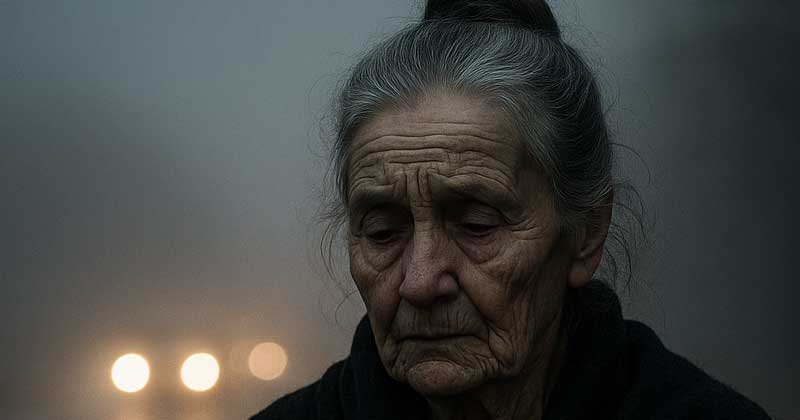
He was a childhood friend, Ion, a colleague of Rajan from the times when they both worked on the railways. His hair had turned white, but his eyes were as warm as ever. He looked at me for a long time and, without asking too much, understood from my humble demeanor that life had brought me down.
— Is that you, Liniște? I can’t believe it… What are you doing here, all alone, like this?
Tears filled my eyes, but I smiled. I didn’t want him to know the whole story. I just said:
— Fate, Ion. Fate brought me here.
He shook his head, then invited me to visit him at his home in his native village. I didn’t want to impose, but his insistence warmed my heart. A few days later, I went and found a true Romanian courtyard: an old walnut tree at the gate, a wooden bench, and a gentle wife who welcomed me like a sister.
They seated me at the table, placed a hot soup, steaming polenta, and cheese from the sheepfold in front of me. It was the taste of my childhood, of simple life in the countryside. I felt my soul awakening.
— Don’t cry anymore, sister, Ion’s wife told me. Life tests you, but God does not abandon you.
From that day on, I began to visit the village more often. I helped them in the garden, picking apples, and digging potatoes. I worked with bare hands but a full heart. I remembered how, once, Rajan and I worked the land in front of the house, how we made zacuscă in the fall and pickles for winter.
Over time, the villagers learned my story. Some looked at me with pity, others with respect. The old ladies brought me flower seeds to plant by the window, the children played in the yard and called me “Aunt Liniște.” In the place where my sons had disowned me, I found other children and other grandchildren in the hearts of simple people.
My secret remained hidden. The bank book stayed with me, untouched. But one day, after Ion had a crisis and needed to be taken to the hospital, I withdrew a few thousand and paid for the treatment. I never said the money was mine. I just told them I had “a little saved up.”
When Ion recovered, he came to me with tearful eyes:
— You saved my life. How can I thank you?
Then I understood that true wealth is not in the bank book, but in the hearts of people.
Years passed, and Radu and his wife fell into trouble. Their business went bankrupt, and they came looking for me, thinking I would still be at the market, by the roadside. But they didn’t find me there. When, one Sunday, they arrived in the village where I lived, the people pointed them to the yard where I was.
I came out to the gate, dressed in a white blouse and with a calm smile.
— Mother… we were wrong… we are sorry, Radu said, almost whispering.
I looked at him without hatred. I saw him weakened, with sunken cheeks, his wife trembling behind him. I knew they had returned not only out of regret but also out of need.
I took a deep breath and replied:
— I forgave you long ago. But know that life does not forgive as easily.
I offered them a warm meal, but I did not invite them to stay with me. I wanted them to understand that love is earned through deeds, not through begging.
That evening, I opened the bank book again. I felt no burden. I knew that the money would go, one by one, to good people, to poor children, to the village church. And that’s exactly what I did.
At the end of my life, I had nothing left in the bank. But I had something that no wealth can buy: peace in my soul and arms that held me close, children who were not mine but who called me “grandma.”
And that was my greatest victory.
This work is inspired by real events and people, but it has been fictionalized for creative purposes. Names, characters, and details have been changed to protect privacy and enhance the narrative. Any resemblance to real persons, living or dead, or to real events is purely coincidental and not intended by the author.
The author and publisher do not assume responsibility for the accuracy of events or for how characters are portrayed and are not liable for any misinterpretations. This story is provided “as is,” and any opinions expressed belong to the characters and do not reflect the views of the author or publisher.


