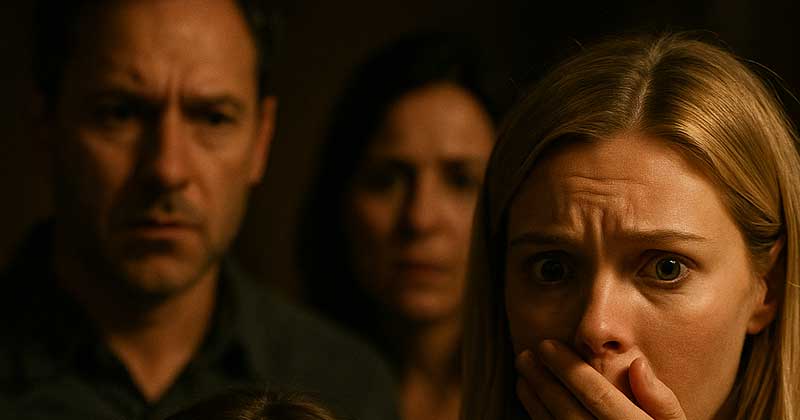
Ana was trembling, but she didn’t budge. Her big eyes, wet with tears, were fixed directly on my sister-in-law.
— I saw her, she said with a sharp sincerity. She was holding my money in her hand and quickly stuffed it into her purse when I walked in.
The room fell silent. The only sounds were the ticking of the wall clock and my daughter’s hurried breathing.
Cătălina laughed falsely.
— She’s just a child, she said. She’s imagining things.
But her voice no longer had the same confidence. It trembled slightly, and her forced smile betrayed her unease.
— Children don’t lie about such things, I said firmly. I want you to check your purse, right here, right now.
The guests took a step back, leaving us in the spotlight. I felt a wave of courage. It was no longer just about money; it was about my daughter’s dignity.
Cătălina tried to protest, but under everyone’s gaze, she opened her bag. Among expensive lipsticks and a miniature perfume, there was a stack of crumpled bills, just as Ana had held them.
A murmur swept through the room. Ana cried, but out of relief. She clung to me, and I stroked her hair.
— How could you? I asked, my voice trembling with anger. From a child?
Cătălina shrugged, then said with cold arrogance:
— What’s the big deal? She has her whole life ahead to make money.
A heavy silence fell over the party. No one smiled at her anymore. Even her husband, who had tolerated all her whims until then, blushed with shame.
In that moment, I understood something profound. Money could be replaced. But what my daughter learned that day was priceless: that the truth is worth defending and that dignity has no price.
I reached out, took the money, and put it back in Ana’s purse. Then I said clearly, so everyone could hear:
— In my house, a child is worth more than all the jewels in the world.
The applause did not come, but the silent approval of everyone said it all. Cătălina gathered her things and left, head down, without anyone saying “goodbye.”
The party continued, but something had changed. Ana stood next to me, holding the money close to her chest. I whispered to her:
— You are braver than you think. Your grandmother would be proud of you.
In the days that followed, I took her to the boutique she had dreamed of visiting for so long. The saleswoman, recognizing our story (as it had already circulated among relatives), placed the bracelet on her wrist with a warm smile. Ana was trembling with excitement.
— Remember, I told her, this bracelet is not just a talisman. It is proof that you fought for what is yours and that the truth always comes to light.
Ana smiled, and her eyes lit up as I had seen them so many times in front of the display window. Only now, it was no longer just a wish. It was reality.
And in that moment, I knew: even if the world sometimes tries to break her confidence, my daughter had something stronger in her soul than any jewel — the courage to tell the truth and defend her dignity.
And that, in our culture, is worth more than any treasure.
This work is inspired by real events and people, but has been fictionalized for creative purposes. Names, characters, and details have been changed to protect privacy and enhance the narrative. Any resemblance to real persons, living or dead, or to real events is purely coincidental and not intended by the author.
The author and publisher do not assume responsibility for the accuracy of events or for how characters are portrayed and are not liable for any misinterpretations. This story is provided “as is,” and any opinions expressed belong to the characters and do not reflect the views of the author or publisher.


