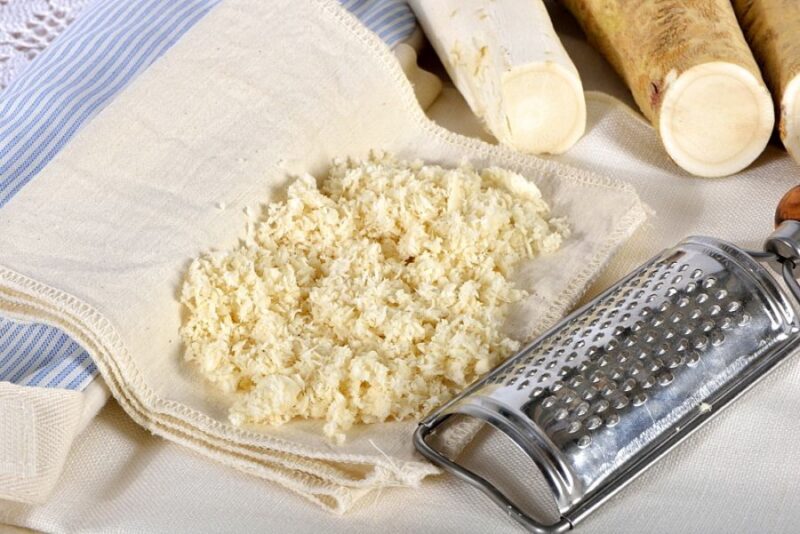
Horseradish (Armoracia rusticana), with its unmistakably sharp taste, is much more than just a strong condiment. In folk medicine and phytotherapy, raw horseradish poultices are considered a first-line remedy against cough, bronchitis, rheumatic pain, pulmonary congestion, and muscle pain. Modern research confirms some of these effects, giving it a prominent place in external natural treatments.
What does horseradish contain?
- Isothiocyanates (allyl isothiocyanate) – compounds with antibacterial, antifungal, decongestant, and local irritant effects (stimulating circulation)
- Vitamin C – with antioxidant and immune-stimulating effects
- Sulfurous volatile oils – responsible for expectorant and decongestant effects
- Enzymes (myrosinase) – activate irritating substances upon contact with the skin
What do recent studies say?
Journal of Ethnopharmacology (2017): extracts from horseradish root showed significant anti-inflammatory and analgesic effects in experimental models.
Frontiers in Pharmacology (2019): volatile compounds from horseradish inhibit respiratory bacteria and stimulate local circulation, supporting the drainage of inflamed mucous membranes.
Phytomedicine (2022): local application of horseradish preparations had a rubefacient (warming) effect in cases of muscle pain and joint stiffness.
How does horseradish poultice work?
Stimulates local blood circulation (warming effect)
Calms muscle spasms and cough
Clears respiratory pathways through expectorant action
Reduces inflammation in joints and muscles
Activates lymphatic drainage and mucus elimination
Raw horseradish poultice recipes
1. For cough and chest congestion
Ingredients:
1 tablespoon of grated raw horseradish
1 tablespoon of flour
1 tablespoon of olive oil
gauze, plastic wrap, towel
Application method:
- Mix the horseradish with the flour and oil to reduce its aggressiveness.
- Place the paste in a piece of gauze.
- Apply to the chest (or between the shoulder blades), NOT directly on the skin.
- Cover with plastic wrap and a towel.
- Leave for 5-10 minutes (caution, it may sting!).
- Remove if the skin becomes excessively red.
Can be applied once a day for 3-5 days.
2. For muscle pain and rheumatism
Ingredients:
1 tablespoon of grated horseradish
1 tablespoon of apple cider vinegar
gauze
Application method:
- Mix the horseradish with the vinegar.
- Place the paste in a piece of gauze and apply to the painful area.
- Leave for 5-15 minutes, depending on sensitivity.
- Can be repeated 2-3 times a week.
The warming and reddening effect locally is normal. If it persists for more than 30 minutes after removal, stop using it.
Contraindications and precautions
Do not apply to sensitive, injured, or irritated skin
Avoid contact with eyes and mucous membranes
Do not use in children under 10 years without medical advice
Always test a small area of skin before full application
Individuals with dermatitis, psoriasis, or rosacea should NOT use the poultice
For complete effects
Combine local application with moderate consumption of raw horseradish (grated with honey, in salads)
Stay properly hydrated and engage in gentle movement after application
Use in the evening, before bedtime, for a calming effect




