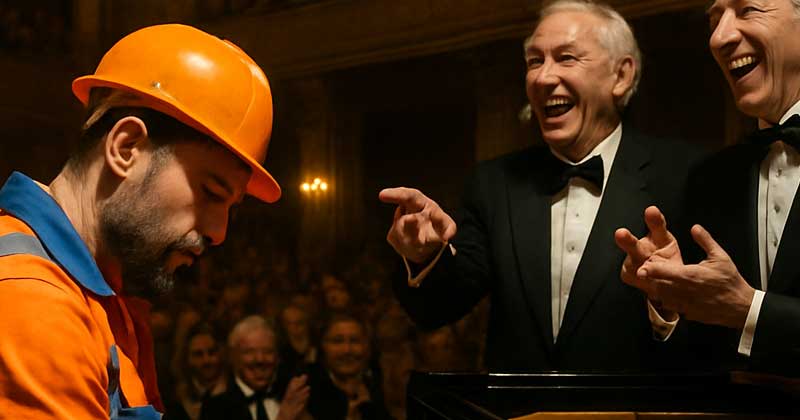
Marcus wiped his sweaty palms on his pants. His footsteps echoed heavily on the polished wooden floor as he approached the piano. People in the audience giggled, some were already filming, convinced they would have a funny clip to share later.
But for Marcus, the piano was no joke. It was a memory. It was his father’s voice, who, on summer evenings, would sit at an old organ and sing Romanian romances, making the hearts of the neighbors across the fence flutter. It was his mother, who softly sang carols on Christmas Eve, even when the table was poor, but the soul was full. It was his childhood in a village where music was played on a record player, and people set everything aside to listen.
He placed his fingers on the cold keys. A murmur swept through the hall. Then silence.
The first chord resonated deeply, like a church bell. The audience held its breath. Marcus was no longer the janitor at that moment. He was the child who had taught himself, at night, from a worn-out manual, on a weathered piano he had found discarded in the village school’s hall.
The notes swayed, some gentle like an evening lullaby, others strong, like a cry from the mountains. His music told a story that words could not express.
The audience began to put away their phones. The laughter faded. Eyes blinked in astonishment.
In those sounds was the longing for home, for the dusty street where children played football until late at night. It was the memory of a mother who would place a slice of warm bread with sugar in his palm, saying, “This is all we have, but we eat with full hearts.” It was the love for his daughter, his only treasure, who fell asleep every night to stories sung at the piano he had borrowed from the church.
His music flowed like a river, carrying those present through landscapes unknown to them, but so familiar to him. Each note was a confession, each chord an unspoken prayer.
A council member brought his hand to his eyes, trying to hide a tear. Another, with a heart hardened by numbers and graphs, felt a lump in his throat. Even the CEO, accustomed to signing million-dollar contracts without blinking, lowered his head, overwhelmed by an emotion he hadn’t felt in years.
And then, Marcus touched the keys with a delicacy reminiscent of a child caressing the icon in his village church. The last notes lingered in silence, like a whispered prayer.
When he lifted his hands, the hall remained silent for a few seconds. No one dared to applaud. It seemed that any noise would profane something sacred. Then, like a wave, the applause erupted. Strong, sincere, shaking.
Marcus slowly stood up, his eyes on the ground. He wanted no glory, no recognition. He just wanted to be the father who, after a hard day’s work, could bring music into his daughter’s life.
In that moment, no one saw the olive-green uniform anymore. He was no longer the janitor. He was the artist. He was the soul of an entire culture, condensed into tired but vibrant fingers.
In the silence that followed the applause, the CEO approached. The mocking smile was gone from his face, replaced by a humble, sincere look. He extended his hand.
“Marcus,” he said with a trembling voice, “that… that was not just music. It was life.”
And for the first time, among all those present, the boundaries between classes, wealth, and titles disappeared. That evening, in the Thornfield Concert Hall, a tired, forgotten single father showed everyone what true power means: not that of money, but that of the heart.
And when Marcus stepped off the stage, with simple steps and a calm gaze, he did not realize that, without seeking it, he had just written the most beautiful story that an entire hall would carry in their hearts forever.
This work is inspired by real events and people, but has been fictionalized for creative purposes. Names, characters, and details have been changed to protect privacy and enhance the narrative. Any resemblance to real persons, living or dead, or to real events is purely coincidental and not intended by the author.
The author and publisher do not assume responsibility for the accuracy of the events or for how the characters are portrayed and are not liable for any misinterpretations. This story is provided “as is,” and any opinions expressed belong to the characters and do not reflect the views of the author or publisher.


