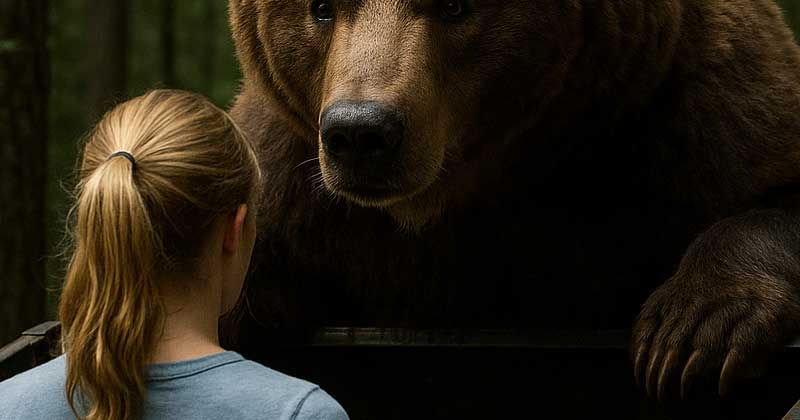
In the container, there was no food, but a bear cub, trapped between the garbage bags, struggling helplessly. Its big, wet eyes looked at me in fear, and its whimpers were barely audible among the rustling of the bags.
Then I understood why the bear was not aggressive. She had not come to search for food, but to save her cub. She was banging on the lid like a desperate mother, asking for help.
I felt cold shivers running down my spine. All the safety instructions were swirling in my mind: don’t get too close, don’t stand between the mother and her cub, don’t make sudden movements. And yet, there, that morning, my human instinct overcame my fear.
I quickly called two colleagues from the camp. They came with nets and protective sticks, but when they saw the scene, they immediately realized what needed to be done. With calculated movements, we freed the cub from the heavy bags and gently lifted it, avoiding any noise.
The bear made no sound, just moved her head, watching our every move. When the cub was placed on the ground, it immediately ran towards its mother. At that moment, the bear let out a deep growl, but not out of anger, rather out of relief. And in an instant, they both retreated into the forest, leaving only heavy footprints on the damp ground.
I stood there, next to the container, with my heart racing wildly. No safety manual prepares you for something like this. We were witnesses to a life lesson: even the wildest animal can ask for help when it comes to its young.
That evening, sitting by the campfire, the tourists listened fascinated to the story. Some smiled, others shuddered at the thought that the bear could have reacted violently. But I felt something different. In her eyes, that morning had not been about anger or danger, but about trust.
And I remembered my grandmother’s stories, who said that the forest has a soul. That every tree, every animal, and every person are connected by invisible threads. “If you respect them, they will respect you,” she would say, recounting how, long ago, in the village, people always left a corner of polenta at the edge of the forest for the creatures.
Then I understood: the forest is not just a backdrop for our walks, but a home full of lives, of mothers and cubs, of instincts and stories. We are merely guests.
Since then, every time I open a dumpster or watch the moving shadows among the trees, I feel the forest’s tranquility differently. Not as a place of danger, but as a parallel world, where love and maternal protection exist just like in our families.
And the lesson of the bear remains alive in me: even the wildest among us knows what a mother’s love means.
This work is inspired by real events and people, but has been fictionalized for creative purposes. Names, characters, and details have been changed to protect privacy and enhance the narrative. Any resemblance to real persons, living or dead, or to real events is purely coincidental and not intended by the author.
The author and publisher do not assume responsibility for the accuracy of the events or for how the characters are portrayed and are not liable for any misinterpretations. This story is provided “as is,” and any opinions expressed belong to the characters and do not reflect the views of the author or publisher.


