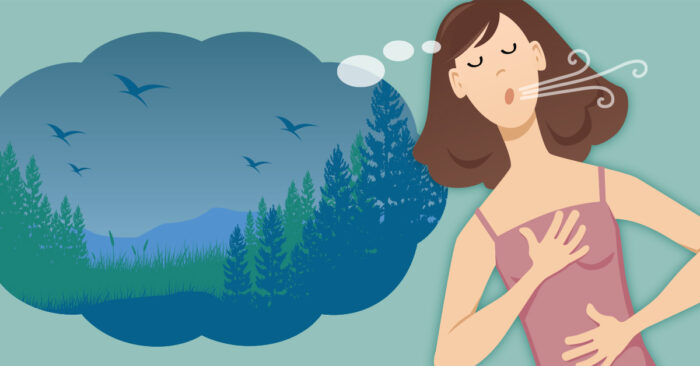
Who hasn’t heard or said the following phrase in a moment of stress, fear, or anger? “Take a deep breath and relax.” This well-known expression conveys a very simple action, yet it is full of wisdom and effectiveness.
Simple, yet often unconscious and overlooked, breathing is extremely important and beneficial for physical and mental health.
The use and benefits of breathing exercises and techniques have a long-standing tradition. Many contemplative disciplines such as meditation, yoga, tai chi, and qi gong integrate breathing techniques into their practices.
More recently, science has delved into this subject, accumulating a wealth of evidence supporting the effectiveness of breathing techniques.
Breathing exercises can help you feel calmer and more relaxed, especially in stressful moments. All you need is a quiet space to focus on your breathing.
The Connection Between Breathing and Stress
The primary role of breathing is to draw in oxygen and expel carbon dioxide through the movement of the lungs. The movement of the lungs is controlled by the diaphragm (a muscle-tendinous membrane that separates the thoracic cavity from the abdominal cavity) and the intercostal muscles.
When a person is affected by stress, their breathing pattern changes. Typically, an anxious person breathes quickly and shallowly, using their shoulders rather than their diaphragm to move air in and out of the lungs. This style of breathing disrupts the body’s balance.
Moreover, excessive shallow breathing or hyperventilation can prolong anxiety by exacerbating the physical symptoms of stress. Controlling your breathing can help alleviate some of these symptoms.
Breathing exercises do not have to take up much of your time. Just set aside a few minutes each day to pay attention to your breathing. Here are some recommendations to start your breathing exercises:
start with two to five minutes a day and increase the duration as the exercises become easier and more comfortable;
practice several times a day;
engage in conscious breathing as you feel the need.
The Effects of Breathing on the Body
When relaxed, people breathe through their noses in a slow and steady manner. Conscious and relaxed breathing seems to calm the nervous system that controls the body’s involuntary functions.
Controlled breathing can cause physiological changes such as:
lowering blood pressure and heart rate;
reduced levels of stress hormones in the blood;
decreased accumulation of lactic acid in muscle tissue;
balanced levels of oxygen and carbon dioxide in the blood;
improved immune system functioning;
increased energy levels in the body;
enhanced feelings of calm and well-being.
Breathing Exercises and Techniques
There are a variety of breathing exercises and techniques you can try the next time you feel anxious. Learn how to use breathing exercises to alleviate feelings of anxiety and stress.
Abdominal Breathing
There are different breathing techniques to help you regain your calm. Essentially, the overall goal is to transition from shallow breathing to abdominal breathing. To do this, you need a quiet, relaxed environment where you won’t be disturbed for 10-20 minutes. Set an alarm if you don’t want to lose track of time.
Sit comfortably and straighten your back to expand your chest. Place one hand on your chest and the other on your abdomen. Monitor how the upper part of your chest and abdomen move as you breathe. Focus on your breathing and try to inhale and exhale gently through your nose. The upper part of your chest and stomach should remain still.
With each breath, try to release any tension from your body. Once you start breathing slowly using your abdominal muscles, relax and enjoy the sensation of physical relaxation.
Box Breathing Technique
Also known as four-square breathing, the box breathing technique is very easy to learn and practice. In fact, if you’ve ever noticed yourself inhaling and exhaling to the rhythm of a song, you’re already familiar with this type of rhythmic breathing. Specifically, you need to follow this pattern:
exhale while counting to four;
hold your lungs empty while counting to four;
inhale while counting to four;
hold your breath while counting to four;
exhale and start over.
4-7-8 Breathing Technique
The 4-7-8 breathing exercise, also known as relaxing breathing, acts as a natural tranquilizer for the nervous system. Initially, it is best to perform this exercise while sitting with your back straight. Once you become familiar with this breathing exercise, you can do it while lying in bed.
Here’s a step-by-step guide!
Get ready: close your eyes to avoid distractions as much as possible. Exhale completely through your mouth, making a whoosh sound.
Inhale: close your mouth and quietly inhale through your nose, counting to four.
Hold your breath: do this while counting to seven.
Exhale: through your mouth, making the whoosh sound while counting to eight.
Repeat: this completes one cycle. Start the next cycle by inhaling again for four seconds.
Mindfulness Breathing
Mindfulness meditation aims to focus on the breath and draw attention to the present moment, without allowing the mind to wander into the past or future. Performing mindfulness breathing exercises serves the same purpose, which can help alleviate your anxiety.
The mindfulness breathing exercise involves choosing a calming focus, such as a sound (om), a positive word (peace), or a phrase (inhale peace, exhale tension) to repeat silently while you inhale or exhale. If you notice your mind wandering in other directions, all you need to do is take a deep breath and gently return your attention to the present.




