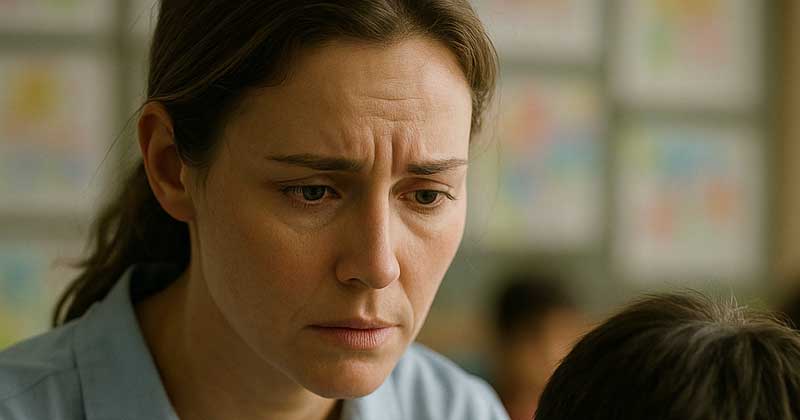
…in a lower voice than usual, trying not to attract the attention of the other children.
The boy quickly nodded, but his rigid body betrayed him. He clutched his backpack with both hands, as if he wanted to protect his back.
— Emil, my dear… why didn’t you sit down at all today? — Lucia asked, with a warmth that only years of working with children can cultivate.
The child hesitated. His lips moved, but the words stubbornly refused to come out.
However, his eyes told a different story. They were wet, filled with fear and shame.
Lucia realized that it was not just a simple game.
She gently led him to the desk and waited until the classroom was empty. Then, softly, she asked him to put down his backpack and sit for at least a moment.
That’s when the truth burst forth.
— I can’t… it hurts too much… — Emil whispered, tears in his eyes. — Dad… he…
Lucia felt her heart tighten. Teachers in Romanian villages, especially those from older generations, were more than just educators. They were like mothers to dozens of children. And she knew when a child was suffering.
She let him cry quietly for a few moments. Then she lifted his chin with a warm, firm hand.
— It’s not your fault, dear. And you are not alone.
That afternoon, after the class had completely emptied, Lucia remained deep in thought for a long time. She remembered her own childhood, the times when corporal punishment was “normal” and no one questioned it. But now… now she could no longer close her eyes.
She decided to speak up. First with the school principal, then with the authorities if necessary. She didn’t want to let another child carry the burden of fear and pain home.
On her way to the staff room, however, a thought crossed her mind: what if she was mistaken? What if the child’s father was just strict, but not violent? But Emil’s voice, filled with terror, still echoed in her mind: “I can’t sit down, ma’am… it hurts too much.”
This could not be ignored.
That evening, the teacher returned home troubled. She made herself a cup of linden tea, just as her mother used to, and sat next to the icon in the corner. In many Romanian families, the power of prayer was the first support in difficult times. And, with a lit candle, she prayed for Emil.
The next day, the boy entered the classroom just as quietly, but more tired, with shadows under his eyes. Lucia didn’t wait any longer. She took him aside and accompanied him directly to the school nurse’s office.
The nurse immediately looked up when the boy, hesitantly, put down his backpack and agreed to be examined. On his small body, there were marks that no child should ever have to bear.
Lucia felt a lump in her throat. It was clear to her that the boy was telling the truth.
That day, the wheel of fate began to turn for Emil. The nurse called the authorities, and child protection was notified. Lucia stayed by his side the whole time, holding his hand and promising him that he would no longer be alone.
The story spread quickly through the village. People, although used to silence, stood up for the first time. Neighbors admitted that they had heard the arguments and screams, but had not had the courage to intervene. Now, however, the truth had come to light.
One afternoon, Emil was taken into protective custody. Tears streamed down his cheeks, but this time they were tears of hope.
Lucia hugged him tightly, just as grandmothers did when their grandsons left for the army, with a tight heart but with the belief that a better path awaited him.
The village gathered around the child. The women prepared pies and sweet bread, while the men encouraged him with simple but warm words. In Romanian tradition, the community sometimes became the only true family.
And so, Emil found support where he least expected it.
The pain did not disappear overnight. But for the first time, the child felt protected. And in his soul, that small spark of faith ignited, that life could be different.
That somewhere, beyond the darkness, there are people who choose not to remain silent.
And for Emil, this was the beginning of a new world.
This work is inspired by real events and people, but has been fictionalized for creative purposes. Names, characters, and details have been changed to protect privacy and enhance the narrative. Any resemblance to real persons, living or dead, or to real events is purely coincidental and not intended by the author.
The author and publisher do not assume responsibility for the accuracy of events or for the portrayal of characters and are not liable for any misinterpretations. This story is provided “as is,” and any opinions expressed belong to the characters and do not reflect the views of the author or publisher.


