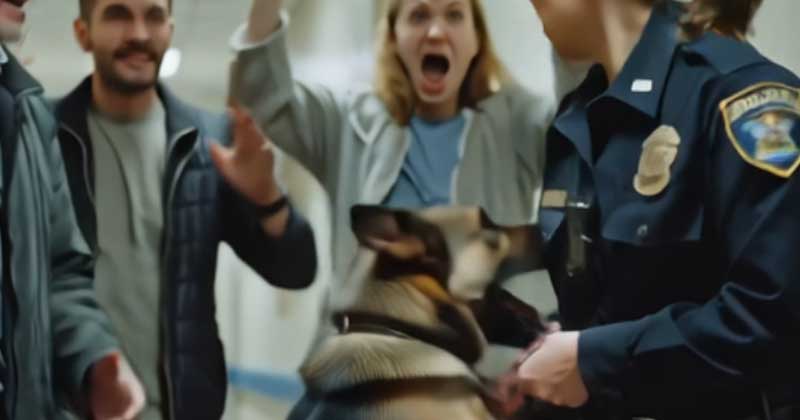
When the door opened, the air in the room felt heavy, as if it held the shadows of the past. The smell of disinfectant mingled with something old, inexplicable. Max entered first, pulling the leash with a force that Kelly couldn’t stop.
The dim lights revealed peeling walls and beds covered with unused white sheets. Yet, in the corner of the room, the dog stopped and began to bark louder, with an intensity that sent chills down the spine.
The nurses exchanged frightened glances. In a hospital, empty rooms were not just rooms – they often carried stories. And in that space, the story seemed to have written itself.
On the nightstand, under a fine layer of dust, there was a photograph. A woman in a white coat, with a warm smile, looked directly at the camera. “Mrs. Maria,” whispered a nurse, recognizing the face. “She was one of the most beloved doctors here. She died a few years ago, right in this room…”
A murmur of astonishment passed among those present. Max, although a dog trained for special interventions, seemed to sense something beyond the visible world. His barking had transformed into a whimper full of pain, as if he were calling for someone unseen.
Kelly knelt beside him, trying to calm him. But just then, from the false ceiling of the room, a sharp noise was heard – like an object sliding and hitting the floor. Everyone jumped.
An old file, with yellowed corners, had rolled near the bed. One of the nurses picked it up and, with trembling hands, began to read. It was the medical journal of Dr. Maria. In its pages, she wrote about patients she had treated, about sleepless nights, but also about a secret: she had donated a large part of her salary to poor families in the neighboring village, without anyone knowing.
A deep silence enveloped the room. Everyone listened with bated breath, as if the woman’s soul still watched over them. Max had settled at the foot of the bed, with wide eyes, as if he were waiting for someone.
The story of the doctor stirred the hearts of all. In Romanian culture, it is not uncommon for people to say that the soul of someone who has done good returns to watch over beloved places. The nurses began to cross themselves, and one of them whispered a prayer, convinced that Max was not barking randomly, but responding to a presence that the people could no longer see.
The news spread quickly throughout the hospital. In the following days, room 207 became a pilgrimage site for patients and staff. People brought flowers, lit candles, and shared stories about Dr. Maria, who had never turned away a patient, no matter how poor they were.
For Max, each visit to that room was accompanied by the same ritual – he would sit by the bed and gaze at the photograph on the nightstand. Like a soldier honoring a fallen comrade, he seemed to watch over in silence.
One evening, Kelly noticed something disturbing. Max, who usually did not show his emotions, had tears welling in the corners of his eyes when he sat there. A real tear, slowly rolling down his fur.
That moment changed everything. People began to believe that Max had not only uncovered a mystery but had reopened a hidden wound in the walls of the hospital – the memory of a person who had not been forgotten, but also not fully honored.
The hospital administration then decided to transform room 207 into a memorial hall for Dr. Maria. The walls were cleaned, her photograph was placed in a place of honor, and a plaque was put on the door: “In memory of a soul that lived for others.”
Since then, Max no longer barked there. He would enter, sit quietly, and look with gentle eyes. As if his mission had come to an end.
And perhaps, in a way, it truly was: a K9 dog had discovered not only traces or hidden objects but the unseen connection between people, tradition, and soul. A connection that, in our culture, never dies, because the good done remains alive, even beyond life.
This work is inspired by real events and people, but has been fictionalized for creative purposes. Names, characters, and details have been changed to protect privacy and enhance the narrative. Any resemblance to real persons, living or dead, or actual events is purely coincidental and not intended by the author.
The author and publisher do not assume responsibility for the accuracy of events or the portrayal of characters and are not liable for any misinterpretations. This story is provided “as is,” and any opinions expressed belong to the characters and do not reflect the views of the author or publisher.


