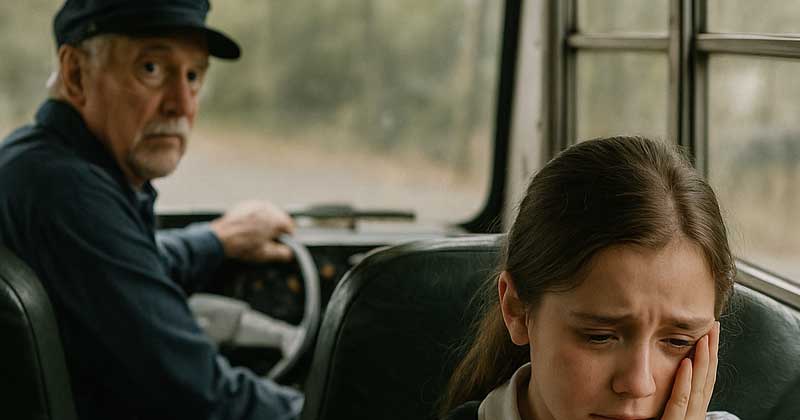
Ion clenched the note in his palm and remained still for a few moments. Outside, the schoolyard buzzed with voices and hurried footsteps, but for him, everything had gone silent. He remembered the times when his youngest daughter came home with red eyes and didn’t want to say anything. Back then, he needed patience and warm hugs to find out the truth.
He rose slowly, feeling as if his legs were giving way. He wiped his forehead and looked at the note again. He felt that he held not just a piece of paper, but a key to a hidden suffering. He knew he had to do something.
On his way to the staff room, his thoughts were tangled. How to say it? Who to tell? He was afraid of making a mistake, but he was even more afraid to remain silent. At the entrance of the school, he met the principal, a stern man with straight shoulders and a harsh gaze.
“Mr. Principal, I apologize for stopping you, but you need to see this,” Ion said, extending the note.
The principal unfolded it, read it, and froze. His heavy silence spoke volumes. They immediately called the school psychologist, a gentle woman in her forties, who had the gift of speaking to children as if they were her own.
Together, they decided to call Emilia during a break, discreetly, without the other children noticing. Ion waited in the hallway, hands clenched, feeling like a grandfather waiting for a doctor’s verdict. From the office, whispers and sometimes a sigh could be heard.
After more than half an hour, the psychologist came out. Her eyes were misty.
“You did well to bring the note. The girl is going through a great burden at home.”
Ion felt his heart tighten. He didn’t ask for details, but he understood that it wasn’t just about small troubles. It was deeper, more painful.
In the following days, authorities got involved. Emilia’s family was visited, and the truth came to light: a father who had gone to work abroad, a mother overwhelmed with worries and work, a lack of affection, daily arguments at home. The little girl felt alone, unseen, unheard.
Ion became, unwittingly, the pillar on which Emilia leaned. Every morning, he greeted her with a warm smile and a kind word: “Good morning, Emilia, I’m glad to see you.” Sometimes he brought her a candy, other times just a short joke. And little by little, her tears began to dry.
The village soon learned the story. Neighbors began to help the mother, supporting her, bringing cooked food, or staying with the children. It was an old Romanian custom, almost forgotten: community solidarity. When one falls, the others lift them up.
Emilia gained courage. One day, as she got off the bus, she said to Ion:
“Thank you for seeing me.”
Her simple words brought tears to his eyes. He realized that sometimes it doesn’t take grand gestures, just eyes that see and hearts that do not remain indifferent.
Years passed, and Emilia grew up. But every time she met Ion, whether in the village or at a countryside celebration, she hugged him like a grandfather. Her story remained an example for all: that a small note found under a bus seat can change a life.
And Ion, on quiet evenings after work, sat at the gate watching the sunset, thinking that beyond roads and steering wheels, his purpose had been to be there, not to turn away. And for him, that was the greatest gift of life.
This work is inspired by real events and people, but has been fictionalized for creative purposes. Names, characters, and details have been changed to protect privacy and enhance the narrative. Any resemblance to real persons, living or dead, or to real events is purely coincidental and not intended by the author.
The author and publisher do not assume responsibility for the accuracy of events or for how characters are portrayed and are not liable for any misinterpretations. This story is provided “as is,” and any opinions expressed belong to the characters and do not reflect the views of the author or publisher.


Related Posts

She Saw Her Husband with Another Woman — and Paid the Bill Without Saying a Word
October 21, 2025
I wanted to surprise my husband at work with his favorite lunch. Instead, I discovered a secret that could have destroyed my life
October 21, 2025