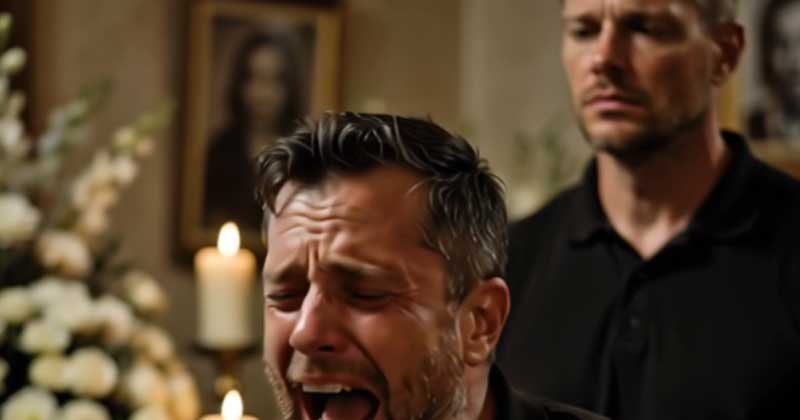
He could no longer breathe. His heart was racing wildly, and his hands trembled on the old, scratched keyboard of the phone he held in his palm. His daughter, Ana, was sleeping in an adjacent room, unaware that her father was collapsing into the darkness of fear.
He looked at the message again. The letters had not disappeared; it was not an illusion. “My love, I am still here. Don’t let them deceive you.”
Deceive him? Who? And more importantly… why?
He swallowed hard and, with a courage he did not recognize, typed shakily: “Who are you?”
Before he could set the phone down, a new message arrived. “You know who I am. Why did you lock me in the dark?”
A wave of cold swept through his body. He remembered how, in his childhood, his grandmother told him stories about souls that could not find peace. In the countryside, people believed that the dead must be watched over with candles and prayers; otherwise, they could return angry. He had tried to do everything by the book, but had he missed something?
In a moment of panic, he stood up and lit all the candles he had in the house. The flames danced, casting strange shadows on the walls. He felt as if he were in an ancient ritual, one that was no longer practiced except in forgotten villages.
The phone vibrated again. “You are not alone.”
He wanted to scream, but he bit his lips. He did not want to wake his daughter. Ana was too young to bear such a burden. He had to be the shield.
Then he remembered something. At the funeral, just before sealing the coffin, he had leaned over his wife and whispered, “I love you. I will never forget you.” At that moment, the phone had slipped from his pocket. But it was just an object. How could an object convey such messages?
A voice inside him told him it was no coincidence. And, although he was trembling, he decided to respond again: “If it is you, give me proof.”
The words had barely left when a sharp noise came from Ana’s room. The girl had sat up, her eyes half-open, and murmured, “Daddy, mommy is here…”
A chill ran through him. He rushed to his daughter and held her tightly. “You were dreaming, my love. You just dreamed.” But his heart told him otherwise.
At that same moment, another message appeared: “Take care of her. I can no longer.”
This time, tears burst forth. There was no more fear, but a mix of pain and longing. He felt that his wife, beyond everything he knew about life and death, was trying to leave them a sign.
He sat down again at the small kitchen table. In the stillness of the night, the candle flames seemed to surround him in a protective circle. He looked up and whispered, “I promise I will take care of her. I promise.”
And then, the phone vibrated for the last time: “Now I can leave in peace.”
The screen went dark, and the signal disappeared completely. He tried to restart it, but it no longer worked. It was as if the soul that had animated it had extinguished along with that message.
In the morning, when dawn brought the first rays of light, the house seemed different. It was no longer cold but warm, as if a gentle presence had remained to watch over them.
The following Sunday, the father and daughter went to church together. There, in the quiet of the altar, they lit a large candle for her soul. The priest told them, “The light of prayer reaches beyond what we see.”
And for the first time after the tragedy, the man smiled. He knew that the messages had not been a curse but a gift. The last connection between two souls that had truly loved each other.
Since then, every evening, before turning off the light, he would light a candle at the window. Not out of fear, but out of love. A simple, Romanian tradition through which he felt he maintained the connection with her.
Because sometimes, even death must bow before love.


