… “You have brought me enough shame. If you cannot serve the family through an alliance, you will serve through sacrifice.”
The father’s words fell like a thunderbolt, and the girl’s heart leaped in her chest. She had never imagined that the one who had given her life would hand her over like a bargaining chip. Within days, Jimena was loaded into a covered wagon, guarded by two of her father’s men, and taken westward, where the dry land faded into the horizon, and the sun blazed mercilessly.
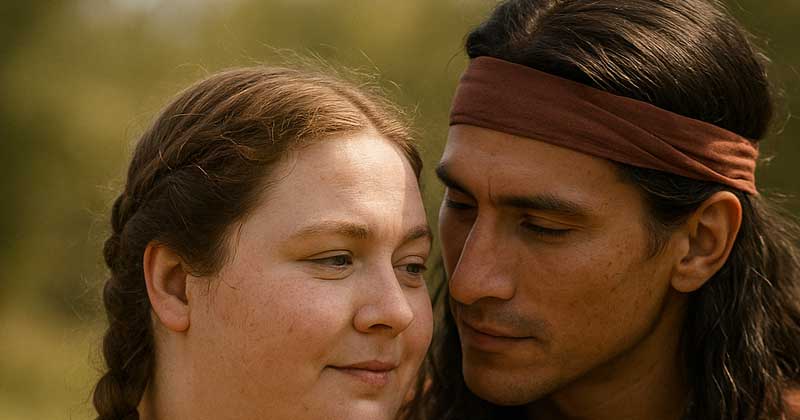
When the procession stopped, a man with sunburned skin, black hair tied at the nape of his neck, and piercing eyes stood before her. He was an Apache warrior, with an imposing stature, yet a calmness in his eyes that contradicted the fierce image her father had painted.
Jimena felt lost, yet for the first time, she was no longer looked at with disdain. The warrior extended his hand, not as a master, but as a man inviting another to walk alongside him.
In the days that followed, Jimena discovered a world she had never known. The open air, the song of the wind through the grasses, the fire lit under the stars, and the voices of the tribe telling ancient legends. For the first time, her body was not judged but respected. Her strong hands helped with daily tasks, and her laughter, when she found the courage to unleash it, was met with joy.
She remembered the evenings at the estate, where stolen sweets were her only solace. Now, instead of sugar and icing, she savored the simple taste of roasted corn and herbal tea. Yet, paradoxically, she felt her heart was nourished more than ever.
The warrior, whose name was Atsa, often looked at her as if he could see beyond her skin and past. He spoke to her about courage, about the connection to the earth, and how every person has a specific place under the sky.
One evening, when the full moon illuminated the camp, Jimena gathered her courage to ask him:
“Why do you not look at me with the same disdain as the others?”
Atsa smiled at her, a rare smile, like a sunrise after a storm:
“Because I see in you a heart that burns. And that fire cannot be extinguished by harsh words.”
Tears filled Jimena’s eyes. Then she understood that what she had sought all her life was not a grand dance, nor an expensive dress, nor the approval of a cold and arrogant world. What she had sought was to be seen.
Years later, when rumors reached back to the Vázquez de Coronado estate, it was said that the “useless” daughter had become a respected woman, a beloved mother, and a devoted wife. That in the place where she had been cast out, she had built her true home.
And those who once mocked her were left with the bitter taste of regret, while Jimena, the despised and forgotten, discovered that true nobility does not lie in gold, but in the courage to live one’s life with dignity and love.
In our culture, just like in the stories our grandmothers told by the hearth that “every person has their star,” Jimena found her star where no one would have believed: in the arms of the one whom the world called a barbarian, but who showed her the purest form of love.
Thus, her story remains a lesson for anyone who has ever felt the weight of rejection: true beauty is not measured in scornful glances and venomous words, but in how your heart learns to love and be loved.
This work is inspired by real events and people, but has been fictionalized for creative purposes. Names, characters, and details have been changed to protect privacy and enhance the narrative. Any resemblance to real persons, living or dead, or actual events is purely coincidental and not intended by the author.
The author and publisher do not assume responsibility for the accuracy of events or for how characters are portrayed and are not liable for any misinterpretations. This story is provided “as is,” and any opinions expressed belong to the characters and do not reflect the views of the author or publisher.


