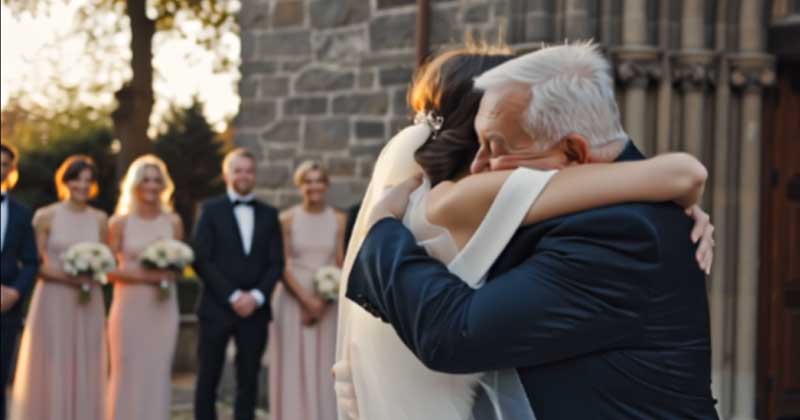
FOR YEARS, CLAIRE LEFT FOOD FOR A HOMELESS MAN WHO NEVER SAID A WORD — AND ON HER WEDDING DAY, HE GAVE HER A GIFT NO ONE EXPECTED 💌🍰
Every morning at 4:30 AM, Clara Dascălu arrived at “Alb & Grâu,” a charming bakery in a quiet neighborhood of Brașov, which was slowly being transformed by new high-rise buildings and expensive cafes. At 33 years old, Clara had become an iconic figure — known for her flaky croissants, mouth-watering cinnamon rolls, and her gentle calm that lingered in the air even after she left the room.
However, the most important gesture in her daily routine had nothing to do with the menu.
Before the city woke up and the bakery opened its doors, Clara carefully packed a warm cinnamon roll, poured a cup of black coffee, and quietly slipped out the side door. She walked two streets to an old wooden bench near a worn-out bus stop. There, she left breakfast alongside a folded napkin, on which she wrote by hand: “Wishing you a peaceful morning.”
The same man was there every day. Graying hair. Worn-out coat. Silent. Always alone, with his hands in his lap, as if waiting for something — or someone. He didn’t beg. He didn’t speak. He didn’t even look directly at people.
Clara never asked for his name. He never told her. But every day, she brought him breakfast.
Her colleagues noticed. Some raised their eyebrows.
“You’re wasting food on someone who doesn’t even appreciate it,” one murmured.
“He’s just going to take advantage of it,” commented another.
But Clara didn’t stop. Not because she expected gratitude. Not because she wanted applause. But because she saw in him a man whom the world seemed to have forgotten — and she refused to ignore him.
When the bakery was taken over by new owners, Clara was called in for an evaluation.
“Your dedication is remarkable,” the manager said carefully. “But some customers have said they feel… uncomfortable seeing a homeless man near the bakery. Perhaps you could donate to a shelter instead?”
Clara nodded politely. And she changed nothing — except for her arrival time: she started coming 15 minutes earlier so no one would see her.
She thought her gesture went unnoticed. Until one morning, when a cashier whispered to a customer:
“She’s been feeding that man for years. Every day.”
The customer replied loudly, in front of Clara:
“Poor thing… she thinks she’s making a difference.”
Clara said nothing. She continued to knead the dough, roll out the pastry sheets — because she wasn’t doing it for validation from others. She did it to see a man whom everyone ignored.
“You’re too soft,” her mother once told her. “You give too much.”
But Clara didn’t believe kindness ran out. On the contrary — it grew the more you gave it away.
Her fiancé, Bogdan, understood this.
A children’s librarian, he admired that Clara always put kindness first. “You don’t just bake for people,” he once told her. “You really see them.”
As their spring wedding approached, Clara ordered the cake from the bakery she loved and invited all her colleagues. Bogdan teased her affectionately:
“You’ve invited half the town.”
But secretly, he admired her for it.
Two days before the wedding, she received a handwritten letter. No return address. Inside, a single sentence, written in neat letters:
“Tomorrow I will come — not for the cake, but to repay an act of kindness.”
Clara reread the message. The handwriting seemed familiar, but she couldn’t associate it with anyone.
On the wedding day, Clara sat in the bridal room, looking out the window at the growing crowd. She spotted her colleagues, her parents, Bogdan’s nieces in matching dresses…
And then — she saw him.
He stood awkwardly at the church entrance. He wore an old but freshly ironed suit. His shoes were worn but clean. His graying hair was carefully combed. For the first time, Clara saw his face clearly.
It was the man from the bench.
Whispers began immediately:
“Is he lost?”
“Who invited the homeless man?”
“Does he want something at the wedding?”
Clara didn’t hesitate.
Ignoring the planned entrance or the photographer ready, she lifted her dress and walked straight out the church door.
Gasps were heard. But she didn’t care.
She walked straight to him, tears in her eyes.
— I didn’t expect you to come, she said softly.
— I wasn’t sure I should, he replied.
— I’m glad you came.
He handed her a small object — a carefully folded linen napkin with hand-stitched edges.
— It belonged to my daughter. She embroidered it when she was little. I thought you might like it.
Clara accepted it as a priceless gift.
— Would you like to come in with me? she asked.
He hesitated.
— Would you walk me to the altar? she added.
The man’s eyes filled with tears. He nodded.
As they entered the church together, the guests fell silent. Clara smiled, her arm linked with the man whom everyone had ignored for years. And Bogdan, at the altar, smiled at them — without confusion, without surprise. Just with understanding.
The ceremony was short and filled with laughter and promises. Clara kept the embroidered napkin in her bouquet.
At the reception, many guests approached the old man to greet him or apologize. Some asked questions. Others simply thanked him.
He didn’t stay long.
Before leaving, he approached Clara and Bogdan with a small envelope.
— I don’t have much, he said. But this is something.
Inside was an old photograph of a bakery — the faded cover, the windows fogged with flour. On the back, a handwritten message:
“My wife and I once had a place like yours. She baked. I washed dishes. We served our neighbors until we couldn’t anymore. Thank you for reminding me what kindness tastes like.”
Clara framed the photo and placed it above the counter at “Alb & Grâu.”
She never saw the man again.
But every month, she began to receive envelopes from different addresses — with no sender’s name, just a postcard. Each with a photograph of a bakery, a café, or a similar place.
“Breakfast shared is hope restored.”
Inspired by that experience, Clara and Bogdan used part of their wedding money to start a new program: “The Morning Shelf” — a wooden stand placed in front of the bakery, where anyone could take a pastry and a coffee, no questions asked.
No sign-ups. No lines. No judgment.
Just food. Just kindness.
Within a few months, others in the neighborhood began to add things. A flower shop left bouquets. A bookstore — old novels. Someone put out winter gloves.
Clara didn’t advertise. But the project grew.
One morning, when the shelf was empty and she felt discouraged, a woman in tattered clothes stopped and left a handwritten note:
“Please, don’t give up. You saved my week.”
Clara didn’t cry often. But that day, she cried.
Years passed.
“Alb & Grâu” became a symbol of the community — not just for pastries, but for the quiet dignity offered to every person. Volunteers came and went. “The Morning Shelf” remained.
Clara and Bogdan had children, who learned to write notes for strangers who stopped by.
“Have a wonderful day.”
“You are loved.”
“Thank you for existing.”
Sometimes, the greatest transformations don’t start with a grand gesture, but with a cinnamon roll and a napkin.
The man from the bench never returned. But his presence lived on in every act of kindness that followed.


